Episode Transcript
[00:00:00] Speaker A: This is Constructive Voices.
Constructive Voices, the podcast for the construction people with news, views and expert interviews.
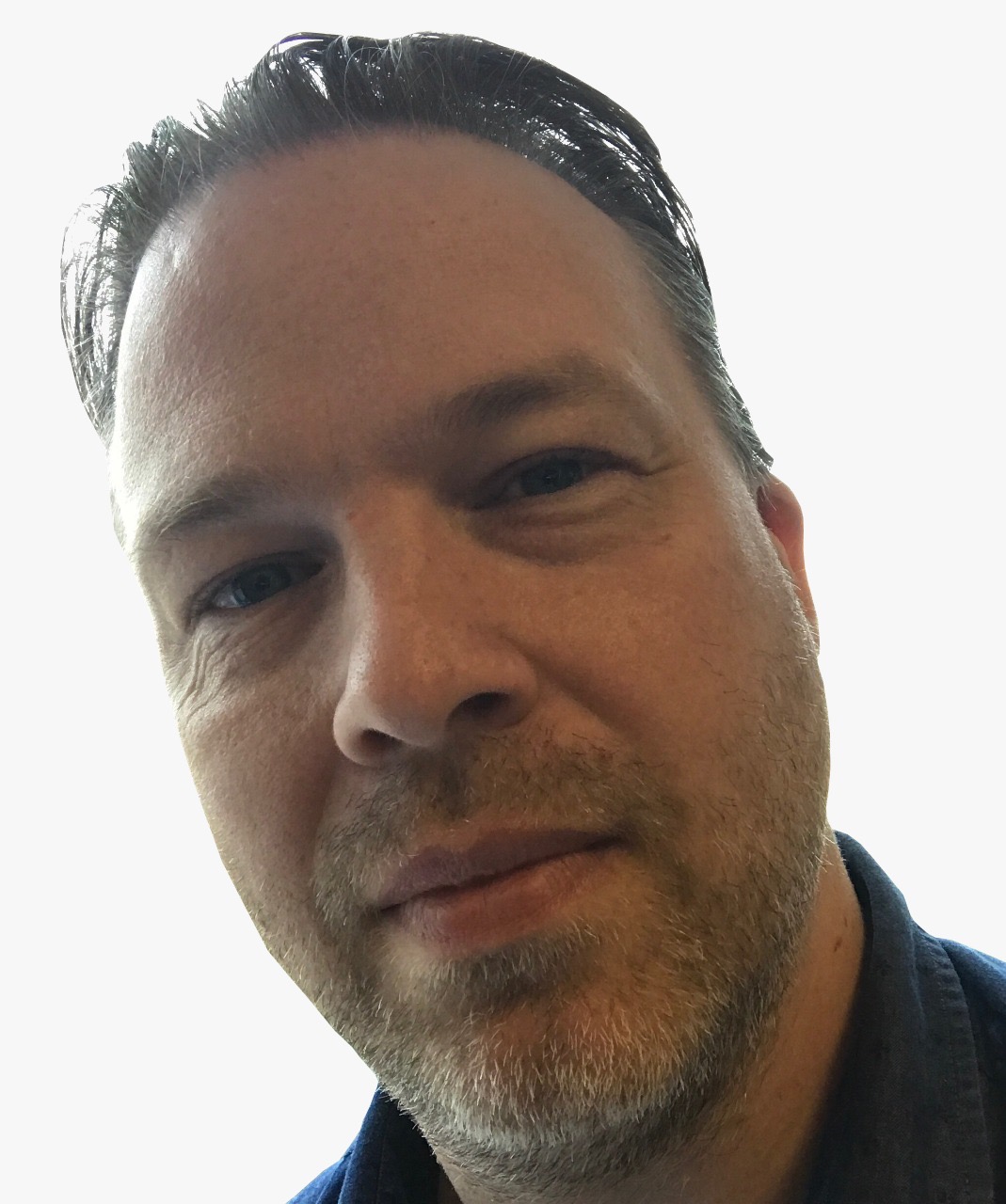
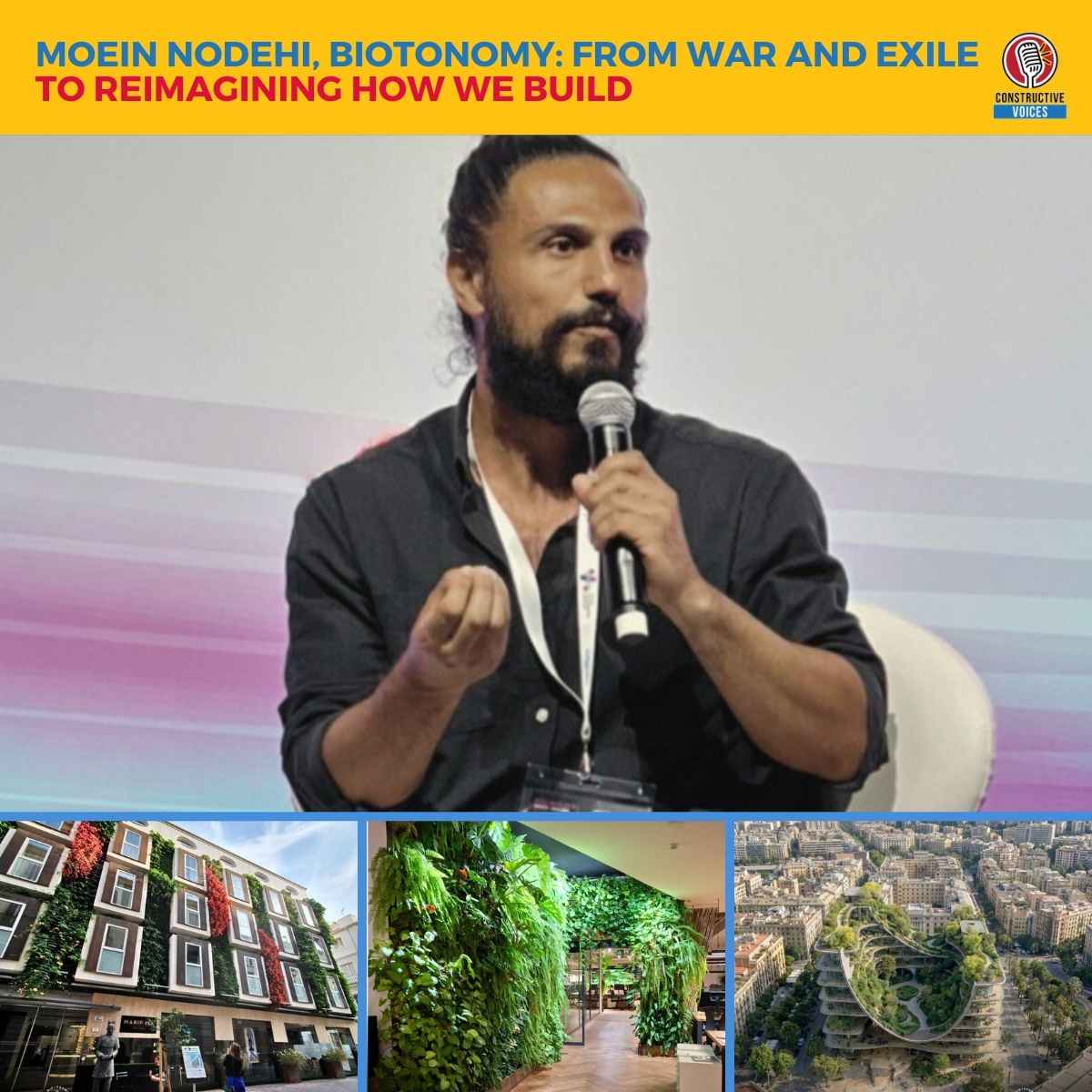
[00:00:10] Speaker B: This episode features the work of Moein Nodehi, a champion of nature based building and the founder of Biotonomy. He was born in the middle of war.
As conflict tore through Iran, Moein Nodehi's family fled in search of safety, eventually ending up in an immigration camp in Sweden. But even in those uncertain early years, another world was being built, built inside him. His parents kept hope alive by telling stories of ancient Persia, its gardens, palaces, civic systems and extraordinary buildings. Those stories stayed with him. So did the contrast he later witnessed when he returned to Iran as a boy. The visible scars of war set alongside the brilliance of ancient architecture. That collision of destruction and civilization shaped him. It made him question how we build, why we build, and what kind of world our buildings are really creating.
Years later, that questioning would take him from engineering school to major construction projects in Dubai and then far beyond the mainstream industry altogether. Disillusioned by what he saw, buildings celebrated as symbols of innovation while human and environmental costs were ignored, Moin chose a different route. He walked away, traveled widely, learned from grassroots projects around the world, and eventually founded Biotonomy, a company focused on nature based architecture that treats buildings as living systems rather than machines.
In this episode of Constructive Voices, Jackie De Burca speaks with Moein Nodehi about exile, ancient wisdom, modern cities, water, heat, resilience, and why nature may hold many of the answers we've forgotten.
[00:01:48] Speaker A: Good morning, this is Jackie De Burca here for Constructive Voices. Now today I'm talking to somebody that actually I've been looking forward to this interview since last year when it was set up, last year being 2025, and we are recording at the end of January of 2026. And the person that I've been really looking forward to speaking to is a gentleman called Moein Nodehi. I'm hoping I'm pronouncing that correctly. Moein. Moein, you're so welcome. Thank you so much for joining us today.
[00:02:16] Speaker C: Thank you. Thank you, Jackie, for having me. And yes, you're pronouncing it really good.
[00:02:20] Speaker A: Excellent news. Okay, now, Moeen, before we press the record button, we had obviously a little bit of a preparation chat and you have the most fascinating story about how you came to be A, where you are physically today and B, who you are as a person today. Would you like to share that?
[00:02:38] Speaker C: Yeah, sure. So when I was born, I was born in the middle of a war. It was the war of Iran, Iraq, and my family decided to escape the war. So the first years of my life was about just, you know, finding a safe place.
And I grew up, we ended up in a immigration camp in Sweden by, you know, just by accident. It was basically the only country at that time that was possible to escape to.
And I grew up with my parents telling me a lot of stories about the ancient Persian civilization because, you know, they, they wanted to keep the mood up for us, you know, the children as we were, you know, escaping the war. So the stories that they would tell me was always about the ancient cultures and how they built their civilizations, you know, everything from how their democracy work and their buildings, their palaces, their gardens. So I grew up with these stories which had a very big impact on me. And so I created this huge passion for ancient civilizations. And when I was 13 years old and the war was over in Iran, I had the possibility of going back with my family.
And it was very interesting because, you know, you come back there and you see all the destruction of the war and right next to it you see all these ancient buildings which are completely mind blowing.
So that had a huge impact on me, you know, when I came back to Iran, everything from, you know, seeing, I remember this specific scene where my parents left me in the car alone for just to go get some food. And I was just looking out of the window and just watching children in my own age just, you know, looking for bread in the dumpsters.
And as growing up in Sweden, which is a very comfortable country and very safe and seeing all of that and next to that, seeing all these ancient buildings, just I had a cloud of questions in my head as I was growing up. And so I was really obsessed about how we are building our buildings, our cities and really our civilization. It was something I started very early
[00:05:25] Speaker A: on to think of such an amazing story. Moeen, honestly. And I know Persia, of course, is the ancient name, let's say, for Iran and absolutely inspirational and amazing. And that was your birthplace you had to run from and then came back from at the same time as undoubtedly being inspired by how things were. Sweden. What is it you do exactly today you've got an amazing company that, you know, has a huge reach, it seems. What exactly is the work that you're doing today that has all this great story and background to it? Moeen.
[00:06:03] Speaker C: So we at Biotonomy focus purely on what we call nature based architecture. And if you allow me just, just to quickly, briefly explain how I got to that, I think it has an important context to it as well. Because when I was growing up one of the first travels that I did by myself was to go visit the pyramids of Egypt. And it was a life changing experience for me.
When I entered these pyramids, what happened to me physically and mentally and on all other levels, energetic levels. It was an experience that I will, you know, always remember as a big turning point in my life. And so this experience got me to really want to learn more about engineering and architecture.
[00:06:59] Speaker A: Let me jump in because that is another fascinating point or comment that you've made. Moeen what happened to you energetically.
[00:07:06] Speaker C: So, you know, it's. I would say, you know, it's what happened is deeper than what I can really explain with words.
But for those who has a little bit understanding of ancient buildings, you know, they were specifically built to have impact on human beings on energetic levels. The way they are designed, where they are positioned on the earth, their geometry, their proportions, their relationship to the sky, the light, the moon, all of this is so figured out.
So when I walked in to these pyramids and I decided to go in by myself, you had the options of going with groups, but I went in myself and there was this entry where you had to crawl. You could literally just crawl. You could not walk through it. And you had to crawl for almost like 10 minutes. And at some point I've entered a huge room and I entered like from the middle, this giant room and just filled with art and symbols and whatnot and just stares everywhere. So I walked down and I went to the middle and I looked up and there was just so much things going on inside of me and it was actually overwhelming. So I kind of had to close my eyes because it was too much happening. And there was a moment where I could not, I could not tell the difference of like, what is me and what's, you know, the rest, you know, I could not feel a boundary between myself and my surrounding.
[00:09:04] Speaker A: And so that's absolutely amazing. And surely when we're having a, let's say a good energetic experience or a spiritual experience out in nature, there is that feeling of blending, isn't there?
[00:09:16] Speaker C: Totally, totally, absolutely. And yeah. And that, you know, when I came back from that trip, I just could not stop thinking, you know, what happened. And honestly, at some point I thought I was losing it. You know, I couldn't speak to anyone because, you know, most people that I tried to explain to, they basically thought that I've just lost my mind. So I just stopped explaining to people, people, you know, but.
And I was young, I was a teenager when this happened to me. So I didn't really had a good understanding at that stage, you know, how, you know, humans energy really work. But that really led me into study more and go deeper into it. And, And I, I quickly learned, like, yeah, there is a science of how we can build buildings that has a very close relationship with the natural world. And when I say natural world, I mean physics, biology, you know, which is science.
And so I went really deep into that. So I decided that I want to learn more.
So going into engineering school was what made really sense to me with, you know, I was naive thinking that I would actually learn this in school.
But to my disappointment, when I went to university, I just realized, you know, there's. And, you know, learning that my university was funded by big construction companies. You know, everything was about just learning how to build, you know, very, very fast, very cheap, you know.
And so what I finished my. I looked out in the world and I was like, okay, who. Who's doing the biggest construction projects? And these people should, you know, really know what innovation is about and what they're doing. And at that time, it was actually Dubai.
So I, I started just reaching out to a bunch of companies and asking, you know, for. For going there to work. And then I actually got a position in one of the biggest construction projects in the world in Dubai. And I was super excited. I was like, okay, now finally I'm gonna go work with the best of the best, because these people are building the biggest building like they did back in the days with the pyramid. So there must be some really, you know, big innovation going on there. But to my disappointment, it was complete opposite. And what I witnessed was another turning point in my life.
While these buildings were, you know, getting awards all over the world for, you know, how big these buildings were and how innovative they were, I was there firsthand witnessing how they were basically using slavery to build these buildings. They were literally throwing their sewage out into the environment without treating it. And so I had another huge cloud with questions over my head when. Just questioning, like, is this really, you know, the future direction of how we want to build our buildings and cities? And the question was, absolutely not. This is, in fact, the opposite direction of what we need to do. So I decided that I'm not going to contribute to this. I'm not going to waste my life building these giant buildings for big companies and banks and whatnot. That is actually destroying the social values of how we should treat humans and the environmental values of how we should take care of the planet, our home. So I decided to just leave all of that behind, even though the salary was amazing, you know, the lifestyle and everything is what most people just dream of, you know. But I decided to leave all of that behind and I started reaching out to people around the world who was changing the direction of construction. And I just called up everyone I could and I told them, hey, can I come and work for free for you? I just want to learn.
[00:13:34] Speaker A: You followed your, you know, very, very strong, strong innate feelings, having experienced what you experienced in Dubai, and you just followed that, like with such, with such drive, by the sound of things.
[00:13:46] Speaker C: Yeah. You know, actually after my experience in the pyramids, I had this thing that kept dragging me and it was always very clear. It was always like clearly telling me, like whenever I had to take a decision, it was very clear if I should go that way or this way. So I just ended up just trusting whatever that was.
And so I was so impressed when I went and I saw and most of these people were doing projects on a grassroots level, you know, and a lot of humanitarian projects. You know, I joined projects all over the world from, you know, building community centers in Africa and helping people to regenerate their land, to bring back the water cycles where people lost the water cycles, building buildings that provided water to people shelter. And these were amazing people out there doing amazing work and the world didn't even know about them and their solutions. But I went and I worked with them and I learned from so many different cultures, different ways of buildings.
And at some point I was like, wow, like these are. There's so many amazing solutions out there that most people are not even aware of. And I asked myself, what if I could put all these solutions together in one concept, in one package and bring it out to scale to the world?
And what if I could use biology to make all these buildings autonomous and with autonomous, I mean, self sufficient.
And that was the moment biotonomy was born in my mind. And I knew that I have to bring this to the world.
[00:15:42] Speaker A: What a huge task though. I mean, you've learned from how many different places did you go to how many different solutions did you, you know, encounter? Moeen?
[00:15:52] Speaker C: Yeah, I mean, I don't even remember anymore, you know, really, honestly, everything from projects in Cambodia, Philippines, Indonesia and Malawi, South Africa, Mozambique to the Caribbean to South America. There's actually so many amazing projects going on around the world. There's so many, so many people working on changing the direction of how we build. But once again, most of it is on a grassroots level and it's happening in rural areas by just People who just really believe in what they're doing.
But the real problem that I realized is that we're not doing anything in the cities. And it's in the cities where the majority of the poor pollution made and it's the cities that are really vulnerable and where, you know, we, we have huge, everything from mental health problem to, to huge pollutions and floods and whatnot.
So it was very clear to me that we need to bring these solutions to scale, you know, and, and it's like so many things that we take for granted today that is working on scale. It all started on a small scale. It started with a group of people doing something in their garage and then eventually bringing it out to the world. And that's basically what biotonomy is working on and doing.
[00:17:27] Speaker A: So I guess I'm assuming from the website Moeen and from everything you've mentioned so far that all of these are nature based solutions, aren't they?
[00:17:34] Speaker C: Correct. It's the, the, the pure focus that we have is to use nature based solutions to build these buildings. So, and, and there's many aspects to it. You know, when, when you talk about nature based solution, people tend to only think, yeah, that's just, you know, adding some greenery on a wall or on the roof. But it's so much more than that. You know, it goes from, it touches upon every aspect of the functionality of the building, everything of how we heat and cool these buildings. Instead of designing the buildings to rely on consuming external energy like fossil fuels or whatnot, we design these buildings to function with physics.
And this comes from, from the ancient technologies that I studied. And there are so many buildings out there around the world, from extreme cold to extreme hot climates where people have built buildings that are able to heat and cool themselves naturally. And we've completely lost this knowledge.
So heating and cooling with nature based solutions is completely proven and doable.
We can do it. We don't have to use the amount of energy that we're using today to build our buildings. This is insane what we are doing to our buildings today. And I don't blame anyone because at some point we thought energy was just endless. We didn't understand the consequences of consuming that amount of energy that we're doing. But now that we understand, we need to go back and look at how does nature solve this. And nature solved this in a very simple way. It's all based on taking good design solutions.
So that's the heating and cooling aspect of it. Then you have the water. Water is a huge problem when it Comes to buildings and cities, and we don't even talk about it, but and buildings.
In fact, I think it's important for people to know. Most people think we treat the wastewater coming out of our buildings and cities, but 80% of the wastewater that comes out of our cities and our buildings goes untreated. Like, we are not as civilized as we think we are, you know, like on a global scale. We are not treating our wastewater water. We're throwing it literally out into the environment, which is the environment that is growing our food, you know, and then we are eating from that ocean and from that land that is polluted. And then that affects our health. So it's insane how behind we are.
[00:20:28] Speaker A: It is insane. It's really insane. Moeen, talk to me about how then a nature based approach would work with we'll say wastewater treatment.
[00:20:39] Speaker C: So when it comes to wastewater treatment, first of all, in nature, there is nothing that you can point out and say, that's waste, that's garbage. It just doesn't exist. Everything in nature turns into a resource. So the way we design this building is with that mindset. There's literally. I personally don't like using the word waste water.
Just the word itself judges the water that it's not useful, you know, but, you know, and I think that's a very important thing to have in mind. Like, if you pay attention to the words we use, you can clearly, you know, it reflects our mind state and where we are. So there is no waste water, you know, because the water that comes out of our buildings, it's actually biology, you know, it's biology. And if we understand biology, the natural world has designed the world in a way that all the waste that comes out of organisms, including us humans, can be transformed into nutrients and, you know, go back to the soil and to the land. But the problem with today's buildings are that we collect all the wastewater from big, big neighborhoods and put them in one central point. And then it becomes very, very difficult to treat it because you've concentrated the waste.
But the way we go about it is that we are using natural solutions to treat the wastewater on site.
So we are working with big urbanizations where we take all their wastewater and we use a system that is called a constructed wetland, which is basically mimicking how the natural world treats water.
And as you might know, Jackie, wetlands are the filtration systems in the natural world.
We basically just mimic that. And the way that works is that you have plants, specific plants that have a root system and they create a specific environment.
In their root system that when you pass wastewater through them, it's the perfect filter and they break down all the solids and, and all the what we call waste and they actually consume it. And the outcome from that system is clean water that you can reuse to irrigate green areas that you can reuse to flush the toilet. We never flush our toilets in our buildings with clean drinkable water. We flush it with recycled water that's been treated by plants. And just by doing this, Jackie, we reduce the water consumption for buildings like between 50 to 75%.
And that is a huge cost saving as well. So it's not just that you're saving the planet, you're actually building a building that financially makes way more sense in your Excel sheet. You have lower utility costs and you're much more resilient because tomorrow, if anything happens to the city's infrastructure like it's happening wherever there is a war or conflict, you see, they always wipe out critical infrastructure first and people are left in their homes without their utilities.
But when you build with nature based architects architecture, you're more resilient because you're not relying on fragile infrastructures.
[00:24:40] Speaker A: It's absolutely wonderful. And the thing that comes into mind moeen you're talking about of course, cities being, you know, just the more polluted places and the ones I suppose in a way that we urgently need to address. Is this something that you've managed to apply in, in city environments as yet?
[00:24:58] Speaker C: Yes. So after a decade of being out there and working in rural areas and really, really picking all these solutions and learning about it, then I decided it's time to go into the city and implement this. And I was studying what could be the most simple and basic thing that we could start with to show people that nature based solutions can be implemented. And what crossed my mind was that I saw this huge wave of green walls and vertical gardens blowing up. I saw that a lot of people are starting to experiment with it. It's becoming very popular to put green walls both inside and outside.
I asked myself, well that is a great solution, but doesn't that also increase your water consumption? And in fact it does.
So I said, okay, then that's a great opportunity to show people that what we can do in cities is that we can take the wastewater out of the buildings, treating it and then reuse it to irrigate all these green walls and green roofs. And so I together with my team applied for, for a European funding. We were lucky enough to get it granted to, to build the first prototype and so we. And this is a funny story, Jackie, because we got this money from the European Union, they basically love the idea of implementing this as a pilot. And we went to our city hall and we said, hey, we got this money, but in order to get the money, we need a permit from you guys.
And they basically laughed at us and told us to, to forget about it, that they will never give us a permit for treating wastewater on a facade in the city center. So.
[00:26:59] Speaker A: Yeah, I know, I know what you mean.
We're both based in Spain. For the listeners to appreciate how it's. It's kind of really bizarre. I don't know if you've been into in other areas of where you're based, Moean, but it's really bizarre that if you go from one community to another in Spain that has autonomous communities, the rules can differ. And then if you go from one town to another, the rules can differ all over again. So when it comes to these type of things in Spain, it can be quite challenging.
[00:27:26] Speaker C: Yeah, and I mean, I've also, you know, tried to do this in Sweden as well, where actually, where Biotonomy was born. It was in Sweden, my first permit that I was trying to get for, for building the, the first building. And I had the client, I had the budget, I had everything to go for it, but it took five years to get the permit. So, you know, I was like, you know, this is not going to work out. So I started, you know, doing projects in other parts of the world. But coming back to this project, we basically, to make the story short, we had to fight for the license, we had to fight for it. And in, in the end, the city made us to sign a contract that if it's not going to work, then we gonna pay for it to remove it. And it was like, sure, why not let us as a small business just take all the risk to make the city green. Why not? You know, so anyway, we did it. So we did it. And there were so many skeptical people there. So many people just told us, we gonna watch you guys fail because this is not gonna work.
But to everyone's surprise, it just. The growth of our green wall was beyond what anyone has ever seen. And it's because we were reusing the wastewater out of the building, which is full of nutrients.
So the plants were exploding. And now our problem was like, what do we do with all these plants that we have to harvest? You know, so then we teamed up with another company that is now basically taking the plants from those gardens and they're replanting it in other parts of the city. So not only is it a green wall that is treating the wastewater, and this building specifically is a hotel, and it's actually generating plans for restoring ecosystems in other parts of the city. So we started with that and you know, that changed the mind state of a lot of people. And from there on, hotels after hotels started reaching out to us and asking us to do the same thing for them.
And then developers started reaching out to us and saying, hey, we are very limited on how much water we can use for our irrigation. Can you guys help us to treat our wastewater?
Because literally we have water restrictions where we live in our city. They literally cut the water when there's no water.
So all the developers realized, well, if we could recycle our water, then we could keep our urbanizations green.
So now we're working with big projects from big urbanization, with big airport projects in many ways, because wastewater is produced constantly and all the time it's a huge resource. And we're working together with our city to make it mandatory to recycle the wastewater of all the new buildings.
[00:30:15] Speaker A: So that's an amazing success story from that huge struggle, Moeen, at the beginning to be able to implement, you know, that first project. And are we allowed to mention the city or. Or would you prefer not?
[00:30:25] Speaker C: Yeah, yeah, absolutely. It's in Malaga where we are based right now. Yeah.
[00:30:30] Speaker A: Such a beautiful city and so brilliant to hear that, that, you know, that side of things is going so well now at this stage and obviously has taken off. What about the nature based architecture part of things in terms of. You touched on it kind of briefly earlier on about the heat, you know, heating and cooling and how does all of that work and what sort of solutions can you talk about there, Moeen?
[00:30:50] Speaker C: Right. So when it comes to cooling, you know, today we built our world on air conditioning systems. And as our city is just getting warmer and water, it's becoming a huge problem because air conditionings, they consume a lot of air energy and then all that energy just makes the planet even warmer. You know, it's like an evil cycle that we've placed ourselves in. Now, Jackie, if you study how ancient civilizations in the desert, which there is a lot of how they cool their buildings, you'll be impressed. And that's basically what we've done. We haven't invented this ourselves. And coming back to me studying ancient Persia as I grew up in Iran, in, in Persia there is a city called Yozd, which is one of the cities that had a huge impact on my way of designing, because the entire city is designed with nature based cooling system and heating system.
And it exists still the today. And I will explain to you how it works. But imagine this, Jackie. After thousands of years, they're still using their same cooling systems with pretty much no maintenance. It's all based on just physics. And what they do, which is so genius that we completely forgot today, is that they take the hot air out of the atmosphere and they channel it under the ground. So if you just go a couple of meters under the ground, you hit cool temperatures because the sun is not able to penetrate so deep. So what they do is that they build tunnels, air tunnels under the ground where they take the hot air and they channel it under the ground with physics. That air gets cooled down naturally and then they channel it back into their building and their streets and their squares. And that's how they've been cooling their buildings for thousands of years. And still today they're using the same technology. So when I learned about that, I was so convinced and I started implementing it in our own buildings, like modern buildings, homes, schools, whatever we've built. And I was so impressed how well it works.
You'll be so surprised how good it works. And not only how good it works, how healthy it is. Because normally all these heating and cooling systems that we use today are mechanical solution which are radiating electromagnetic pollution. We cannot see it with our eyes, but you can measure it scientifically. The radiation that we're exposed to from all these machineries that are surrounded by us has a huge impact on our well being, has a huge impact on how our focus is, how our energy levels are.
So when you remove all of that from the building, you really can sense it. When you live in a building that is operating with physics rather than mechanical solutions. So that's the cooling gas and the heating aspect as well, is based on the same principles, it's based on physics. But what we do there is that we actually harvest the sun during warmer periods and we store the temperatures of the sun inside the structure of the building for months and then we reuse it in colder season and colder days.
And this is something for, you know, if people really want to dive into it.
This is, you know, the technical term for this is thermal mass.
So if you understand how to integrate thermal mass inside of your buildings, and you understand, you know, the sun hours, the sun angles in that specific area that you're designing, and you maximize the sun solar gain, you can store natural temperatures for a longer time. And most people have experienced this Themselves, but they, they don't know about it. You know, Jackie, how you can, you know how you can walk out in nature a day and maybe you sit down on a big rock and you feel like, hey, this rock is really warm or yeah, yeah, okay, but what is that? How come that rock is really warm? That is nature's way of storing temperature. That rock has so much density that is able to absorb and hold that temperature for a long time and then it can release it slowly, slowly. Now, if you understand that concept and you integrate it into your blueprint of your building, you can basically heat your building just by using the sun.
[00:35:46] Speaker A: It's so amazing. Now, the one thing that pops into my mind moeen apart from like wow. And I'm really excited to be learning more about this, you know, with future projects in mind, personal projects. But how does it work? If we're looking at retrofitting existing buildings, how does that go?
[00:36:01] Speaker C: That's a really good question. Because the demand for improving all these structures that we've done is huge. We need to address that at scale. And the good thing is you can do it with nature based solutions. Retrofitting existing buildings with nature based solutions is completely doable and we need to focus on that because the majority of the buildings that we've built in our modern time are performing so bad.
So the challenge with doing that is that you have to address each building based on its own conditions and you have to study and see what is possible. And the, the easiest thing that we've learned from retrofitting existing building is the water and managing the, the water, like both harvesting rainwater and producing fresh water supply for the building and for recycling the wastewater of the building is probably the easiest solution to implement in an existing building building, both from a cost perspective, but also from a practical perspective, because all the piping is done in a way that it's very easy to just go in there and redirect the water and make that happen. The heating and the cooling can be also implemented, maybe not to 100% in all buildings when it comes to retrofit, but you can easily take this design decisions that help you to reduce your energy consumption. You know, with 50% that already makes a huge difference just by placing the windows in the right place and putting, you know, materials that have good high density and thermal capacity of storing temperatures in, in the right way. So it, it's completely doable. We've done projects of retrofitting and we're doing it. And the implementation of green walls and green roofs as well, is very easy. You can almost do it on all the existing buildings. And the good thing with that is that you can combine it with the water recycling system and it not only has an impact on the building itself, it provides a huge impact on the neighborhood as well. Well, you know, everything from improving the value of the neighborhood, of bringing more tourism, you know, to the neighborhood. Because everywhere you do a green wall, it basically attracts a lot of people. It actually becomes meeting points. That's also a very interesting aspect to it. But to come back to your question, yes, you can definitely use nature based solutions for, for retrofitting buildings.
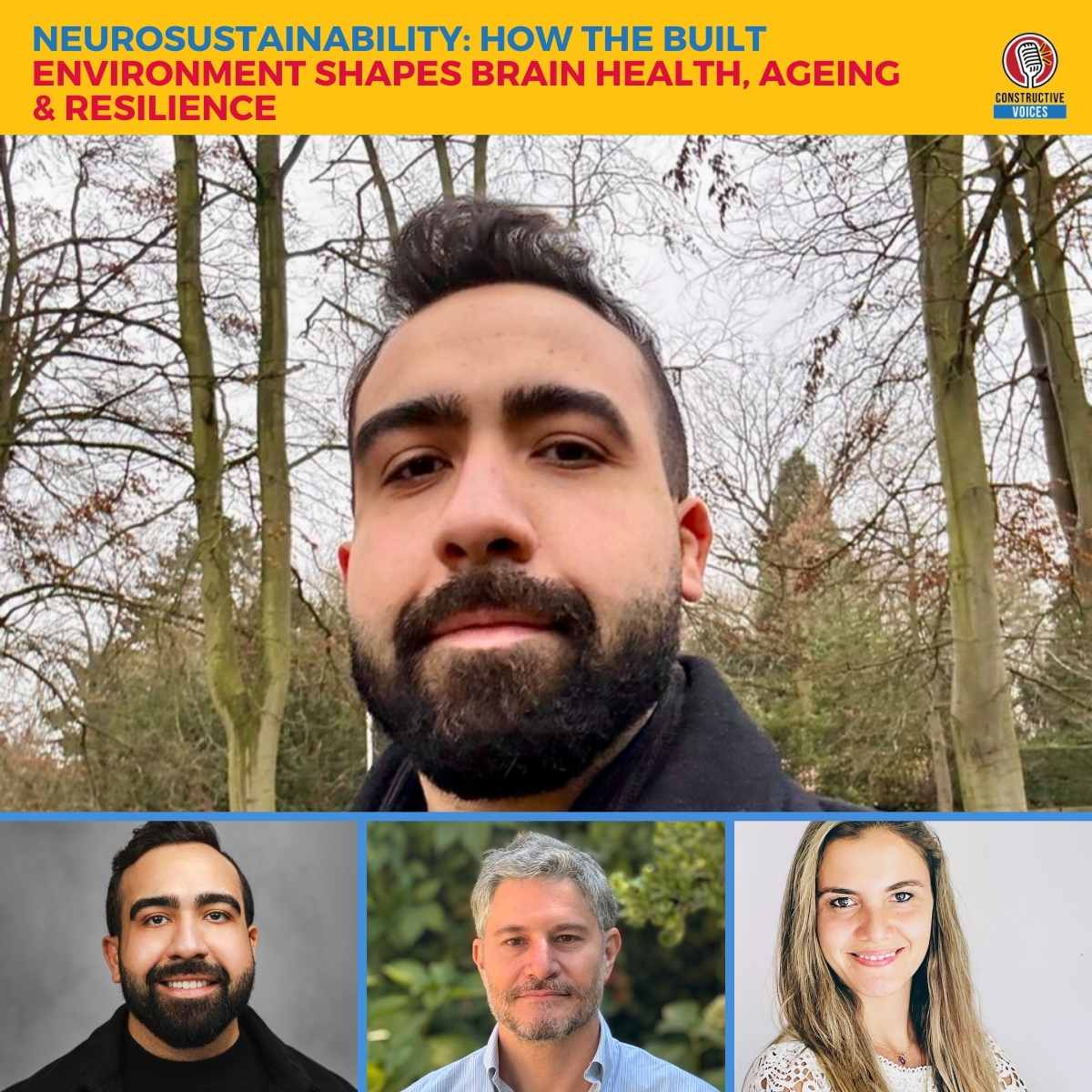
[00:38:49] Speaker A: Okay, that's, that's really good to hear. And when you touch on the green walls and improving the neighborhood, it links me into the series that is currently being broadcast from the earlier part of this year, which is all about neurosustainability, which I'm not expecting you to speak about, but it's very linked to the work you're doing at the same time. And essentially it's about having environments that are keeping us active and are good for our brains, essentially. Which of course the work you're doing is doing that naturally, isn't it?
[00:39:20] Speaker C: Yeah, it's doing that naturally and it's doing that work behind the scenes. We tend, Jackie, to keep it very simple for our audience and for our clients because it's such a new concept for most people. I mean, I'm sorry to say it, I'm talking about nature, that nature is new concept for people. Most people are so disconnected from it, but it's doing all that work in the background.
We're not selling that because it becomes too complicated for people to understand it. But for the people in your audience who already understand this or is generally interested in it, you know, there is actually very good reports, scientific reports out there, that show the impact the human brain, how building in this way have, you know, they've literally done researches where you can see what kind of brain waves it creates inside of our heads. When we are inside of a building that is designed with natural forms and geometries, and when we are inside of buildings or when we are in nature, you know, there are enough reports out there that shows the impact. And for example, there's this one report measures the brainwaves of people inside a building that has organic shapes. And one where people are inside just a square building with a flat roof. And the people inside the building with this organic arc shaped roof, they are producing way more alpha waves than the people in the square building. And alpha waves are the Waves that we generate when we are in a peace of mind, when we are in a creative state of mind. So literally the design decisions that we take for our cities, for our buildings, has a direct impact on our brain weight and our well being. So actually, you know, a lot of people tell me, Jackie, yeah, but a green wall is expensive and you have to maintain it. We shouldn't put cities money to maintain, you know, green infrastructures like that and comments like this. But if you can actually measure the impact that it has on the people living in that city and how those people become healthy and rely less on hospitals. So now you have a group of citizens that don't go to the hospital that often because their energy is system is so balanced. You're saving a lot of money there. And you have way less people taking sick days and days off their work because they're not burned out anymore. Their city and their buildings are designed to constantly recharging their energy systems. I mean, the amount of money you say as a city for investing in making your buildings and your city healthy for the people, it's a no brainer financially. So I can give you some really concrete stories about real projects. I had no idea. Jackie, when we were doing our first green wall here in the city of Malaga, you know, the one that we had to fight the license for, what started happening was that interesting enough, A lot of people started to tell us that they have changed their route throughout the city to every day to pass by the garden.
[00:42:38] Speaker A: How wonderful.
[00:42:39] Speaker C: I had no idea that it would have this impact. You know, when you walk through the city, you choose what directions you want to go. And people started to passing by here. And then people started using this as a meeting point. So it became a meeting point in the city. People started calling each other, saying, hey, meet me at the green wall. And then we had a study done by an intern who went and asked a bunch of questions to, to all the stores in that neighborhood, how this project has impacted their business. And all of them reported that they've had an increase in sales. They had more people coming, spending more time in their restaurants, in their cafes because they could look out towards the garden. And then we realized, wow, it's actually impacting the commerce of the neighborhood. It's bringing more economy people, people are more willing to stay in that neighborhood because it's more healthy. You know, I mean we spend money to go and travel, to go visit parks and you know, get out of the city. And when you bring the nature into the city, then that's what Attracts people. So that's it.
[00:43:44] Speaker A: That's absolutely it. And by coincidence, this morning in the Guardian newspaper, there was an article about the high streets of the uk, how they're really going down, down, and how that affects the, the neighborhoods, the economy and everything like that. And there you are, just like that. Such an easy potential solution that you've just been talking about.
[00:44:02] Speaker C: Yeah. And another very interesting aspect, and once again, there's, there's a lot of reports for people to go and look this up for yourself. There are studies showing how it actually reduced the crime rates in neighborhoods.
[00:44:14] Speaker A: I was just about to say actually that beforehand because you were talking about the health benefits. And I'm thinking to myself, this, you know, it's, it spills over into mental health. And then we're going into. Some people are committing crimes because they feel so bad for various reasons, economic reasons, mental health reasons. It's just massive. I mean, the potential is just massive, isn't it?
[00:44:33] Speaker C: Totally. I mean, one of the concerns people have about green walls is say, yeah, but, but people are gonna, and especially old ladies, they're gonna steal all the plants from the wall. Like it's, it's not safe. Safe.
But I'm telling you, there's research that when you place this, the, the neighborhood feels more safe because when you have something beautiful like that, it attracts more people and you maintain it and you take care of it. It doesn't just look like an abandoned corner in the city, you know, it, it avoids crimes.
[00:45:07] Speaker A: It's so wonderful. So, yeah, we hope a little bit. Like when we're talking about the series that's run just before your episode. We just hope that there's going to be important people like policymakers and those people who count in decision making processes. Taking some notes at this stage because as I've said to other guests, Moeen, this is the time. There's so many changes that have to happen anyhow because of climate change. Why not just, you know, bring it up a notch or two and incorporate all of these things?
[00:45:34] Speaker C: Yes, totally. And if I may add something to all the. Those policy makers out there who really want to make this happen. See, the challenge today is that if we really want to bring this to scale, we need to dare to innovate. You know, we need to dare. We need to stop all these nonsense of all the risk analysis, like this is a cancer we have created in our civilization. We're analyzing the risk so deeply that we convince ourselves of not innovate.
It's a huge problem. We must stop doing that we, we must dare to take risk. We, we have to be bold and be okay. Like, okay, we're gonna try it and if it works, great. If it doesn't work, we will know how not to do it, you know, and then we will share that information with the public.
And the, the challenge right now, Jackie, is that there's so many companies like us out there spending their own money, taking risk and innovating and really, you know, really with the ambition of really bringing this at the scale while the city is just sitting and waiting for everyone to do, taking the risk and then eventually waiting for universities to write the scientific reports and they, they're going to act. You know, what I suggest to cities is take risks. Join us, join us in this journey of innovating, be part of it, spend, put a budget for failing. You know, stop being so afraid and waiting for everything to, you know, be perfectly done before you actually take action. You know, I, I think it's, it's very important culture that we need to change in the cities.
[00:47:19] Speaker A: Yeah, I totally agree. I mean, you know, I know it's kind of a radical, common, but, you know, money is man made at the end of the day and such a huge amount of power that surrounds us. And also, as you've just already explained very, very well, such a lot of trepidation about making decisions that could be very good at the end of the day. A lot of that is tied up in people who are worried about making a mistake, worried about spending money. But there won't be money to spend if nature, you know, hasn't been helped by humans to correct the imbalances that we have currently.
[00:47:49] Speaker C: Totally.
[00:47:50] Speaker A: So I would like to ask you about some of the awards that you've won because that's really, really important for people who are listening to you for the first time. You have won some very, very important awards. Moeen, let's, let's talk about that.
[00:48:04] Speaker C: One of the first ones that actually, which is also one of the biggest ones that came to us was we were doing a project, Jackie, in Lebanon. And, and Lebanon is a country of a lot of friction and conflicts. You have a lot of different religious group living there. You have a lot of geopolitics going on there.
So this was during the Syrian war, and you had a lot of massive amounts of Syrian refugees moving into Lebanon beyond what Lebanon could manage. So we, through actually one of our students, we came to Lebanon to do a project, and this was a humanitarian project where we were building a culture center together with a group of Syrian immigrants together with a group of people from different religious groups. So it was actually a conflict resolution project that was funded by the UK government. And this program was to basically bring people from different religious group and put them together to work together in a project. And it was, you know, in the beginning, the first weeks, it was beyond what I could imagine what was going on. The hate between these people was something I've never experienced in my life. But as we were proceeding and these people were realizing what we are teaching them. We are teaching them about how to build buildings that heat and cool themselves. We're teaching them how to harvest water, clean their own water, recycle the water, how to build buildings that produce food so you don't rely on having to always buy groceries. And they just started to shift, you know, they started with time to realize, wow, this is really powerful. Like this is something that is again, the game is life changing for all of them. So they all turned into friends, you know, everyone started working towards the same mission and the project was very successful. And this project was awarded by the un, the United Nations. So the United nations have something called the UN Habitat, very focused on buildings, how we build more in a sustainable way that also have a social impact. So this was the first award that we received thanks to this amazing project.
[00:50:29] Speaker A: Huge congratulations, Moeen. Like, what a story behind it. So the hate that you experienced at the beginning and the amazing work of something that you know is going to be functioning so well for the people who are in the area, but almost more importantly is the fact that they collaborated and became friends, isn't it?
[00:50:45] Speaker C: Totally. I mean, if you would have asked me the first weeks if, if that would be possible, I would tell you no, I don't believe these people will ever get it long, you know, but when they entered in the building and it was cool, and when they saw the water coming out of the faucet which was all harvested by the rain, they were freaking out, you know, and these are people who come from struggle, come from hunger, come from lack of water, you know. So no, it was really, I was impressed myself what impact we can have, you know, instead of, you know, coming from the project where people were used as slaves, literally not paid to be forced to do the buildings, to this making project where you actually bringing people together.
It was very inspiring for myself to see the power of this concept.
[00:51:36] Speaker A: What other awards, Moeen?
[00:51:37] Speaker C: Yeah. And thanks to that, then suddenly we got a lot of international attention. A lot of people got aware about our work and a lot of people started Reaching out and there was more collaboration and project opportunities for us. And then, you know, when we moved into the city and the project that I explained earlier that we had to fight for the license and all of that to recycle the water. And imagine that, you know, first the city is fighting us for not giving us the license and then in the end they ended up awarding us. They actually ended up awarding us. And first our city awarded us for the best social project in the city. And after that award, we got more attention on a natural level. So actually the government of Spain awarded our project as the best retrofit project in Spain in the whole hotel industry.
[00:52:32] Speaker A: Wow, that's just amazing. Congratulations again, Moeen, to you and your team.
[00:52:35] Speaker C: Thank you, thank you. And thank you for pointing out the team because, you know, I need to make it really clear there's an amazing group of people behind all of this, you know, working day and night to really make this happen. So. And yeah, and then from there on then that even brought, you know, more attention. And now we've been invited, you know, to participate in different awards. But you know, those are some of the main ones that had a significant impact as well for the whole mission. Because before that people were still very skeptical, you know, is this something that you can actually do? But thanks to all these recognition, people are seeing the value of implementing these solutions and people are getting more and more confident that it actually works. You know, and this is all what we're focusing on right now, Jackie, is all about executing, is all about just delivering real world projects to the world and showing people that it can be done.
[00:53:39] Speaker A: So on that note, Moeen, I think it's important to delve into the fact that your services and technologies are available around the world or where exactly can people, people work with your team?
[00:53:49] Speaker C: Yeah, so we are actually operating globally. We do way more projects outside Spain than inside Spain. So we're constantly working on new projects in different parts of the world. And the way we work is that we collaborate with developers, with architects, with, you know, hotels, whatever kind of project, because it's all, in the end, it's buildings and cities. So we are also offering our services to the public sector. We're doing projects right now where we are helping to regenerate urban areas with nature based solutions. So that's everything we do everything from helping with the early initial conceptual design to the actual engineering to actually the construction. This is something important as well, Jackie, that we actually just design these things. We actually build them and we maintain them ourselves. And I think that also has a huge impact or is a fundamental recipe of our growth as well. Because everything that we design is the feedback loop within our organization is very short and we always make sure to design things in a very practical, practical way. And then along all of that, we also have our own educational program. So there's so many people around the world who wants to use nature based architecture, but they don't know how.
So we run our whole educational program which is called the Biotonomy Academy.
[00:55:23] Speaker A: How does that work? Is that sort of self, you know, it's self paced or are there webinars or is this in a face to face situation or is it sort of a hybrid?
[00:55:35] Speaker C: So we have an online academy program which is self paced, which is basically what people do to just get started. Right. They can just learn about nature based architecture on their own and take their time. And it's designed in a way that both architects, engineers, developers or even average people who have no technical background can take the course.
So that's like the foundation program. And then we also offer real world programs where students from all over the world join us in real world projects during the actual execution where we show them they work alongside our construction team and they get practical learning, hands on of how to implement these solutions on site. And then there's also educational program for the maintenance aspect of it as well.
[00:56:30] Speaker A: I love the idea of the hands on learning. That sounds just like such an experience within itself. I'm sure people must love doing that.
[00:56:37] Speaker C: Yeah, it's a life changing experience for most people, honestly. And I'm not saying that, you know, for trying to sell it, it's literally a life changing experience because it's beyond education as well. You know, it's, it really once you get involved with our team who has been doing this for over a decade, you know, you also. There's a lot of personal growth involved as well. Because all of this that we talked about is not only just, you know, technical solutions, there's a big aspect of a mind shift and how to, you know, personally grow as well.
[00:57:14] Speaker A: Fantastic. Now all of this can be found on your website which is B for Barcelona, I Italy, O Oviedo, T Tarragona, O Oviedo, N Navarra, O Oviedo, M for Madrid and Y for Yankee. And that so wasn't the correct phonetic Alphabet, but I think I got it and that it's a dot com. The website is beautiful. It's really, really informative and but at the same time very user friendly, very calm. It's a very Calm kind of website to have a good look at. Look around. Moeen, are there any technologies that you'd like to talk about that we haven't covered in the conversation so far?
[00:57:51] Speaker C: Oh yes, absolutely.
We're living a very interesting time right now with the growth of AI. The AI technology is changing everything. No matter what we think about it, no matter what opinions we have about it, it's happening and it's, and it's happening so fast and most people have no idea how fast it's going. And it's going to have a huge impact, both very positive and in many ways it's going to be challenging as well. But we are the group of people who focus on the positive aspect and we are constantly innovative of how to implement AI technology and we're doing it in order to scale these solutions up. And we have already implemented AI technology into our green infrastructures and it's been funded and backed by the European Union. And the results are just mind blowing. We can clearly see thanks to this technology we are understanding nature to a level that we would never imagine. You know, we're not even scraping the surface surface of biology, today's knowledge about the natural world. But thanks to AI, we're already seeing how we can make all our projects way more efficient, way more affordable. And that is so exciting to me. That is so exciting to me. And I'm really looking forward to all the opportunities that AI technology is going to bring. And not only for the green infrastructure, we're also actually implementing it as intelligence into our homes and the buildings that we're building. We're working with a Swedish company that has over 20 years experience in AI technology and we are building an operating system for all the homes. And the homes are basically constantly monitoring the heating, the cooling, the water, the water recycling, the irrigation system and the green walls and the green roof. And there's a common intelligence inside of the building that is taking the right decisions every day, every hour to make sure that the building's performance is optimized and that everything is functioning in a way that it's providing value and well being for its inhabitants.
[01:00:17] Speaker A: That sounds really amazing as well. Yeah, it is. It's very, very, very exciting. AI and particularly in, you know, in your use case scenario. Fantastic. And can really speed up a lot of the knowledge we have again when used, I suppose with the correct intentions.
[01:00:30] Speaker C: Totally, totally. I mean I can give you a very clear example of a project we're working right now is we are getting into 3D printing, which is robotics and AI. And we are gonna be able to deliver these buildings at a speed that it has never been imagined before. What used to take six months to build with 20 people is now gonna take one to two weeks with three people. So you can imagine how we can reduce the cost of buildings. And I think that is such an important thing. I think most of your listeners right now, including myself and my team, we all know how expensive it is to, to buy a home today. It's, it's just crazy. You know, we need to change this. And thanks to robotics and AI and this technology, we are going to see that happening in the next coming years. And that's very exciting.
[01:01:31] Speaker A: Yes, we also need to see, I think this is just a personal opinion that I'll throw in there, a balance between, between protecting nature but not having huge areas of land unattended so the wildfires can, can occur. So I guess my vision would be like using the kind of structures that you and your team are working with, but having them maybe dotted around the countryside so they're like in tune and imbalance with nature.
[01:01:55] Speaker C: Totally, totally. That's going to be also more feasible as well to do. I mean, we've been very restricted of building everything so densely, but with new technologies, all of that is going to change.
[01:02:07] Speaker A: So that's really good to hear. So listen, it's been a brilliant conversation from my perspective. Is there anything you'd like to add or advise the listeners? Moeen?
[01:02:16] Speaker C: Well, you know, I know, Jackie, that there's a lot of people out there who, you know, really, really want this to happen. And I know a lot of people as well think that, well, you know, what, what can I do about it? You know, and there is a lot you can do already. You know, you don't, you don't have to be an expert in the field to get involved. If this is exciting for you, if you believe in this mission, you can get started already. You know, as I mentioned, we've developed our program, our community in a way for people from all over the backgrounds to join and be part of this movement. You know, and I think it's so important that we bring people together from different backgrounds to make this really happen. So, you know, don't be one of those people who just gonna wait and see what happens. You know, if this really resonates with you, join people, join us, join other organization, whoever is out there that you resonate with, join them, join their community, get involved, involved in the conversations, support them, whatever you can do. Because there's a huge, huge opportunity coming There's a. The market for green buildings and green technology is so big that there is space for everyone to get involved. So if this resonates with you, just get started, get involved. That's the most important thing. Don't wait, don't push it. Just start today.
[01:03:47] Speaker A: That's great advice, Moeen, and achievable advice. And I guess the one question that comes into my mind is how often are your projects available with those learning opportunities for people to go and do hands on work with you guys?
[01:04:01] Speaker C: So we're right now working on various projects that we will announce that people can come and join. And the way it works actually is the people who are enrolled in our online program have the, the priority to join those projects. So if you really want to join those projects, then get into the community and that's where we're announcing the first ones and we have some coming up this year in Spain where is going to be the opportunity to learn how to build wastewater, natural wastewater treatment system and green walls and green roofs. And this is going to be in a city in Spain called Zaragoza.
So if you really, really want to get involved in that, then join our community, our online platform and from there you will have access to all those opportunities.
[01:04:58] Speaker A: Okay, that's absolutely wonderful, Moween, thank you. It's been an absolute pleasure and a fascinating conversation, I have to say.
[01:05:06] Speaker C: Thank you. Likewise, Jackie and honestly, thank you so much for, for what you're doing.
People like yourself that help other people amplify their voices, I, I cannot emphasize how important it is for the overall mission. So thank you so much, Jackie. It's, it's been a pleasure.
[01:05:24] Speaker A: Thank you so much Moeen and I really appreciate you saying that.
Sam.
Sa.