Episode Transcript
[00:00:00] Speaker A: This is Constructive Voices.
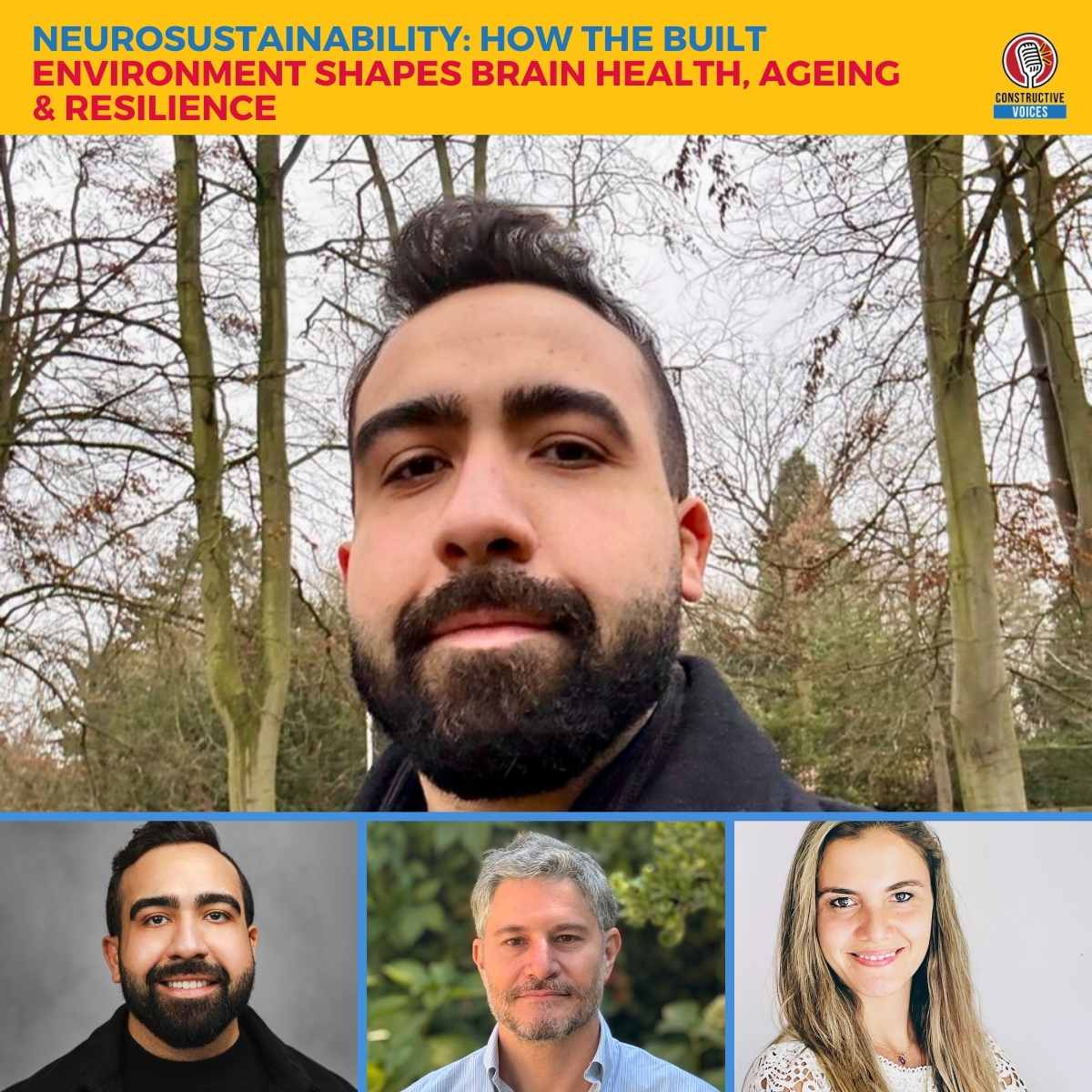
[00:00:02] Speaker B: Mohammed is back, and for this episode, he's bringing you a conversation that feels like it belongs at the center of how we design the future.
He's joined by two truly eminent voices in the field. Professor Augustine Ibanez, one of the world's leading brain health researchers, and Burchin Ikes, a neuroscientist pushing the frontier where climate equity and brain health collide together. They're asking a question that's urgent, practical and surprisingly personal.
When we talk about brain health, we usually think about genetics or lifestyle or healthcare. But what if one of the most powerful influences on your brain is something you walk through every day? Your street, your building, your commute, the air you breathe, the noise you try to sleep through, the heat that builds up in your home, the green space you can or can't reach.
In this episode, we explore a bold idea that brain health is not just personal, it's designed. Mohammed, Agustin and Borchin unpack neurosustainability, a way of thinking that links climate inequality, the built environment and the brain.
Together, they break down the exposome, the total set of conditions that shape us over a lifetime. From pollution and stress to education, safety, housing and belonging.
Because the built environment isn't just a backdrop, it's an active force, a multiplier of harm or a multiplier of resilience.
You'll hear how city design can change cognitive load, why navigation and wayfinding matter as we age, and how indoor spaces where we spend most of our lives can either protect our sleep, learning and mental health or quietly undermine them.
And running through it all is one urgent who gets access to brain healthy environments and who doesn't?
This is a conversation about design, yes, but it's also a conversation about equity, aging and the future of our cities.
Let's begin.
[00:02:00] Speaker C: Thank you so much, Mark. That's a great introduction. I am Jackie de Burcke here for Constructive Voices. You won't hear much from me today because I'm going to hand you over to the more than capable Hans voice and brain of Muhammad Hesham Khalil. This is the third and final part of his miniseries about neurosustainability. But first of all, I'd love Bertin Ickes to introduce herself. She's also been part of this series. And then I'm just going to hand over. This is an amazing episode. Hello, everyone. My name is Burchin Ikes. I'm a neuroscientist who have been studying brain health for over 20 years, lead a group called Neuroclimate Working Group. This is a global network of scientists, physicians, architects, policymakers, all working at the intersection of climate change and brain health. I also have founded and direct the research initiative that works at the intersection of the environment and neuroscience called Echo Neuro and a junk lecturer at Stanford teaching about the topics around brain and planetary health. Fantastic.
[00:03:01] Speaker D: So.
[00:03:01] Speaker C: So yeah, you've really amazing background obviously. And Mohamed, can you do the same please?
[00:03:07] Speaker D: Yeah, sure. Hello everyone, I am Mohammed. I'm an architect, researcher in neuroscience and a PhD candidate at the University of Cambridge. Exploring the intersection of environmental enrichment and neurogenesis as part of a work towards achieving neurosustainability. Specifically my focus on environment enrichment begins with the urban environment and then extends to architectural applications to enhance neurogenesis through motor, cognitive and visual enrichment.
[00:03:34] Speaker A: This is constructive voices.
[00:03:37] Speaker D: It's really great to have this conversation with Professor Augustine and Bertin. We will be talking about the environment, brain health and the aging brain. Lots of things to address problems we encounter in the environment. How do they affect the brain long term and what are the possible solutions for this. So we'd like to welcome Augustin who is joining us in this episode. If you'd like to introduce yourself please for the audience.
[00:04:02] Speaker A: Hi Mohammed. Sure. This is Agostin Ivanez. I am director of the Global Research Networks at the Global Brain Health Institute GBHI in Trinity College Dublin and also scientific director of the Latin American Brain Health Institute. And it's a great pleasure to talk with you all.
[00:04:19] Speaker D: It's a great pleasure to talk to you Dr. Augustine. And you obviously have a lot of very interesting research and experience about the aging brain and the exposome and we'd like to hear from you first about the exposome mean for people who hear it for the first time.
[00:04:34] Speaker A: Sure, sure. So scientists, sometimes we use strange words for simple things. Probably many people is familiar with the terms like the genome or the proteome or the brain. Tom like when you say this for example with the genome we refer to all the genetics contributions to health and disease while combined they constitute the genome. In the case of the exposome we talk about different environmental conditions. They can be like, you know, physical things like temperature, pollution, the level of greenness or social like socio economic inequality. You know, how safe is your neighbor, what has been your education?
The core concept is how these factors as a component set of influences shape health and behavior. So that could be a basic definition of the exposome.
[00:05:31] Speaker D: Yeah, it's really interesting to know because as we may think about the exposome as like the external factors that may really shape our own internal biological environment. There are lots of factors I think that have been identified recently, including air pollution and climate change. I know that your burshin have been working on related topics, but I'm also wondering if the built environment, because greenness is really one of the very most important and trending environmental factors that have been addressed recently in the past couple of years. But I always see that the built environment itself maybe hasn't been given the same attention comes to the exposome because I'm really bringing this because the United nations is forecasting that people will be living in urban environments like over 2/3 of the population by 2050. And already we have like statistics saying that people spend around 90% of time indoors. So how do you think this may influence or like broaden the definition of the exposome?
[00:06:28] Speaker A: Oh yes, this is a great point. I think that there are two related topics in what you mentioned, Mohammed. One is we, at the very least, I would say the neuroscientists, we don't have a real good models on how the brain is embedded in the body and in the context, right? So we don't have these powerful scientific methods to address the, this relation between macro factors like pollution or sociopolitical instability and brain signals or brain process. We are just starting to realize that the brains have a body and an environment. And when we bring all the pieces together, it's not only that we identify connections between them, but it's much more. This is that we can develop more precision models. We can start to understand many things that if you look at just at the brain, you will never understand.
This is one point and the second point I will say is a meso scale, the build environment between the macro scale factors. Those are far in terms of spatial and temporal dimensions.
The built environment is a core and neglected aspect, as you mentioned, but it's a critical one, is the space where we most of the time live, move, think, also thrive or become sick. They are multiple initiatives trying to, you know, fill in this gap and trying to bring the attention as you mentioned, you know, like the, let's say, the neuroecological aspects. How do you see what's the space? You see what's the level of greenness, what the access to nature, Right? So this is a critical aspect. How we create architectural environments that promote brain capital and not reduce them is a huge area of research, very emergent. But I think that is critical because as I mentioned, I think that is a kind of meso level in which we can connect the large macro Factors with the more individual micro factors.
[00:08:43] Speaker D: Yeah, this is really interesting And I really 100% agree with you. It's really evidence is growing and it's just like in the past couple of years that we have seen like evidence about residential greenness and tree cover density and how those are associated with brain volume changes. We came to understand that it's not a linear relationship between green environments and brain volume. But also other factors are associated with this relationship such as like sky visibility, air pollution and climate change. I'd like to hear from Burchin about this. We're still like talking about the urban scale as Augustine mentioned because select at the smaller architecture scale inside building it's far more complex. But I'd like to hear first from Bertrand about this. What do you think?
[00:09:24] Speaker C: Yeah, exactly. I agree with both of your points. I see built environment as a multiplier of impacts and opportunities when it comes to the context of more larger exposomes and including climate change. Climate change is this overwhelming crisis. It affects our natural environment that we are surrounded by. It affects our socioeconomic environment and the built in environment.
And the built environment when we talk about heat, extreme heat or air pollution, it has a role. It can make things worse for us when we are feeling if it's a housing that region of a city that's not well climated then it could get really hot and that could cause more harms on our brain. But it could, it's also multiplier of opportunities. When we're creating co designing new living spaces it's really a great opportunity to see okay, this is a warming world that we're going to have perhaps more wildfires, we're going to have more air pollution. How do we design living places so that they're healthier for our brains and as Augustin has mentioned for our bodies because they're all connected.
[00:10:26] Speaker D: Yeah, this is really interesting. And also when we talk about temperature and climate change this is a very important topic and I see that while we know that temperature has ranges and thresholds when it becomes good, when it becomes bad. So in indoor environments we can say that head protector or head out exposure to heat has benefits for the brain. As we see it increases brain drive neurotrophic factor. But of course without elevating the body core temperature to severe temperature and also without having direct heat exposure to the head, which is something that we can control in the indoor environment but outdoors it's really difficult to do so because we get both like the good and the bad effect of temperature which is really important. To address how climate change is changing all of those factors. But also I would like to bring two important factors that maybe highlight how the built environment contribute to the brain changes. So there are two factors. First is the environmental affordance for physical activity which I've been working on recently. Because with those conditions that you mentioned first, air pollution and very low temperatures, or like very high temperatures, those extremes really disrupt the increase in brain drive neurotrophic factor bdnf. When people for instance, go for cycling outdoors in those conditions still, if they do the same activity indoors, in a controlled environment without air pollution and in a controlled temperature, they really see significant increase in BDNF concentrations. It's peripheral BDNF of course, because we cannot test it in living human brain. But this really creates an interesting contrast between the indoor environment and the outdoor environment that Augustin has just mentioned.
So I would like to hear from you, what do you think about how this is affecting the aging brain? Because probably people age in place and spend most of their time indoors, specifically residential places. So Professor Augustin, what do you think about those two scenes?
[00:12:16] Speaker A: Yeah, thank you. Thank you so much, Mohammed. I think that this is a great point. You know what, when we look at climate change evidence, what we most find is how climate change impact the cardiovascular system or the brain health or the overall health.
Most of evidence is providing something that we already know. Of course there is too much for understanding. But we know that let's say pollution or temperature peaks have a huge impact in our health. But the question is what we can do for that. I think that built in environments represent a unique opportunity for developing interventions and also for solving a critical aspect. So one of the most pervasive effects of the expos on let's say socio economic inequality or pollution are associated with structural challenges like, you know, the poorest countries are, you know, facing the worst exposomal conditions. We have been done many works together with Burchin and others showing this. Right? But maybe the built environment can act as a buffer that can protect against structural conditions that we cannot change immediately or that have a huge inequality in the world. Right. So I think that for me built an environment provides something that the rest of the exposome it's more challenging. It's the opportunity to modify the inner environments. Right. And for that there is so much to be done from ergonometrics. Right? So this is even at scientific level, when we look at air pollution, most of the research is looking at the, you know, satellites or combined satellite and particle measures that provide a Very, you know, broad estimator without precision. If you measure the air quality where you spend most of your time, probably a building. Right. You can have a much more precision science for that. So I think that we need to really, really invest more in the built in environment, but also starting to manipulate that for creating better conditions. I think these two things are essential and at the same time something that is more cool, more interesting. It brings a lot of transdisciplinarity. We can combine technology like wearables with architectural designs, together with neuroscientists. So these kind of transdisciplinary solutions can really provide innovative ways to deal with terrible big challenges like climate change or exposome research.
[00:14:57] Speaker D: Yeah, very interesting. And thank you for bringing this important issue about equality. And also, how can we monitor how people interact with the built environment or navigate the built environment? Because this in turn can determine lots of health consequences.
Because we have two studies, one of them addressing the problem of people who spend most of their time indoors at home and others. The other study addressing how the spatial complexity of different neighborhoods really affect cognition. So both of studies are tackling the same problem, but from two different perspectives. And the first one really found that spending more time outdoors is associated with enhanced cognitive function. And the other one found that quantifying spatial complexity, well, now cities are built like to be more comfortable with easy way finding and so on. But that comes at the expense of the demanding navigation, which can in turn provide cognitive stimulation. And in turn this study shows it has neuroprotective effect and also is associated with lower risk of Alzheimer's disease and mild cognitive impairment. So I want to take to try to see those studies together and to hear from you and Borchin together because you have been working on the aging brain and how it's affected by the environment. So how do you think the aging brain and Alzheimer's disease can be taken as probably outcomes that should be given enough attention? And how we quantify people, how people use the built environment can be a good way to understand the aging brain and cognitive decline.
[00:16:32] Speaker A: Oh, this is a wonderful point. But I will give the voice to Burcim first and then I can contribute a little bit.
[00:16:38] Speaker D: Sure.
[00:16:38] Speaker C: Thank you so much. Yeah, I agree. It's a great question.
I think I want to go back to inequity issue again just for one minute because when we think about being outdoors and because there's so much more stimulation, it can be really good for the brain. But again, it depends on what kind of outdoors you have access to. If you you have access to green spaces, if you have access to clean air, trees, so that it's not too hot, then that can be a very stimulating place for the brain for to be exercising, to be walking, which can be. Which can really lower our inflammation in our bodies and in our brains, but which is a critical mechanistic factor for the brain aging and, and that can be very beneficial. But if you're going out and all of a sudden we are in the middle of a very dense urban environment with pollution coming from the vehicles and there's a lot of noise and there's a lot of light and that kind of stimulation can be actually really bad for the brain. And so I think in studying those and I think it's really important that's why to focus on and what. That's what I really love about also August's research is to look at the research and understanding and information coming from the global south, from really marginalized communities where we have to reanalyze what does it mean being outdoors, what does it mean being indoors, what kind of interventions can work for both that can affect brain health in general throughout the lifespan, but also for the aging. Yeah, I just want to make that point and I think in terms of brain's own aging, I think it's. We know that there's a lot of mechanisms mechanistic factors go into place. We know that air pollution now is a big risk factor for dementia, for stroke, and that's a very preventable thing.
We contributed to this report that came out last year called State of Global Air Report. And there we were able to show that one out of four dementia deaths in 2023 was attributable to air pollution.
But being able to come up with some clean air policies and so on can really clean the air and can have big benefits, co benefits on our brains and our body health as well. So I think that could be a lot of research that needs to be done in thinking about how to provide within living spaces, healthier environments and see positively how can they have co benefits on our brains as well.
[00:19:06] Speaker A: Wonderful reporting. Yeah, I fully agree. And few other comments about that. So starting from the more macro, first of all, how navigation is organized in a city, you can measure more or less the entropy of a city, how complex is to navigate a city, how organized are the streets, the labeling, etc.
There is a wonderful research. Hugo Spears and UCL and many others have shown that the larger the entropy of a city, the more strong the cognitive load. You need to really develop more strong cognitive Abilities.
For cities with larger entropy, of course this is good because it's a stimulation. But in aging, when you start to have declining cognitive abilities, especially navigation skills, this can be very challenging.
One important thing is making agent friendly cities. This is a critical need.
They are just a few small wonderful examples in some countries that have started to test how to make aging friendly or dementia friendly cities.
But we need to do much more.
This is at the more macro level then on the micro level. Once again, as Burcin has mentioned, pollution is have a huge impact.
One thing that can protect pollution and temperature is the quality of the air and the temperature. Some studies and Nature Medicine paper already have shown that a way to reduce the impact of climate change. It could be providing good hair and good temperature, especially for aging and dementia. There, there is evidence that this already have a positive impact. This is kind of thing. But then we can go moving deeper. How we create environments that promote interaction, that promote cognitive stimulation for the people that is under cognitive decline, for example, that needs much more, let's say fine grained knowledge about environments and about the mind.
What are the environments that we feel more comfortable, that we want to explore, we want to move, how we guarantee that the people keep hide the activities, the body movement, the exercise. These are the kind of things that I think that is a lot of space to develop in. We have horizon Marie Curie project called Click Brain, in which Burcini is also a great collaborator for that in which we will do a lot of things more oriented to research and macro factor exposon. But we also want to work with understanding bona fide cases of communities, buildings or environments that they promote brain health, like improving the air quality, the mobility, the exercise, the temperature, the interaction of the peoples and developing bona fide cases to understand how much they can be extrapolated or applied or use it in different socioeconomic settings. Which is another set of challenge that we may want to talk a little bit about.
[00:22:29] Speaker D: Yeah, wonderful points. Thank you so much for addressing those points. Because indeed it is not a linear relationship. As you mentioned. For instance, people don't want to get lost in a maze. Like the city has a maze when they are going to work in the morning or so it really depends on the context. And I think understanding the mechanisms that can do good for their brain is phase one and then phase two is to understand where to implement those enrichment mechanisms. As we know, because really increasing stress as we implement the enrichment mechanisms in the wrong place can really have adverse effects that can in turn probably impair neurogenesis in humans that we know that Exists into the 10th decade of life and probably may have adverse effects at the end. So that's really wonderful insight. And also I would like to comment on Bertrand's comment on the quality of the environment. That's another factor that we should really pay attention to because we know from the research on restricted environment enrichment that spending two to three hours outdoors is really good to compensate for the loss of complexity and enrichment that can be lost indoors. But again, as she mentioned, it all depends on the quality of the outdoor environment. Maybe getting outdoors to get exposed to air pollution and severe heat stress and excessive noise, then this doesn't become an enriching experience.
Which again I think brings us back to Yogasen just mentioned the microscale and how important it is because it's a controlled environment. For instance. Well, the workplace is one example, but also housing and apartments and things that people really spend most of their time in and probably most of their life.
So how do you think this is related to equality and the aging brain and probably cognitive decline? How important it is to really pay attention to the micro scale as well as I've been seeing that attention has been given to the macro scale. I'd like to hear from both of you on this.
[00:24:26] Speaker C: I agree. I think there's really important things you can do both micro and macro level. When we talk about macro level, as Augustine mentioned, there's so many different opportunities for people from different disciplines, professions, backgrounds to come together and work anywhere from city planners and working with scientists and architects and clinicians and community members who are living in these environments to think about together how to design spaces, living spaces, cities and with in mind that this is a changing climate. So what was maybe true 50 years ago about the heat patterns and extreme weather events is not the case today. So if we're, you know, I used to live in Los Angeles until last year we had those really affected large wildfires that just were devastating. And now in creating rebuilding in those spaces, thinking about how to build places that will be more resilient to wildfire. So macro level has a lot of opportunities to have more population wide impacts. And I think in the micro level there's a lot of things that can be done and individual level, a lot of things to learn at the individual level to make our brains more resilient. With the built environment in mind, it could be anywhere from behavioral changes like you had mentioned Hamid to be how much stimulation there could be in the environment, how stairs. Right. We were talking about this earlier Muhammad in our earlier episodes that could be a great way for especially aging population to have physical exercise. And then there's also even more micro level. There's, there's ways of our biology. And that's the question August and I often discuss is what if there are certain elements within, inside us that can also make us more resilient? That when there's two brains, two people that are exposed to different, similar things in their exposome, one may have faster aging than the other one. And so what is causing that fast aging or slower aging? And how can we learn about those and mimic those biological patterns or behavioral patterns to make individuals more resilient as well?
[00:26:27] Speaker A: I will continue on that point, Marcin. I think that is fantastic. This idea of for so long. Once again, neuroscientists, we have put the focus in the disease, in the decline in the deficits.
And we don't realize that an important percentage of the people, when they face environmental conditions, a very adverse environmental, social condition, even biological disease, they can cope with that or they can have healthy aging. This is one of the most fascinating questions. Most of the research is very, very limited of what happened within the brain if you have a gene that protects you.
Regarding the risk of dementia, or how good is your cognitive reserve. I think there are wonderful pathways. But we can expand this concept of resilience beyond the brain into the mind. For example, how we cope with stress, how environments help us to cope with stress, to interact with other people, to keep an active mind. But not only the mind, then the community, the spaces which are spaces that provides more resilience and which are even exposomal factors. When we talk about exposome, we just think in the negative aspects. But definitely they are environmental factors, even at the macro level that are very positive.
We need to rebuild this conception of resilience across level, not only at the brain or at the mind, but also at the micro interactions, family interactions, community interaction, buildings and environment.
There is so much to do, especially with building environment.
Basic things like thermal regulation, passive coolings, green roof, vertical gardens, cross ventilation designs that should of course be smart enough. Designed to be applied to restricted resourcing settings or socioeconomic settings with no chance to have fancy developments, air quality and pollution mitigation. As Burcin has mentioned, not only PM2.5, but many others using smart indoor infiltration, pathwires, urban trees, etc.
The other is bring nature into the inner environments. Bringing green exposure reduces stress, inflammation, depression have been linked to better cognition and even slow brain aging.
Provide natural light, indoor vegetation, shattered green spaces, visual access to Green aspects. Another thing that is really important for cities, noise reduction, crawling noise really not really impact your attention, your cognitive abilities, but also and more critically impact your sleep. When your sleep is disrupted, you know you have from the glymphatic system to the learning process are impacted. So acoustic insulation, building orientation away from traffic. Many things that can be done. Then social architecture like, you know, bringing the positive aspect of social exposome. Because social isolation, especially in all works that are just sitting in front of a computer, like we are doing right now.
How we can create environment that counteracts this and create more interaction and mobility like shared spaces, workable, mixed use in designs, intergenerational housing. This is another critical thing for aging.
I think that there is a lot of innovation for the people that is retired. How they can have active roles in society through intergenerational interactions. Because this not only provides protection for the aging brain, but also create huge opportunities for innovation. I think that how we can fight structural inequality, it's critically many other energy efficiency etc etc etc. So I think that there is at the very least there is emerging a set of evidence that can provide us with specific tools to improve the build environments.
[00:30:58] Speaker D: Yeah, wonderful insights and really 100% agree with you. And this is what I've been trying to do in my PhD and so far three problems have been hopefully resolved. So first we butcher mentioned stairs that we discussed last time. And it's really an architectural responsibility not just to provide buildings with stairs, but if they are not designed in to be appealing enough for people to use, then they're missing out this enrichment opportunity. And it's not just the provision of this structure enrichment, but making it biophilic, designing it in an inviting way for people to use. This is one aspect. The other thing is to bring nature indoors, which is really one important thing to restore this lost connection with nature. Since we are spending most of the time indoors, we really need to advance the understanding of biophilia and green architecture. This is why I created the newer Biophilia index that not only looks into how to create indoor spaces inspired by nature to reduce stress and provide stress recovery, but also to support neurogenesis along the way. As we understand from studies done in humans and animal models. What are the different mechanisms that can achieve this and in a very passive and inclusive way for everyone. Because we know that using CERES can be for people, but not for others with mobility issues and so on. But for the Neurobiophilia index we are really relying on nature's elements as daylight, olfactory Enrichment indoor plants, among others. There are like 10 items and how they come together can be really something that can achieve this equality without having to rely on the architecture design. Or of course it's important when it comes to spatial complexity and the provision of stairs, but this is more immediate and I think this is more critical. So I really hope that in the future we can see an advancement from just the concept of sustainability to neurosustainability as we think of how green architecture or like green building grading systems can take into account the impact of the design of the environment on green plasticity to really promote adaptive plasticity in a sustainable way. It's a shared responsibility. Do you have any thoughts on policymaking or how can we think of the implementation?
[00:33:11] Speaker C: Yes, sure. We know one of the things we work on is about how the policies around climate mitigation, climate adaptation and clean air policies work as co benefiting our brains. And we see huge changes. For example, there was a study that was done by an economist colleague in Berkeley where they looked at after China implemented these very strict clean air policies, within days of the air's cleaning, the suicide rates really dropped and they were able to relate it directly, link it to the air getting cleaner. So we know that that was a really great way of showing how critical the air we breathe to our brain health and mental health. So I think it's really important in really bringing in the brain, brain health and mental health into conversations around different policies, working with local governments. As we talk about these living spaces and macro and micro factors that impacts one's aging, brain aging and so on. It's really important to work with the local governments, with the city planners in developing and implementing these, these regulations that will clean the air, that will bring green spaces and accessible of course accessible is a really critical point. We are going back to equity issue and so that the populations can really co benefit from the environment being clean, but for having healthier brains and healthier bodies too.
[00:34:34] Speaker A: Very well said Burcin. I fully agree. I think that one important thing is reframing the narrative because I think that the big responsibility comes from scientists as I mentioned. I think that we have been told takes so long to understand the connections between large immediate environments, whole body health and the brain. Something that I started to call it the synercom, like the brain health synergy.
Understanding the synergies that in real life happen across macro micro environments, the whole body health and the brain health. So this is essential because when we want to bring narrative for policymakers and if we want to talk about things like brain capital or brain resilience. Right. We need to move from isolated things like design or just exposome. And for that we need to bring a clear narrative and how these synergies impact health care, cost reduction, productivity, energy savings or climate adaptation targets. We need to make very clear the neuroecological links between healthy buildings, preventive, green, health infrastructure. Right. So this is something that is essential in my opinion. The other thing that when we talk about policymakers is that most of ministries in most of countries work in a very isolated way. So this is not just Ministry of Health or Ministry of Housing or Climate Environment or Energy or Social development. Right. It's really a trans ministerial action and without this we will continue doing fragmented interventions that won't be enough to deal with the interaction of these factors. Right. And we need to create kind of operational tools like creating this kind of index that we were talking before. Healthy exposome and index when you bring local evidence based data. This is other thing that is essential. We cannot just get in what mean thermal or indoor or noise scores in global settings. We need to understand how is that in each neighbor, in each city. So developing tailored personalized models to create, let's say specific metrics for policy makers and to understand how we can use climate policies as first main door to bring this more tailored specificity. Last point is, you know how we do equity first implementation. So social housing, schooling, elderly housing, informal settlements, other private sector incentives will have a huge inequal impact if we don't pay attention for this. So I think that a critical way is to think creatively to assure that we don't increase the inequalities by doing implementations that are not working in different settings.
[00:37:37] Speaker D: Yeah, this is very interesting and I think it's really important that one, it's the scientists responsibility to provide those tools that can inform public health. But at the same time it's the use of those tools to reduce the inequality. One thing can be through using them for longitudinal studies to really understand the impact. Because as you said, it's not about how each factor works in isolation, it's how they work together. And what's important at the end is how each individual navigates those different environments. Because we're not living in just a single indoor space or like in a single neighborhood. But people really diversify their experience and trying to understand first to quantify the enrichment in those environments and then to see their long term impact. I 100% agree that this is truly needed and important. It's timely and I think with the Advancement of knowledge that we have right now. I think it's the time to start bridging this gap. Because otherwise we know that any maladaptive brain changes or like maladaptive epigenetic changes may be carried across generations. Of course, like this is very complex to address right now. But the sooner that we address this, the better that we not just address public health for the current populations, but also for forthcoming generations.
So what are your final thoughts? I'd like to hear from you, Lucent and Burchin. What are your final thoughts? That one thing you wish to see happening, like as the immediate action that you need to see happening soonest.
[00:39:05] Speaker A: Puchin, you want to go ahead?
[00:39:07] Speaker C: You go ahead first August.
[00:39:09] Speaker A: Okay, okay, okay. So I think. I don't know if they are immediate, but at the very least critical aspect in a very general terms. I can comment on two things. There are many others, but I want to comment. One is as a scientist and another how regarding implementation. So as a scientist, I think that we need to recognize the strong limitation of current models. We need to move. Nowadays we have a huge opportunity to connect data from environment to micro environment, to whole body and to brain. So for this I think that important thing is to going beyond or currently disembodied, non situated universal models of brain health. We need to create really situated, embedded. Embedded means putting the brain into the specific bodies and in the specific environment.
We can do a lot of things. We can do computational modeling because in the past our statistical model has been always based in homogeneous samples and unidimensional data. Now we have huge from biophysical modeling to machine learning and deep learning. We have huge tools that allows us to first connect the levels. Second address heterogeneity in data that is critical for understanding global diversity. But also using simulations for biophysical modeling to twins, digital twins. To understand how specific interventions can be implemented first in silico, to understand how environmental factors are heterogeneous body health profiles can impact an intervention and develop tailored intervention. We need to develop this brain health intercom model in which we still pour limited scientific tools, but we make an effort to have a more holistic, more integrative approach to understand the process and to use simulations to start to testing the huge interaction between factors when we assess intervention. This is one point and the second point I think that for long time ago we have in mind that the science can be purely basic or purely applied.
I think that this is a wrong idea. I think that all research can have potential implementations.
Sometimes we need to create the structures across the scientists to make these translations or also we need to educate scientists to think about potential implementation. Even when what you are doing is extremely basic or far away from the real world, you need to make a effort for that. And this is essential for developing evidence based intervention. Without this we will always have these strong divisions that when you create basic discovery, a potential solution, but never works in real life. So connecting translation to the core scientist model is also my second suggestion or advice.
[00:42:19] Speaker C: I agree with August 100%. Well said, August. I think as scientists it's important to realize that our roles and responsibilities are also changing in this world. We should be not just just thinking about expanding the knowledge base, but like he said, think about how could be applied, have the responsibility to raise awareness on the knowledge and translate it into action. Whether this is making communities more resilient, whether it's talking with the policymakers, whether it's educating the public, we have to be really thinking about interventions or when we're studying even the effects of heat on the brain or the built environment on the, on the brain's neurogenesis and so on. I think it's really important to think real life what is a scenario and have that controllable experiments but really make it try to mimic what's happening in real life so that we can provide solutions that will fight all these multi crises we're in, whether it's climate change or pollution and others. So I think that the really critical part and also working together, having this episode is an example of it. We have architects with the scientists together. We have to be coming from different ends and bring out our backgrounds and our experiences and expertises together to be able to solve these big real life problems.
[00:43:36] Speaker D: Yeah, definitely. Thank you Augustine and Burchin. I think it's really important that we really show everyone that it's a shared responsibility from your scientists, architects and policymakers and even more like people. And it's not just the sole responsibility, but really every step counts and we are always faced by limitations that should never like stop any research opportunity because it's been too long that we don't understand environment enrichment for humans. And we've been relying on animal models where the translation is not really straightforward. So it's now that this gap is getting reduced as we have evidence on humans and we have evidence on animal models that we can look together and we can really understand how this may affect neurogenesis and the aging brain and different things because we have empirical evidence in humans. So I think it's this responsibility that should drive each scientist to really take a step and provide just one useful thing that can make an impact because at the end it's a collective effort that creates this bigger impact. So yeah, I really hope that with those tools that we have talked about can provide an opportunity to further validate and further conduct research to see how different populations respond differently and to different parameters and if there is more resilience depending on different environmental conditions during the upbringing. And yeah, so that's really. That was a very wonderful conversation. Thank you so much Augustine and Burchin and do you have any final thoughts?
[00:45:07] Speaker A: I just want to say thank you Mohammed and also Jackie and I think that this is the kind of discussions that we need to bring into society. So I enjoyed much more these kinds of conversation than having another three neuroscientists talking about the same topic. So we need to from society to science to connect the dots for this idea of the Synercom. Thank you. Thank you for pushing this agenda.
[00:45:32] Speaker C: Thank you so much for coming and spending the time. Augustine, it's been absolutely brilliant. Thank you so much.
[00:45:37] Speaker A: This is constructive voices.