Episode Transcript
[00:00:00] Speaker A: This is Constructive Voices. Constructive Voices, the podcast for the construction people with news, views and expert interviews.
[00:00:11] Speaker B: Welcome to Constructive Voices, where the built environment meets the ideas shaping our future.
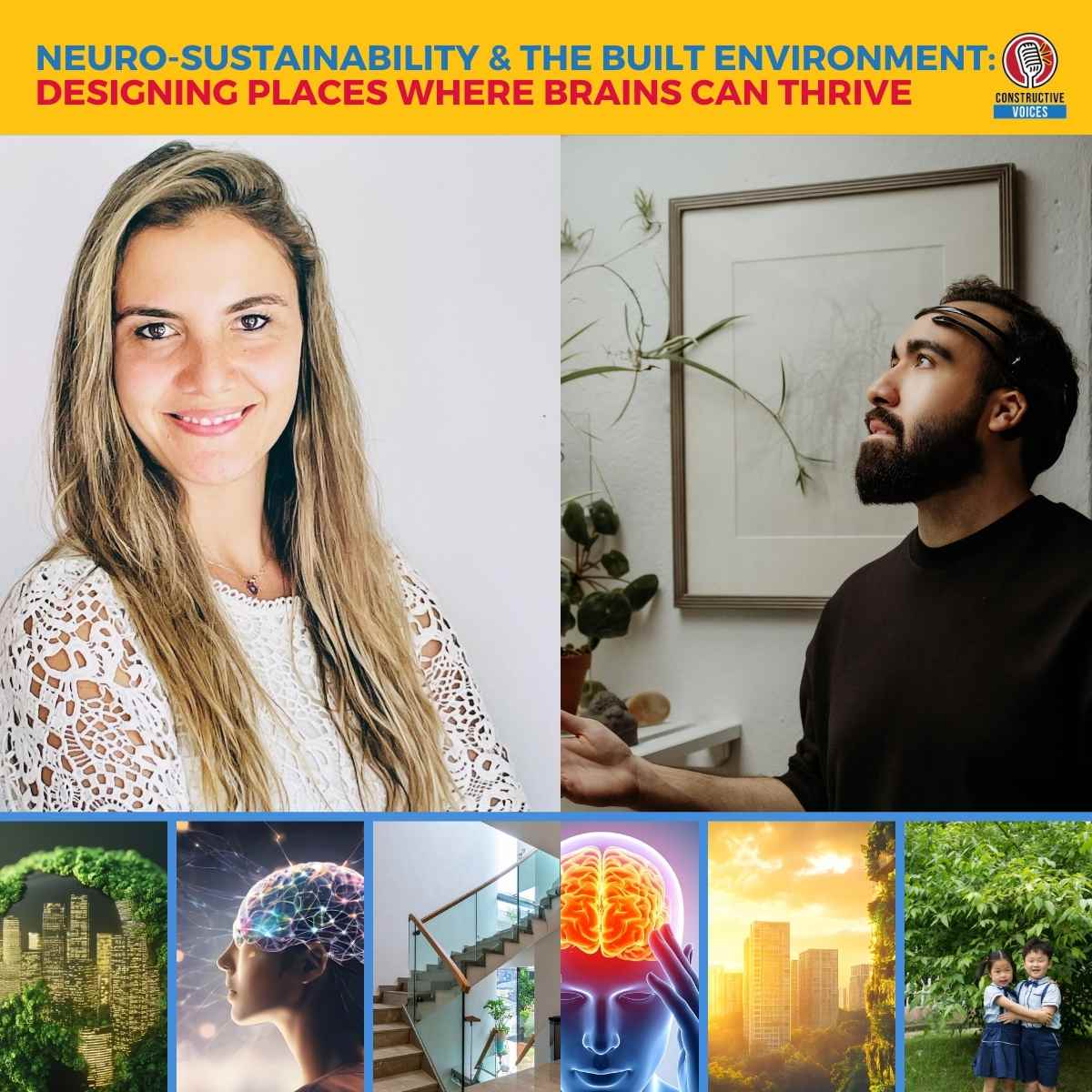
In this second episode of the Neurosustainability series, we explore a simple but powerful truth. The places we live in don't just affect how we move, work or sleep. They can influence how our brains function, adapt, and stay healthier over time.
The conversation brings together two perspectives that rarely share the same room.
Mohammed Hesham Khalil, an architect and PhD candidate at the University of Cambridge, investigates how environmental enrichment, from urban design to indoor architecture, can support neuroplasticity and neurogenesis.
Alongside him is Burchin Ickes, a neuroscientist with more than two decades of experience, founder of the Neuro Climate Working Group and director of Econeuro. Working at the intersection of climate change, environment and brain health.
Together they unpack what enrichment really means in practice. Opportunities for movement, cognitive stimulation, clean air, restorative indoor spaces, and the kinds of environments that reduce chronic stress rather than quietly amplifying it.
Because when most people spend close to 90% of their time indoors, design stops being just aesthetic, it becomes biological.
And the stakes go even higher when we consider vulnerability.
Children, older adults and communities facing the heaviest burdens from heat, pollution and inequality.
This isn't just a design conversation. It's a public health conversation, a climate conversation and a policy conversation.
This is neurosustainability, building places that don't just function, but help brains thrive.
And now over to you, Jackie.
[00:02:01] Speaker A: This is Jackie Deberka here for Constructive Voices, and I am with two really fascinating people here today, one of whom I've spoken to before at the beginning of the series that we're doing on neurosustainability. And that's Mohammad Heshan Khalil, Mohammad's very welcome second time around. But also we have today, Burchan Ikiz. You're both so welcome and we're really going to have kind of like a freestyle discussion today about neurosustainability. But firstly, could you introduce yourself, Burcin?
[00:02:27] Speaker C: Sure.
[00:02:28] Speaker D: Hello, everyone. My name is Burcin Nikiz. I'm a neuroscientist who have been studying brain health for over 20 years. I lead a group called Neuroclimate Working Group. This is a global network of scientists, physicians, architects, policymakers, all working at the intersection of climate change and brain health. I also have founded and direct the research initiative that works at the intersection of the environment and neuroscience called echoneuro. And a junk lecturer at Stanford, teaching about the top topics around brain and planetary health.
[00:02:59] Speaker A: Fantastic. So, yeah, you've a really amazing background, obviously. And Mohamed, can you do the same, please?
[00:03:06] Speaker C: Yeah, sure. Hello, everyone. I am Mohammed. I'm an architect, researcher in neuroscience and a PhD candidate at the University of Cambridge. Exploring the intersection of environmental enrichment and neurogenesis as part of a work towards achieving your sustainability. Specifically, my focus on environment enrichment begins with the urban environment and then extends to architectural applications to enhance neurogenesis through motor, cognitive and visual enrichment.
[00:03:34] Speaker A: Fantastic. Now, you've been writing loads of papers and exploring neurosustainability. Muhammad, in a few sentences, which I know is tough, can you explain why architects and planners should care about this?
[00:03:47] Speaker C: Yeah, sure. So, technically, our brains are always in a constant phase of change. So, like, it's change, it's the only constant for our brains.
So from birth, even into the 10th decade of life, the human brain never stopped responding to the environment.
So if we are living in an enriched environment, then this is how we nurture neuroplasticity, neurogenesis, and several neurotrophic factors that nurture the brain in turn.
So if we understand how the urban environment, architecture, design, and even design can nurture those neuroplasticity processes, then we are not only guaranteeing that the population are having like a brain health, but also that the generational inheritance of those changes is something that we should look at because it does not stop at the individual brain. Because those changes, as we discussed before, I think we had that chat that epigenetics is something that we need to look at because one modification in a human brain does not stop by the experience of that individual, but it is inherited in the next generations as well. So it's really a great responsibility for architects and urban planners and designers.
[00:05:01] Speaker A: Fantastic. Okay, that's a great answer. Now, virt, before meeting Mohammad, what had your experience been with neurosustainability? Perhaps without that actual label for it?
[00:05:11] Speaker D: Yeah, I love the term neurosustainability and Muhammad's approach as an architect, thinking about how to really support and promote neurogenesis through environmental enrichment. In my case, you know, when I started my career As a neuroscientist 20 years ago, interested in brain health, interested in the diseases that happen to the brain. Anywhere from Alzheimer's disease and other neurodegenerative disorders to more neurodevelopmental disorders or even serious mental illness, we always thought about if we want to study them, if we want to understand how our brain stays healthy and connected, then we have to look just inside the Brains themselves, just very neurocentric point of view. Just let's look at our brain cells and see what's going on. But more and more the field had changed over time, and now we're understanding how important the environment, the outdoor environment, the indoor environment, and general life experiences, lifestyle is really impactful in our brain's health and its neurogenesis, as Muhammad likes to focus on. And I think it's fascinating and it's true that our indoor environment, outdoor environment, things we see visually, can have a huge impact on our brain's development, on our mental health and the physical health, neurological health of our brains as well. So it's really fascinating field and it's getting more and more bigger from our perspective. We're also trying to, in addition to this built environment and outdoor natural environments, role in our climate change in our brains, we are also trying to bring the angle of climate change to it. How does the changing planet impacts our indoor outdoor environments, living spaces, and in turn, how does that impact our brains is one of the areas that we are looking at.
[00:06:57] Speaker A: That's absolutely fascinating as well. Now, one thing that I tuned into when I listened to your conversation that you both had in preparation for today's chat was you did speak about the developing brain during pregnancy. And I, I think because of the broadness of our audience, it'd be really interesting just to touch on this. It's kind of like Mohammed has already mentioned epigenetics, which is a really amazing subject within itself for people. Most people have children or would hope to have children at some stage. So I think it's something that can touch a lot of people and illustrate well the scope of neurosustainability in the developing brain. Either of you want to take that one?
[00:07:34] Speaker D: Sure. I can start. So our brains really developed a really high and a fast progression through the time that they spend in the womb. Neurodevelopment, especially in the last trimester, happens very majorly. And what happens, what we're understanding is the environment within the womb that the fetus sees. This may be the mom eats. It could be. We're understanding that we have studies from our cohort from, from our group that shows that even if the parents are exposed to some air pollution, for example, in the environment, that can have some effects on the structural changes of the brain of the fetuses that are not even born yet. We see that these babies that are exposed to air pollution through their moms while they're in the womb are usually born much earlier and they have structural changes in their brain and they show neurodevelopmental delays. They have increased risk of being diagnosed with autism and adhd. And later in life, in the young adolescence and young adulthood, these individuals have higher risks of having anxiety, depression and other more serious mental illnesses as well. We had, some of researchers in our group even showed that it could be, it doesn't have to be even a chronic export to sometimes a very acute stressful climate disaster such as we had Professor Yoko Nomura at CUNY who had looked at mothers who had experienced a superstorm, this was Superstorm Sandy, that happened about 50 years ago or so in New Jersey, New York area. These mothers had this very acute trauma and stress happening from that disaster. And she saw very similar things of the, again, structural changes in the children's brain and behavioral and developmental issues later in early childhood in these children. So it's, it's, it's really important for us to understand even at the policy levels, if you're someone who is pregnant, if you're a healthcare professional, an ob gyn, it's really important to be able to really understand how important the mother's environment is and what they go through and really make preparations and awareness around that because that's then it's life term. Whatever changes happen in that child is going to be lifelong and as Muhammad had mentioned, can be even carried from generations to generations.
[00:09:55] Speaker A: Yeah, it's absolutely huge, obviously. Mohammed, do you have anything you'd like to say on that?
[00:09:59] Speaker C: Yeah, thank you Fortun. Because you highlight a very important point that, yeah, we took that neurogenesis and neuroplasticity as a bigger umbrella is something that is from birth to the tenth decade of human life. But also like we cannot ignore that the developmental phase is very critical because adult hippocampus neurogenesis is something that's important in childhood. That's like how neurogenesis is seen as an aspect for vulnerable population. It's like we need to sustain it for the adult person, but, but for the developing brain, that's something that we need to pay more attention to. And as Persin has said, also like when researchers talk about the environment, we mostly talk about diet, exercise and so many factors. But it's not that we overlook the built environment, but because not so many projects have explored the impact of the built environment before on the brain. So it didn't get the attention that it needs specifically because we can change diet, we can change change habits, but we cannot change a built environment. It's built once and it lasts for tens of years. So this is why we have to take into account this chronic exposure to the built environment. And it's either enriched or not. And if it's not, then that is going to have adverse impacts on your plasticity for a lifetime and for generations to come. So this brings attention to the impact of the built environment as something that is chronic and potentially more severe than just things that are like, achieved or like can be changed and so on. So yeah, we are happy that we are bringing this intersection of two different realms of research to highlight the importance of something that has been like overlooked for years.
[00:11:43] Speaker A: Sure. And I mean, obviously it's a time of great change in general because of what's happening with climate change and biodiversity loss. So, you know, it's such a brilliant time to bring your theory in and have that actioned as well. When you mentioned the enriched environment in neuroscientific terms, how would that translate Muhammad into the likes of streets, buildings and public spaces?
[00:12:07] Speaker C: Well, we can break it down into three main aspects. Physical activity, which I call the environmental affordance for voluntary physical activity, and the cognitive stimulation to what extent the layout is, is high in spatial complexities, like when we talk about how the street network is something that can be classified as simple or complex.
And last but not least, we talk about the environmental quality itself. If we provide environment enrichment in the form of increased opportunities for voluntary physical activity and cognitive stimulation, but those environments add more stress or they kind of like are high in air pollution, then there is a clash and we cannot really call it an enriched environment. Specifically at the urban level. They translate as well at the architectural level, when convenience and comfort is the kind of like the drive to design buildings. But when we spend like around 90% of time indoors and there is almost no chance for cognitive stimulation or physical activity through the building, then this is a really great gap that we need to kind of like fill through exploring how can environment enrichment apply to architectural design as well? Specifically that architectural design is, it's been known for increasing stress. So we are high on the side of air pollution at the urban level, pressures at the architectural level, and both environments are very low at the enrichment level. So this is where we see that there is no balance.
[00:13:37] Speaker A: Okay, so just from my own conversation, Bertrand, you're involved in many different countries because of the groups that you're involved in. What sort of case studies and ideas in tune with what Muhammad is talking about. Can you talk about?
[00:13:53] Speaker D: Yeah, sure, I agree with Muhammad. The built in marmot is such a critical part of brain's ongoing neurogenesis. And health. And because I love the way he just divided this. The cognitive neurostimulation and enrichment is such a big part of it. It's our brains is all about, it's the, you don't use it, you lose it. Just kind of like our muscles in our bodies. Yeah. So if, if there's a neuronal connection happen. And before I go to the international examples, I just wanted to point out of what I really love about the approach of Muhammad to thinking about neurogenesis and neurosustainability and that enrichment part. And this was a conversation Mohammed and I had earlier. So what happens in the human brain when, when a child is born is that the first two, three years of life, it's all about connections. It's all about the neurons making connections with themselves. They make these synapses. So everything, it's the prime time of learning. Whatever they see in the environment, whatever the social connections are a huge part of neurogenesis. And that enrichment through the cognitive stimulation, but also just from levels of hormones and oxytocin and attachment and memory, those social connections are really, really, really critical to our neurogenesis and brain health. And the first three years is all about making these connections. But what happens is in the neurodevelopment that if you're outside of the field, you may not know is something called axonal pruning. So after these connections, let's say our brain made 1000 synapses. These are these structures that where the one neuron talks to another one. And, and these are the key to our learning and memory. And everything of what makes our brains smart is those social, those connections between the neurons. And the brain starts refining itself. It starts becoming, to make it more efficient, it starts pruning those connections. And by the time you reach 10 years old, you lose half of those connections that are made in the first two, three years of life. And so, so it becomes really again, very critical then this early stage of life, if you continue giving enrichment, this could be cognitive stimulation. This could be spending time in nature. Diet, of course, is an important part. And social connections showing, you know, exposing the kids to arts and travel and nature and all these different things that will really continue to make those connections stay. Because if you connect, the more you use a brain's connection, the more likely that it will not get pruned, but it will stay, stay on. And that's why I love the idea of enrichment in, within the built in mind. Because like as Muhammad said, We spend 90% of our times indoors. So it's really important to have these homes and living spaces that are created naturally for people to interact with each other for, to have stimulation that will make sure that the brain constantly continues to use those beautiful connections it had made very early in life. So they stay on so they don't get pruned. And some of the things we are seeing in our group's work, for example, is unfortunately impacts of air pollution, noise pollution, light pollution in certain areas of the world and heat, most of our buildings in different parts of the world, however, not created for this increasingly warming world. It can be very, very hot indoors. And that can really affect our brains, our brain's functioning and connections. The indoor air pollution from cooking gases to, to anything can really impact our brain's connections and health and memory. For example, we have a Southeast Asia subgroup that have researchers and clinicians and parents work in India, in Nepal, in Bangladesh and several other places in Malaysia and so on. And they have been doing some studies understanding how both heat and air pollution together affects children's cognition. And they see that, you know, on the days of really hot days, children's performance, school performances drop when the air pollution reaches certain levels almost at 400 AQI, which is really, really high, especially during winter times in urban places, the schools get out and the schools. And so that affects children's interaction with each other. They're learning and they have to stay indoor. But indoor necessarily doesn't mean it's healthier and it also disrupts their school processes. So those are some of the things we're looking at. How can we really make sure that the environment, how can we make these changes and ways to protect brains of the really vulnerable populations, children, aging populations, people with existing health conditions, lower income communities, marginalized communities, those are the ones that we have to look out for the most.
[00:18:31] Speaker A: So what ideas have come to the fore so far in that work that you're doing?
[00:18:35] Speaker D: Yeah, so one of the things we're trying to do and we, we try to come up with markers of understanding our brain's vulnerability, resilience, and then be able to really identify the most vulnerable populations using what we call this brain vulnerability and resilience index that can be mapped out to different neighborhoods and working with local governments to show, you know, these areas are really at risk of, you know, brain damage or having really be impacted for on their brain. So that we can work with local government being able to ensure, for example, that there will be continuity of healthcare, perhaps we can really clean out the air for the school environments in those regions. How can we do that? Maybe we have to lower the traffic load that happens in those areas. Can we build green spaces so that there could be which becomes naturally as cools the environment but also provides a great mental health support for people taking advantage of those green spaces, which is something else that our researchers in our in our group had found. It can be about cleaning the air as well. How can we create these built environments that can have more ventilation to be able to get the unclean air out, but also to provide again not so much heat. Could we have talk with some architects to make sure there could be natural light coming in, sunlight coming in? How can we make it that these are nature based building materials that won't emit so much of toxic materials in today environment? Those are some of the ways we try to work with the architects and city planners and policymakers in our groups to ensure that the brains stay healthier in these environments.
[00:20:13] Speaker A: Mohammad, I'm sure you've plenty to say on that topic.
[00:20:16] Speaker C: Yeah, definitely. There are lots of interesting things that Prochin has said I'd like to comment on. Well, first that we know that children are more vulnerable because their brains are developing at this critical stage. Since Purchin is working on this policy making, which is very important because the translation of the research, interdisciplinary research per se, needs to be translated into awareness based policies. And this is what makes neurosustainability more important because we have three phases. First, the critical developmental stage where children are more vulnerable. And the second stage is when we talk about adulthood. There is an importance about neurosustainability and not neurogenesis per se for some reasons, because the rate of neurogenesis is argued to be 700 neurons per day per each hippocampus and the decline from early adulthood to late adulthood is fourfold. So this is why neurosustainability is something more important, because it aims to enrich the environment at the critical developmental stage and to nurture this process, like to give it the boost that it needs. And then during adulthood it maintains what has been developed already. And then as we said, it lasts even beyond the individual, where epigenetic changes are inherited from one individual to another. And then the second point I'd like to comment on is how air pollution and climate change come as two important factors to consider when it comes to neurogenesis. If we take it as an example, because air pollution can inhibit the impact of urban physical activity that can enhance neurogenesis. Well, this paper came out today. It's good to give some new insights because if we Take walking and cycling as examples taking place on a daily basis, mostly by everyone. We can say that either walking or cycling can increase what it's called brain drive neurotraffic factor that nurtures neurogenesis. But if cycling takes place near a traffic road, for instance, there is one study that showed that BDNF did not increase when cycling took place near traffic road compared to cycling with the same intensity indoors in an air filtered room. So that brings our attention to the importance of air quality. Something that is inseparable from the effect of physical activity. And that's something that needs to get more attention. The last point is climate change because one more important factor is called like heat stress. Well this term is always coined with the adverse impacts on the brain. But walking in an environment, it's an outdoor environment that is 16 degrees Celsius. Studies shown that walking for 180 minutes in a 16 degrees Celsius environment did not increase BDNF and derived neurotrophic factor. But walking 480 minutes in a 32 degrees Celsius environment has significantly increased the level of BDNF. So that brings us to really see heat stress from a different perspective. That without missing that excessive heat stress can be pro inflammatory and that can really inhibit neurodegenerative even if that will increase bdnf. Because neurogenesis kind of like in the middle between like enhanced BDNF and neuroinflammation. On the other side when we take like air pollution, temperature and what can modulate them, we cannot but see the tree covered density and tree placement as an important strategy in urban environments that can provide air quality and also reduce excessive heat in urban environments. So that's something that we look at at the urban level. Yet in the indoor environment maybe it's more complicated as Procina said, that air pollution can stem from different sources in the indoor environment. That needs more than the provision of just like a green environment indoors, because it's very more complicated indoors. But also when we look at the influence of the temperature, it's something that we need to consider how it's applied or considered in the indoor environment as well. To sum is kind of like a linear process like air quality, temperature, EdNF, neurogenesis, neurosustainability. That's how we build up towards building stress, resilience, enhancing mental health and reducing the risk of Alzheimer's disease and so many more beneficial aspects to count.
[00:24:38] Speaker A: I think the indoor situation obviously is way more complicated. Somebody I spoke to for the podcast Last week mentioned the fact that there was sort of a novelty value in work that they were doing because they were going to build a cancer clinic and they were going to attempt not to put any cancer causing materials into it. I'm sure you could both comment on the indoor complications and challenges that are faced.
[00:25:03] Speaker D: Yeah, absolutely. And most of those materials as they deteriorate as like especially as happens in the older buildings days. When I lived in New York, we had New York City, the buildings were very old and we had always, every time we rented a place had to sign these forms saying like, oh, I know that the paint by the windows have lead in them and I accept that I don't have young children yet that you had to sign up this like informational thing. And it's really important in building new places to think about it. But also in for people who are living in the older buildings. How can we make it continue to make it healthier? What can we change? Is I think also another important conversation. And when you're thinking about a certain, especially buildings related to healthcare, I think it is definitely so important to think about using materials that are perhaps biophilic or that are not known to have any made from toxic materials, how they will age, what they will have around. There was a study done, I think 20 years ago or so when they had looked at patient populations that I have undergone, gone through a very simple surgery, some kind of, I think appendix surgery or something similar where they would have two or three days in the hospital to recover and then they would be, they could go home. And they did a little study where they had shown they had in one room, picture of an abstract painting and no access to windows. And in another room it was a picture of just green space, some trees or some green spaces. It was not a window looking through the park. It was literally just a painting of some green space. And they had found that the patients that were in looking at the painting with the forest or green space had shorter time span in the hospital for exactly the same procedure than the ones that were looking at abstract paintings. Of course there need to be more system, but it just shows how important perhaps is how there could be different tools on our toolkit already that we can use to make it more healthy for individuals living in those spaces or staying in those spaces for certain reasons.
[00:27:04] Speaker A: I have heard about that study before and it is kind of amazing. But going back to one of the topics that was mentioned earlier in the conversation. If we're thinking about epigenetics and if we're thinking Also about like the modern world as we know it really, it's only a few hundred years old.
So in the sense of what we knew, our ancestors knew was obviously blue, green plants, all of that type of stuff. Mohammed, any thoughts?
[00:27:28] Speaker C: That's interesting because we have been living in cities not for too long because.
And that's why we are yet to encounter the consequences of those potentially adverse impacts of the built environment on our brains. And with no doubt that Alzheimer's disease is one of the things we can take as an example because for instance, urban layout complexity is associated with the number of cases has been reported to be associated with Alzheimer's disease and mild cognitive impairment. This was one of the interesting studies I came across. It was based. They quantified spatial complexity at each zip code and then that was associated with the number of Alzheimer's disease cases. And also not to forget to mention that mental health as well is a predictor of a neurosustainability or like impaired neurosustainability. I'm like going to be using this word too frequently, but yeah, and that's why we're really keen on seeing how can we enrich the environment, specifically the indoor environment, because like you said, at the urban level still there are some elements of nature maintained, like trees. We can increase tree cover density while providing side visibility. That's good. That can counteract pollution and can provide access to daylight and also modulate heat stress. But the indoor environment is really something that's even more critical because it's argued to be like 90% of time spent indoors. My current work is at the intersection of biophilia, indoor voluntary physical activity and layout, spatial complexity and visual complexity.
I'm delving deeper into some factors more than the others in my PhD and that's as part of the efforts to provide enriched indoor environments for healthy epigenetic changes for the current population and the upcoming generations as well.
[00:29:20] Speaker A: Okay, obviously really fascinating work you're doing. I think, Bertrand, you might, might like to step in here and perhaps you could explain biophilia for those who aren't aware of it. I think most people will be, but I'd love to hear your opinion on what Muhammad has been talking about.
[00:29:34] Speaker D: Yeah, sure. You know, biophilia is, is a term I learned only last year. It's a very, I think design face term. But I loved it from the moment I learned.
It's the, in a way, I think and Mohammed, please tell me if I'm wrong, but the way of mimicking the nature and like being very or. Or using Natural materials in the building living space. And I. I love. One of the things I love about Muhammad's work is really the focus on the adult neurogenesis. And as he has mentioned, it's so important to continue to have enrichment and indoor enrichment. And our world is. Our planet is changing with. We're having more and more heat waves. Jackie, earlier, before we started, we're talking about how hot it is now where you live and increase can increase your or lower your blood pressure. It can cause, you know, if you're someone that lives with migraines or with epilepsy, you know, these can get really worsening of symptoms when you're exposed to heat. And it causes. It makes most of us to have to stay more indoors and get out of our routine of maybe taking a walk outside, more physical exercise, talk to your neighbors. I'm talking about thinking about also our aging populations. It's very important to. Especially if you're someone with mild cognitive impairment and so on that has much higher risk of developing Alzheimer's and similar dementias later on. It's really important to see stay to a routine to have that's enriched with physical activity, social connections and of course healthy environment. And what happens is the more and more you get heat waves or you have extreme weather events such as wildfires. And there's actually studies that show that wildfires happen and people who are exposed to those wildfire smoke and so on can have really immediate detrimental effects to their much more cases of hospitalizations and diagnosis of dementia and so on shortly after people being exposed to wildfire smoke. And these are wildfires now happening all over the world much more intensely longer periods of time. Until last month. I was living in Los Angeles last January, which was our wet month that was supposed to be not even a time we would have fires. We had the most devastating wildfires happen to our communities. And this can have years and years of impact on our health and especially of aging population and so on. And what happens is then those people are forced to stay more indoors and that cuts their connection of their social connections. That cuts their physical activity and that really limits their enrichment. And we see that that can really increase the progression of diseases if they already have very mild impairment or so on. We saw this actually during COVID times when people had to be isolated and stay indoors. People who already had or just have very mild cognitive impairment or had just started off Alzheimer's or Parkinson's disease, their disease progressed much more rapidly than was expected. Because if we don't use our brains, if it's not enriched, then we're going to be losing those neurons much faster. So these are really, I think, important as our planet's changing, that we have to really modify the indoor design too. So the people who have to force to stay more indoors will have, as Muhammad said, more opportunities to still enrich, more opportunities to still exercise or have that kind of social connection or have the benefits of green spaces indoors as well.
[00:32:45] Speaker A: What you're saying, unfortunately, is very true. Like I'm based in Spain and I tried to get up early to exercise during these few months of like non stop heat waves. And a lot of the time I'm successful. But sometimes you have a bad night because you couldn't sleep because of the heat. So unfortunately it's very true. Mohammed, if you were to speak to somebody who's a policy maker in any country that you choose, that you feel familiar enough to speak about, what would be your sort of like basic ideas and instructions regarding what they should be.
[00:33:15] Speaker C: Doing at the urban level? I would say that some countries really suffer from excessive heat waves. Like you can reach above 45, even over 50.
That's definitely impairing neurogenesis and can even impair like the whole neurosustainability framework that we're talking about. So that is something that needs like a well prepared urban infrastructure that can provide the appropriate environmental conditions for people even if they are not walking or cycling outdoors, but just when they're under the exposure of extreme heat waves, that is not, they're not impairing their own brains. So it's just beyond that, they're not getting the benefit of walking outdoors. So for some countries that's more severe than others. So I would definitely pay more attention to this. And what is more general, to be honest, is for housing because people like age in place. Most people don't change their place of residence for years and some, some people spend like a decade on average at the same house. So if you're designing a house without appropriate affordances for voluntary physical activity, and if that house is not providing the appropriate cognitive stimulation and at the same time the indoor environment is kind of like increasing the neurotoxicity, then that is completely adverse. And I see this like a worldwide challenge that it needs like immediate action from policymakers.
[00:34:43] Speaker A: That seems like something that's extremely urgent. And I know from your work as well, Bertin, you have some tie in with the World Health Organization, don't you?
[00:34:51] Speaker D: Yes, yes, absolutely. We are. I think one of the ways we have to use our science, what we know is about educating others as well and raising awareness on these issues. And that's why I'm so excited about this opportunity jacket that you gave to us in talking about these topics. But yes, we work, we partner with World Health Organization in preparing training materials on how air pollution and climate change are impacting our brain health. For any healthcare professionals and public health professionals and community health workers around the world, for example, to be able to inform neurologists and psychiatrists or hospitals to know that if there's days of heat waves, there may be people with existing neurological conditions, let's say epilepsy, as I have mentioned earlier, or multiple subsclerosis. There's much more higher chances that those people will have worsening of symptoms episodes. People with serious mental illness, bipolar disorders, schizophrenia, medications they use antipsychotic medications usually make individuals much more heat vulnerable. So there's higher chances of those individuals to have heat stroke. But it could also, it works less efficiently. So there's higher chances of those people being hospitalized for psychosis, ibs, suicide and similar things. So it's really important to inform healthcare professionals from around the world in being prepared, especially for emergencies and disasters such as wildfires and floods and incoming heat waves, on how to be prepared, how to really continue support their, their patients and also prepare for new patients coming in. It's really important for the hospitals to be prepared, emergency rooms, for example, to be preferred that there's a neurologist or a psychiatrist on call. So with World Health Organization we are working on those training materials, but also on, for example, advising them on their dementia prevention guidelines. We are able to include air pollution for the first time in those dementia guidelines this year. That will be coming out soon. So again, coming back to that role of the environment and how to add it on to the prevention side of things as well. Okay.
[00:36:56] Speaker A: I mean, obviously that's really good news to hear that's going to be included for the first time. That's, that's certainly very positive news. Mohamed, what are your thoughts?
[00:37:03] Speaker C: That's pretty interesting. What FORTUNE is doing with the group is spreading the awareness that's needed. And also I want to add that now since we have like more insights about how the built environment can be impairing or like nurturing neuropathicity. That's something that will be so valuable to integrate if we can. And also as an architect, I can also say that architectural education holds a great responsibility about spreading the awareness for the upcoming generation of architects that the built environment is beyond aesthetics and that they hold responsibility towards Architecting the brains of people for whom they design buildings. That's why I think that the curriculum needs to be updated. It has to be not just as an optional module, but it has to be core of the architecture education as well.
[00:37:50] Speaker A: Yeah, I think that's obviously a very a very necessary idea. What would either of you feel if you were able to say okay, what's the idyllic set of materials and design taking what we've spoken about for an interior.
[00:38:04] Speaker D: Mohamed, I'll let you on the design but perhaps I could say something that definitely would ensure that there's enough natural light coming in and there's some kind of way to make sure that outdoor noise does not come in. Because again we talk about the importance of sleep and noise and light pollution can really impair with that and which would then impair with the neurogenesis and the brain health. And if we could bring in some of the greenery from outside the inside and using materials that are not toxic, that's not lead or other materials that we asbestos and so on that we know are really harmful for our health. And also thinking about the long terms as thinking about how the planet is changing, make sure that it's flood proof that it has provides enough ventilation so it doesn't become a heat dome indoors that there's a natural ventilation of air that to make sure it clean. Those will be definitely. I love what Mohammed said that to be thinking and responsibility of the architects when they're planning beyond aesthetics. And I couldn't agree more. So making sure those are definitely part of the design process.
[00:39:09] Speaker C: Thank you Fortune. That's all relevant and like I say, it's highly relevant because it sits the indoor environment with the standards of quality that it needs for any environmental enrichment that can be implemented indoors. And for that specific topic, environmental enrichment, I want to say that stairs are the only means in the indoor environment that can provide sufficient physical activity that can nurture neurogenesis. Walking indoors is really good for moving the body, but it is never exceeds around 2.3 metabolic equivalents. When we talk about the affordances. But using the stairs is really starts from 3.5 onwards depending on ceiling height, the number floors and so on. So I think people should start changing their mindset. Instead of skipping the stairs for taking the elevator, we need to go back to using the building itself because we are talking about design, but we cannot separate it from the lifestyle that takes place inside the building. So I want to emphasize the use of stairs as one of the most significant ways in the indoor environment to enhance neurogenesis. It's kind of like a cost free exercise machine that's built in the building. Building.
[00:40:20] Speaker A: Bertrand, would you like to add anything?
[00:40:22] Speaker D: Yeah, I. I love it. I was thinking, yes, of course, stairs. But I was also thinking, I want to ask you, Mohammed, what do you think about how to make it? I love the stairs idea, but how could we make it accessible and for people to be. Have. Have these natural opportunities? Because when we talk about especially aging population, when we think about the late adulthood near sustainability, it can be a. Seen as a fall hazard and so on. So accessibility becomes an important issue. So how would you be able to integrate, be able to have that physical exercise, but also that it is accessible for people who have much more mobile impairments or disabilities may come from because of a disorder or for. For the aging purposes?
[00:41:04] Speaker C: That's really interesting because I had to take that into account when I had to define environment enrichment for humans in the indoor environment. And for that reason, this is why I'm exploring voluntary physical activity and layout spatial complexity at the same time. So one has to compensate for the other. It's great if we can combine both of them in the indoor environment. But at least if physical activity cannot be part of the enrichment, then we have to design architectural layouts that are high in spatial complexity so that it provides the needed cognitive stimulation during the spatial experience itself. But when we talk about the value of stairs, like I want to acknowledge, because my supervisor Cohen Simmers, I'd like to acknowledge his earlier works about how, for instance, like people who buy a home after retirement, really the big decision has to influence from my perspective, I'd say neurogenesis specifically that we know that it persists into the tenth decade of life. Having staircase is something that is as valuable as having an indoor environment that is restorative. We can count so many good aspects about the environment, but having a staircase is really, I can say, vital for the aging population as part of the vulnerable population as well.
[00:42:18] Speaker A: So what ideas haven't we covered? I mean, I know it's such a fascinating and in depth, you know, conversation, but what ideas that we haven't spoken about so far would either of you like to discuss?
[00:42:28] Speaker D: Yeah, I'm curious maybe to hear Muhammad's point of view about how could you know when we talk about neurogenesis sustainability, one of. And it could be through the forms of cognitive stimulation, but could be other forms is this social connectedness, right? We know it's incredibly good for our brain health, our mental health. It is one of the dementia Prevention guidelines has that social connectedness aspect. So I'm just curious, how can we integrate more in our indoor built environment design? Indoor design, because we know a little bit more that in the city planning and so on, to have gathering grounds or parks and so on, great way for bringing people together. Naturally, urban living has that kind of bringing that social connectedness in its nature. But I'm curious, how can we design, how can we bring it into the indoor built environments to ease that social connection? Would it be places where making sure that, you know, I have colleagues that architects that are thinking about for workspaces. How can we create these spaces of very spontaneous meetings and chats can happen? But I wonder for other areas, how can we make it happen so that. Because it's such a crucial part of neurogenesis and brain health, especially for the aging population as well.
[00:43:44] Speaker C: Yeah, thank you, Porcin, for raising this important point. And actually I was part of the first pilot study. In that pilot study, we explored the effect of physical environment enrichment and the social enrichment. And it became like clothes and even the social enrichment side was slightly above the percentage of the physical environment. And we have to take this into account. I can provide some examples at the top of my head. For instance, multi generational living is one thing. In housing we can think of co working spaces that welcome people from the whole community. I've seen this example in one of the buildings, it's an apartment hotel, but their co working space is welcoming everybody from the whole community. And also when we talk about at the urban level, we can really emphasize the social contact. But it's more challenging at the level of the indoor environment. For instance, see some students who are studying abroad and there is very limited opportunity for getting to get in touch with other people. And that's why the common spaces for student accommodation is something that's also important. So it has to be part of the environment. It has to be part of the environmental enrichment framework. How to bring people together. I would definitely put it at the top of the list.
[00:44:54] Speaker A: So Bertjan, just to try to wrap up today's kind of conversation, what would your three or so it could be two, three, four takeaways be that you would like to say to somebody who's in a policy making position right now?
[00:45:07] Speaker D: Yes, absolutely. Thank you for the opportunity. I would say that as we are seeing more and more disasters, extreme weather events happening, as we are experiencing more heat waves and so on, and realizing, first of all, realizing that this is bringing changes in our planet and environment is not just an environmental issue but it's a big health issue and it involves our brain health as well and our neurogenesis and our brain development.
And so it needs to be definitely there has to be joint efforts between designers and architects and city planners and policymakers and scientists and clinicians and people with lived experiences, especially coming from vulnerable communities, thinking about solutions. We have to realize that as to Mohammad's point, that indoor environment is just as important as outdoor environment in being responsible for protecting our health and as well as protecting our brains and activities and really thinking about how we can ensure that the environment we live is healthy and it promotes enough enrichment for it to be able to. To continue connecting. And I would like to also re emphasize how important it is to make sure that built environments are for everyone. It's accessible and it's really thinking about any and every population for every possible way of living. So it really go back to really thinking about the most marginalized communities and to make sure everything's always accessible for everyone. Those would be my point.
[00:46:37] Speaker A: Thank you very much. And yourself Mohamed.
[00:46:39] Speaker C: Yeah, I would definitely add to this that the built environment is the architect's role towards achieving brain health. And that is a lifetime effect that we need to see architecture as a pro neurogenic practice more than just a form follows function practice. I know that it has developed since then talking about sustainability and biophilia. But also we need to expand the understanding of sustainability to be also encompassing neurosustainability as part of the sustainable efforts so that we can see this hopefully being implemented in for instance the green building rating systems that prioritize the efforts to enhance well being. But of course we need to understand well being through neuroscience evidenced approach that will be something transforming. I think if we can update or kind of like given your perspective to the understanding of sustainability, certainly I think.
[00:47:37] Speaker A: That just as in Europe we're looking at the Energy Performance Directive for buildings, it would be brilliant if we could look at the newer sustainability directive for buildings, wouldn't it?
[00:47:48] Speaker C: Yeah, definitely.
[00:47:49] Speaker A: So either of you like to add anything to today's conversation?
[00:47:52] Speaker C: Thank you. It was, it was a great conversation. Thank you Jackie. And thank you so much Fortune for joining. It was great to cross paths architecture, neuroscience, I know they are always working in parallel but it was really great to get so many intersection points. Thank you for joining.
[00:48:08] Speaker D: I couldn't agree more. Thank you so much.
[00:48:09] Speaker C: It.
[00:48:10] Speaker A: Yeah, I think it was an absolutely wonderful conversation. Thank you so much to the two of you. This is constructive voices.