Episode Transcript
[00:00:00] Voice Over: Constructive Voices, the podcast for the construction people with news, views and expert interviews.
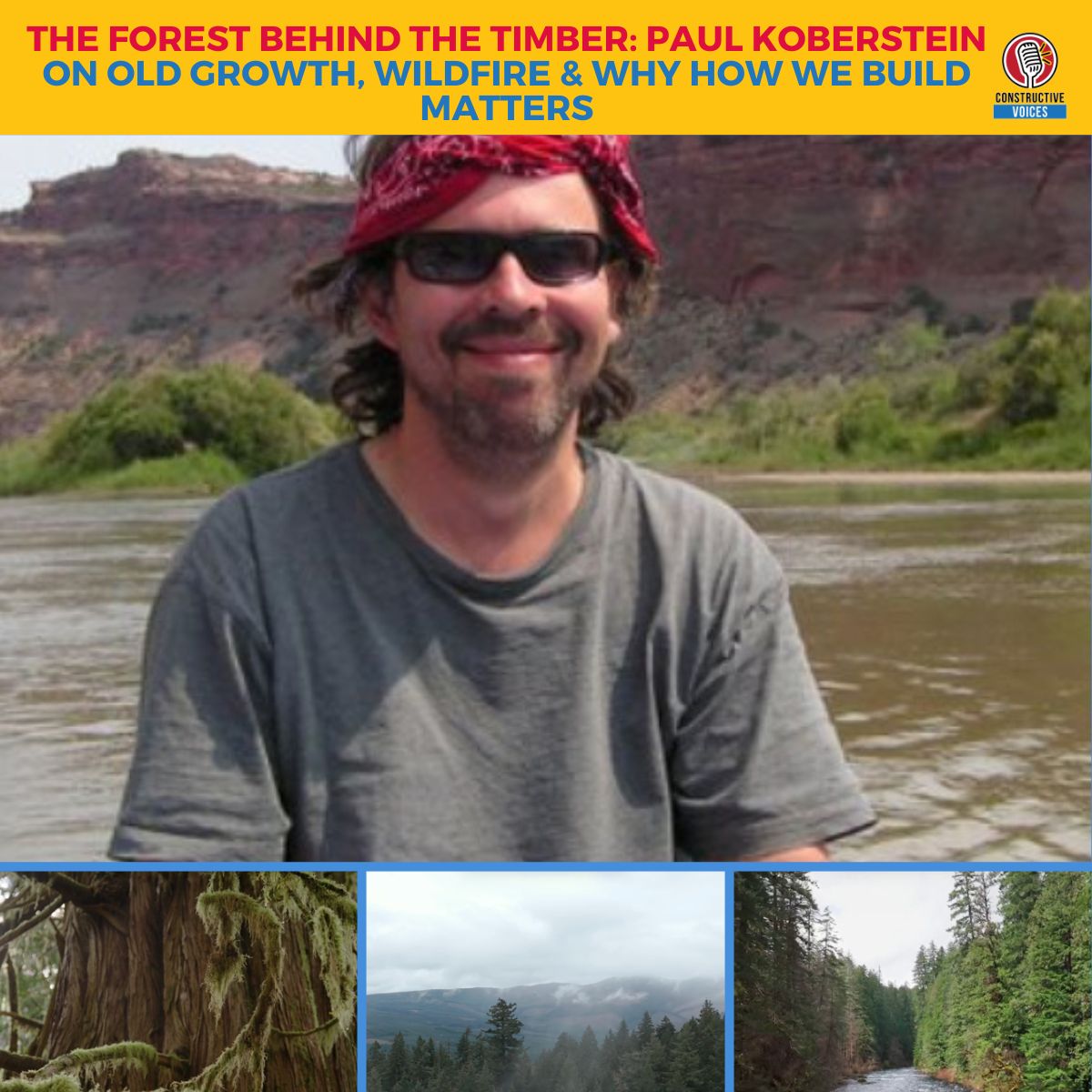
[00:00:15]Jackie De Burca: In this episode of Constructive Voices, we step outside the building site and into the forest, because the two are far more connected than they may first appear. The built environment is under pressure to reduce its carbon footprint. Timber, and especially mass timber, is increasingly being promoted as part of that solution. Around the world, architects, engineers and governments are looking at wood as a lower carbon alternative to steel and concrete. But there is a harder question behind the promise of timber construction. Where does this wood come from? A building material can only be truly sustainable if the forest behind it is protected, restored and responsibly managed. A young plantation is not the same as an ancient forest. And replanting trees is not the same as preserving the carbon, biodiversity, water systems and cultural value of old growth ecosystems. So today I'm joined by Paul Koberstein, an environmental journalist and co author of Canopy of the Life and Times of the Great North American Temperate Rainforest. Now, Paul's work explores why old forests are not just scenery, not just timber and not just wilderness. They are living climate systems. In our conversation, we discuss why old growth forests matter, how industrial logging is being reframed as wildfire prevention, what the Trump administration's forest agenda could mean for millions of acres of public land, and why the construction sector needs to ask much deeper questions about the timber it uses. Because if forests are one of our strongest natural defences against climate change, then how we build and what we build with becomes part of the same story.
[00:02:04]Voice Over: This is constructive voices around the world. Timber is being repositioned as one of the most important materials in the future of low carbon construction. This is not just about traditional timber frame homes. It is about engineered wood products such as cross laminated timber, Glulam and laminated veneer lumber. Materials that can be strong enough for offices, schools, apartment blocks and even high rise buildings. The United Nations Environment Program has argued that the construction sector needs to shift towards ethically and sustainably sourced bio based materials, including timber and bamboo. UNEP says that in many regions, properly managed bio based materials could help deliver emissions savings of up to 40% in the building sector by 2050.
Governments are also beginning to treat timber as part of climate and housing policy.
The UK's timber and construction Roadmap describes timber as a renewable low carbon resource with potential to reduce emissions, create jobs and help deliver homes. But it also stresses the need for sustainable homegrown timber supply because simply increasing demand for wood without thinking about forests would be a dangerous mistake.
Across Europe, mass timber has already moved from experiment to mainstream demonstration.
Notable examples include HOHO Wien in Vienna, De Karel Doorman in Rotterdam, Sara Kulturhus in Sweden, and major new timber led urban projects in Stockholm. So the promise is real timber can store carbon, reduce reliance on concrete and steel and support faster, cleaner construction. But that promise only holds if the timber comes from forests managed for carbon, biodiversity, water, local communities and future generations, not simply for extraction.
[00:04:10]Jackie De Burca: And I'm with Paul Koberstein. I've recently read his book, which is a really amazing book called Canopy of Titans. Canopy of Titans and why Old Forests Matter. Paul, would you like to introduce yourself just a little bit of your background on why you wrote the book?
[00:04:27]Paul Koberstein: Well, sure. And thank you for inviting me to your show. I appreciate that. I am in Portland, Oregon, on the west coast of North America in the United States.
I wrote the book with a woman here in Portland, Iska Applegate, to actually it was an investigative project to find out what can these big trees we have here on the west coast of North America can they do for the climate.
It was very much a learning adventure for the both of us. We found out a lot of things and I appreciate your kind words about the book. It's great to hear.
[00:05:00]Jackie De Burca: Okay, now Paul, you have obviously a big background in journalism prior to writing the book or sort of overlapping with that. Can you tell the listeners a little bit about that, please?
[00:05:11]Paul Koberstein: Well, sure. I have always been a journalist, so the only thing I know how to do is write. A lot of my friends can attest to that.
I've been, I've been a journalist in Portland for gosh, 40 years. And so that'll take me back to the 1980s, early 1980s. I was originally a reporter for the Oregonian in Portland, Oregon, and as an environmental journalist here. And the Oregonian is the biggest newspaper in Oregon. So from there I've been an editor of my own. I founded a publication called Cascadia Times, an environmental journal based here. And we cover regional environmental issues, trees, forest, salmon, energy and so on, all the big issues. So I've been writing about these things for a very long time.
[00:05:58]Jackie De Burca: Fantastic. So you're, I mean, apart from, you know, the achievement of the book that you've co written and that amazing background that you have, Paul, you're also going to bring us into some of the American perspectives as we have them currently right now in 2026. We're in the first half of 2026. But for listeners, Paul, who haven't as yet read your book Canopy of Titans, what actually is the great North American temperate Rainforest and, you know, why does it matter so much globally?
[00:06:27]Paul Koberstein: Oh, thank you for that question. I appreciate that. Canopy of Titans is a book that highlights the immense amount of carbon storage potential of the force in this region of the world, the Pacific Northwest and the science, why they are our best natural defense against climate change and fire and forest fires and so on. Older trees do so much for the planet, and this book is really a celebration of them and profiles them in terms of where they are, what they can do and how big they are. They're so big. The biggest trees in the world and stretching from for 2,500 miles north of San Francisco all the way into Alaska along the western ridge of the continent.
[00:07:13]Jackie De Burca: Fantastic. Now, of course, Constructive Voices is kind of like broadly known as a built environment podcast. But the further we've gone in, we're five years into doing the podcast and the articles and everything that we're doing, events and so on. The further we go into it, we obviously see everything is interlinked. And that is starting to begin to answered the question some listener might have. Why are we talking about a book like this at the moment? But we know very well it's all interlinked to climate change and many, many other issues of today. The book, obviously, Paul, it's about forests, but it also reads like it's an investigation into power extraction and political failure. When did you realize this was not just a nature story, but a political story?
[00:07:57]Paul Koberstein: Well, I have always been, in my career as a journalist, always been taking an investigative bent. I feel like the. The stories that really matter, the ones that the reporter has to do some good amount of digging. And there was a lot of digging that went into this book for sure. So we investigated the value of these trees and why they are the very, very best natural defense we have against the threats of climate change and the loss of biodiversity and fire. And we thought that that story resonated not just among people in our region, but globally. I'm glad to see that people in your neck of the woods are also interested in the value of these trees. And actually all trees, not just these in the Northwest, but certainly in Spain and Portugal and Europe and Australia. And it's really a celebration of the value that trees provide us more than we really know. They're not just scenery, they're actually doing really important work.
[00:08:51]Jackie De Burca: Okay, Paul. So just linking back into is always fascinating for me and I think lots of other people linking back into your own background as a younger person, did you have a great connection with trees in the past?
[00:09:04]Paul Koberstein: Well, I, I certainly did. You know, I grew up in this area. I remember my parents taking me on camping trips to places like Brighton Bush Hot Springs in the Cascade Mountains when I was a kid. I remember falling into the Brighton Bush river as a five year old and my father grabbing my, my me by the ankles and pulling me out of the, out of the drink while I was about to drown myself. So great memories of these, of these forests, but also traveling through these, this region, watching the tree farms, the clear cuts grow and grow year by year and feeling rather sad about the loss because what replaced the grand old forest was tree farms and small industrial looking plantations. They're so different. They're not for us really, just crops.
[00:09:56]Jackie De Burca: Okay. It's very logical, Paul, for I think the average person who doesn't read, you know, too much into these things, you know, to think, well, but they're planting trees here and that makes up for, you know, the other bad things that have happened. But this of course is not the truth as, as you know, the book makes very clear and you know very well. Let's just highlight, Paul, what can an old growth forest do as opposed to, you know, what we're talking about plantations for the likes of climate, water, biodiversity, fire, resilience and even culture, if you like, versus, you know, heavily managed timber landscapes?
[00:10:30]Paul Koberstein: Well, certainly, you know, just getting back to your previous point, I just want to make very clear that I'm not against logging per se. I'm just saying that these are the trees that we should protect. The old trees, the big trees, the trees that throw the most carbon there is.
The biodiversity aspect of them also is very important. They provide habitat that cannot be replaced by the tree farms. There's certain species, many species that rely on the dense, deep, immense forests that they involved in. And the tree farms are no replacement for the natural systems that we had here originally.
So, you know, the other part is water. Forests provide water. They store immense amount of water. They release gradually over the following months after a rainfall, snowpack certainly. So there's so many things that the forests do for us, not just provide lumber and wood for our homes and construction and so on.
[00:11:30]Jackie De Burca: Okay. I mean, I guess again, thinking of the audience, Paul, that we have, some will be very, very, you know, up and knowledgeable about biodiversity and all biodiversity related issues and some won't be. If you were, we'll say, going into, you know, I don't know exactly what you call it in the States, but you know, like in Ireland would be a junior school, you know, kids up to around the age of 10, if you had to go and explain to a classroom of kids of, you know, around that age group, what is it that these old forests do versus these new ones?
How would you put that across?
[00:12:04]Paul Koberstein: Yeah, yeah. In our region. Our children in our region are going to be very familiar with the things that thrive in our older forests, specifically salmon. We have the world's most vibrant, abundant salmon runs in the world, and those. Those evolved along with these forests, and they rely on each other. Actually, the forests provide great habitat, but also when the salmon. The salmon go out to the sea after spawning in the forest and come back in about three or four years, they bring nutrients from the ocean that they can't get anywhere else. And there's been a number of studies that show that trees that grow near a salmon spawning site grow three times faster than trees further away. So there's a symbiotic relationship between the habitat and the biodiversity, and it's. It's really a beautiful thing.
[00:12:52]Jackie De Burca: Okay. I mean, yeah, I totally get that. And that's. That's a great example, isn't it? Let's jump into a little bit of the political side, Paul. You've actually described the current direction of U.S. forest policy as a dismantling of conservation progress. How extreme is the Trump administration's forest agenda compared to previous eras?
[00:13:16] Speaker D: In the United States, this debate has become even more urgent under Donald Trump's second administration.
In March 2025, President Trump signed an executive order titled In Immediate Expansion of American Timber Production, calling for an expansion of American timber production.
The following month, the U.S. department of Agriculture announced an emergency situation determination covering 112,646,000 acres of national Forest system land. The USDA said this followed Trump's order to expand American timber production by 25% and would empower the Forest Service to expedite work on the ground.
Then, in June 2025, the USDA announced it was rescinding the 2001 roadless rule. That rule had restricted road construction, reconstruction, and timber harvest across large areas of the National Forest system.
The USDA said rescinding it would remove prohibitions on road construction and timber harvest on nearly 59 million acres of national forest land.
This matters because roads are often the first step in opening intact forest landscapes to industrial activity. And that is exactly the kind of policy direction Paul Koberstein is warning about in this conversation. A shift from forest protection towards extraction justified in the language of fire prevention, domestic production, and deregulation.
The forest policy sits inside a much wider climate context.
On his first day back in office, Trump ordered the United States to withdraw from the Paris agreement again.
In February 2026, the US Environmental Protection Agency finalized the rescission of the 2009 Greenhouse Gas Endangerment finding, the legal foundation that had allowed the EPA to regulate greenhouse gas emissions from vehicles under the Clean Air Act.
And all of this is happening as the climate signal becomes harder to ignore.
NASA confirmed that 2024 was the hottest year on record, with global temperatures about 1.47 degrees Celsius, warmer than the mid-19th century average.
So when we talk about timber, forests and construction, we are not talking about a niche material choice. We are talking about one of the defining tensions of the climate era, whether forests are treated as living climate systems or as raw material waiting to be extracted.
[00:15:49]Paul Koberstein: I would say it's not just extreme. They have dismantled so much of a century of progress on the conservation of our forests, and that is unfolding at an extremely rapid rate. For example, the Secretary of Agriculture, Agriculture, which is who is in charge of the forest, came out with a plan last year to thin over 100 million acres of these older forests. And that's in addition to another plan that you came out with to increase the logging effort by 25%.
The other component is that there's a large expanse of roadless areas or areas that have not been logged, not been roaded for log trucks.
These, they've been protected for.
We're talking about 50 million acres or so. 50 million acres. They've been protected since the Clinton administration around 1999. That is also being done. Done by the Trump administration is simply an. There's no end to the assault that is going on in our country against nature. And it's all we can do to fight back against that. As a journalist, my role is to report and inform, and I am trying to do that as best I can. But there are a lot of other people who are doing the same thing as journalists, as activists, as political operatives, and so on. So there's a. I guess what I'm saying is there's a tremendous resistance that is underway, but at this point, the Trump administration has about three more years to go in office, and there's no telling what further damage they're going to be able to do. And I'm rather fearful of what will happen.
[00:17:27]Jackie De Burca: I guess we all are, Paul, unfortunately, because as you know yourself very well, you know the Trump administration and lots of things that relate to climate change and biodiversity affects, you know, lots and lots of countries around the world. Unfortunately.
[00:17:41]Paul Koberstein: Well, you know, the Destruction of the environment that's going on in this country right now is really taking a back seat to all the other things that are happening that Trump is doing. And of course, that would include the war in Iran, his trade policies and so on that are very destructive and harmful to countries around the world. It's, it's, again, it's a tragedy that's unfolding right in front of our eyes in real time. It's the complete train wreck. There's no way to describe it really, but it's horrible.
[00:18:11]Jackie De Burca: As a journalist, and I know we're slightly going off track here, Paul, but as a journalist, are there many other, you know, of your fellow journalists and media people that, you know, that feel that there might be, as it goes into, you know, global media possibility that he isn't stable in his mind?
[00:18:30]Paul Koberstein: There's a constant chatter in the media about his mental state, that he's losing it, that he's, he's, he has some sort of form of dementia. I think there, there are people who are rooting for that process to, to speed along more rapidly than it is. But then on the other hand, there's also hope that there are people around him who could put the brakes on, on the things that are happening. And personally, I don't see that. I don't see a lot of people around the President who are adults in the room, so to speak. It's, it's, it's almost like there's actually no good news every day.
[00:19:04]Jackie De Burca: Yeah, it is. It's a particularly tough time. And obviously when you and I spoke, it was back towards the end of 2025, and we didn't have the Iran war at that stage. Obviously, that's been a huge game changer. You know, in Europe, of course, we have the big effects of the, of the fuel increases. I was in Ireland at the time where there was a lot of, I don't know if you would have seen it in the media in the States, but there was a lot of protest trucks, trucks protesting, blocking places around Dublin, the capital city. So all of these things are having all sorts of knock on effect on people's lives. But of course, at the same time, climate change.
[00:19:39]Paul Koberstein: Right. And before Iran, you will recall that Trump invaded Venezuela and I'm not sure that went really well. And now he's talking about his next target be Cuba. So really, who knows what's going to happen kind of in that never ending, never ending the salt on the things that you and I value. And that's the real tragedy here. I know that your program tries to be nature positive. I really appreciate that. I agree with that fully. But we also have to have our eyes wide open to see and witness what's really happening and to be honest about it all. And that's really the challenge.
[00:20:14]Jackie De Burca: Definitely, Paul. It is a huge challenge. And it's really hard to, I guess, you know, try to put much into words, except for, I imagine you might feel a little bit similar to myself in the sense of, you know, you're working on another book, you're obviously producing important research and material and putting it out there that I guess you feel. And that's maybe some tiny little comfort to you that you're doing, you know, playing your little part of trying to bring out important information.
[00:20:41]Paul Koberstein: We all have to do what we can. You're doing, obviously, a very important role as well, communicating the information and synthesizing it so people can grasp what's going on. And that's, that's the challenge itself.
The, the administration here, the Trump administration, is very secretive with many things it's doing. It's also attacking journalists. Announcement yesterday, a Pulitzer Prize, where it was one of the Pulitzer Prize I was awarded, was awarded to a journalist with the Washington Post who had, who had a list of a thousand sources that she had been working with, with inside the Trump administration. These were sources who were, who were telling her things that the administration did not want to get out. One day, one night, actually, early in the morning, like 5am they knocked on her door, the FBI did, and seized her cell phone, her laptop, her computers, everything, trying to find out who these 1,000 sources were. And fortunately, the courts have stood in the administrative, in the administration's way and are blocking any attempt to access those devices. But there's a real need for brave people in this country right now to stand up to this administration, to be. Frankly, there are not enough people who are doing that. But this one reporter with the, with the Washington Post, her name, I think is Hannah, and I can't remember her last name. She did, and she's paying the price for it. I guess that when they took her laptop, they took her wedding plans. So, so another downside of being a journalist is you also have to live a real life. And sometimes when you are putting yourself in the, in the public AI like this, your personal life and your professional life collide and makes it really difficult.
[00:22:25]Jackie De Burca: Yeah, for sure, for sure. But it's kind of extreme to hear, but not surprising, sadly. Paul, you know, what you've just said about Hannah, I hope she had her all her information backed up somewhere that can't be easily traced. That's the obvious, obvious kind of reaction to that. Let's go back to, you know, what you said earlier on, Paul, about the administration obviously has pushed for a 25% increase in timber production and all an emergency mandate affecting more than 112 million acres of national forest land. What does that really mean on the ground?
[00:22:58]Paul Koberstein: What it means is just a whole bunch of logging that will rip apart many or most of these ecosystems. When you cut a, when you log a forest, especially some of these areas that are unroaded, you have to build a logging road that requires invading the habitat of these species and to run a log truck through. So there's a lot of impacts, not just logging, not just cutting down trees that are going to ensue and fearful that this is going to lead to more invasive species coming into our forest.
These logging roads can be pathways for unwanted species, alien species that can disrupt and tear apart our ecosystems. And this is already happening, right?
[00:23:47]Jackie De Burca: I mean, yes, it's pretty disastrous, to say the least. The removal, Paul, of roadless area protections is particularly significant.
Why are roads often the beginning of the end for like an intact forest ecosystems?
[00:24:02]Paul Koberstein: Well, roads, roads are the pathway for a logging tracker or anyone really to go in and take out, extract trees, extract minerals or whatever you want to get or, you know, even hunting. There are pathways for people to go in, other things to go in. So the roads are the first step in a process of destruction of a natural forest. And the argument I make in the book getting back to Kennedy of Titans, is that an intact forest, a natural forest that has not been logged, stores much more carbon than one that is a tree farm or a younger forest. The older trees, they are bigger, they store more carbon and they are adding more carbon every day, sucking it out of the, out of the air.
And as you know, that carbon is what is causing the planet to heat up and the sea levels to rise. And we can talk about fire too, which is the subject of my next book.
[00:25:00]Jackie De Burca: You know, the sad thing on top of everything we've discussed just now is it's often presented as a wildfire prevention. And I think in your view is wildfire being used as like a political cover for a much larger industrial logging agenda Poll.
[00:25:16]Paul Koberstein: It really is with the administration wants to do is thin 112 million million acres across the country as a way to reduce fuel that they think will reduce the risk of wildfire. The science I've read shows that thinning opens up the canopy. It Allows more sunlight into the forest and wind to reach the forest floor to dry out the woods and create a wind tunnel effect that can actually accelerate fire, spread it.
I mean, there's, there are ways to do things to restore, but the idea afoot is to basically to do industrial logging, and it's all about, pretty much about profits, about extraction.
[00:25:58]Jackie De Burca: Indeed. And what about the Fix Our Forests Act? You know, kind of sounds reassuring, Paul, but does the title of it kind of conceal something, do you think?
[00:26:07]Paul Koberstein: Well, I'm not sure what they're going to be fixing. That's my, my question. We did some math and, and it really surprised me. The Fix Our Forest act would basically embody into law the 112 million acre plan that the Trump administration had embarked on and would basically set that in motion for forever. We did some math. And what would this cost? What would it cost to thin 112 million acres? How often do you have to thin it for us to keep it safe and, and secure? The numbers we came up with there are pretty staggering. We calculated that, actually the Forest Service calculates that it costs about $3,500 each acre to thin an acre of forest times 112 million. And you're talking well into the billions and billions of dollars. $300 billion. But that's not it.
[00:27:03]Jackie De Burca: Yeah, shocking.
[00:27:04]Paul Koberstein: It's more than that. You have to thin the forest every 10 to 15 years. You have to maintain the. If you want to reduce the fuel, you have to keep doing it again and again because forests grow back probably five or six or seven times a century. So if you extrapolate that $300 billion cost over a century, you're looking at in the neighborhood of $2 trillion. And no one's really paying attention to this price tag. They're saying we need to thin the forest to protect the communities around the forest. Well, and how much is it going to cost? Well, they even get to that. They don't even talk about the cost. So we, we're going to publish this soon in Australia I've recently been working on in a magazine here on the West Coast. But this cost is simply staggering. There are so many other needs that are, you know, real. We have huge problems with homelessness and other social problems that really need funding. And to divert $2 trillion to something that is not going to solve any problems other than the bottom line of an industry makes absolutely no sense.
[00:28:11]Jackie De Burca: Yeah, no, I totally agree.
[00:28:13]Paul Koberstein: That's my point of view.
[00:28:14]Jackie De Burca: So, Paul, with, you know, all the knowledge and the research that you've done, what would a genuinely science based forest fire policy look like instead of what they're proposing?
[00:28:25]Paul Koberstein: That is a good question. I think that you have different types of forests that probably each require a different approach. The scientists I talk to and respect the most say the forests that you need to protect are the old mature forests and old growth forests. And you can do your thinning, do your logging in the tree farms, tree plantations. If you do that, you'll get all the timber you need for all the wood products that you need. But if you protect the older forests, that is the key. And those are the, as I said, those are the forests that store the most carbon. Now, as far as a fire policy, same thing. Protect the old forests, thin the younger ones. And then you have to be aware of what happens to the communities that have grown up, sprouted up around the forest. People love to live in a forest or live near the forest. And it's an area that is of great concern because these are the communities that get burned down or get torched by wildfire. The solution is to harden these homes, to use non flammable material to build your roof, your deck, and to also keep wood, woody debris, firewood away from the house.
If you live in one of these areas, and there's about 150 million people in this country that live in these wooded areas, including me, I live in here. I actually live in a forest. And you know, we have, we have to take care to make sure that we don't leave a lot of woody debris around the house in case a fire comes through our area.
I mean, this is, it's just being just common sense. I think that. And the Forest Services data also shows this is the best way to go. But hardening your homes does not help a timber company make profits. And I guess that's, that's the deciding factor as far as the policymakers are concerned. They will do what the industry wants rather than what makes the most common sense for the public.
[00:30:22]Jackie De Burca: Sure, Paul, and you mentioned during our research phase a word that I don't think I can even pronounce, but I will try Pyrocumulanimbus. No, I didn't think, I don't think I said that very well. For short, pyro cbs, which is basically like wildfires creating their own weather. Let's, let's just talk about that because I had never heard the term before. What, what exactly are they?
[00:30:45]Paul Koberstein: Yeah, we're talking about a type of fire that probably the most violent fire that you can have is called a pyro. Cumul.
You're right, I can't even say it.
Or pyro cd.
[00:30:59]Jackie De Burca: It's a bit of a mouthful.
[00:31:01]Paul Koberstein: It is a mouthful. What it is, we'll go with the short.
[00:31:04]Jackie De Burca: The short Pyro CBS is good.
[00:31:06]Paul Koberstein: Pyro cbs. And these are.
In certain conditions, a fire will rise up and start sending a plume of smoke towards the stratosphere. I mean, these plumes are violent updrafts that exceed 100 miles per hour in speed.
And they're happening all over the world. Since 19, I mean, sorry, 13. There have been over a thousand of them on every continent except for Antarctica. In fact, there's been a number of them in Europe and especially in Spain. There's a database that's been published by the U.S. navy Research Lab that showed that the location and the severity of all of these pyro CBs and there's been a number of them in Spain and Portugal. For example, in 2022, there was a series of Pyro CBs in the Laseo area near the Spain and Portugal border. There's like eight of them in a single month in August 2025. So these, these pyro CVs go up to the stratosphere, which is about, I'm going to say, 46,000ft. 40 to 46,000ft. The beginning of the stratosphere. Don't hold me to that. I mean, they're way up there and there's a barrier between the lower part of the atmosphere, the troposphere, which is where we live, and where all the weather is in the stratosphere. And these pyropods are able to break that barrier and spew smoke and ash into the stratosphere, which then circles the globe and adds to global warming. It can linger there for months and alter weather patterns and all caused by these fires. It's an amazing physics that's involved. And add one more thing. There's a. Probably the most well known outbreak of these pyro CBs was in Australia in 2019. 2020, during Australia's Black summer. You may have had shows on this, but the fires are so bad that it triggered smoke alarms in homes in Sydney, Australia. There are 38, 38 of them in one season in their summer and injected millions and millions of tons of smoke and water vapor into the stratosphere. If you can imagine a fire pulverizing an entire forest and launching it all into the stratosphere, an amazing amount of energy that has to go into that. I can't even imagine. I Can't fathom, but it's one of the most spectacular and horrific events that can occur on our planet, and very few people know about it. And they're happening more and more frequently. These pyro seabees, by the way, also spawn something called fire tornadoes, which are tornadoes, but not just wind. They're flames whirling around and. And carrying with them all this sand and rocks and other debris. They actually shred for us rather than just burn them. And those are increasing as well as a result of climate change.
[00:34:14]Jackie De Burca: Yeah, yeah, it's pretty scary, to say the very least, obviously. And as some people know, I'm based myself in Spain. My partner is actually from Portugal, and I also have a very close friend of mine who lost somebody in a wildfire in Greece, lost her husband in front of her eyes. So it's, it's, you know, kind of close to home.
So, Paul, obviously you've mentioned, you know, the spectacular but horrific nature, which are two amazing words, you know, so well chosen for pyro cbs. Why are they also so dangerous for firefighters and for the communities on the ground?
[00:34:50]Paul Koberstein: Well, I think that the most dangerous thing that they do, besides spawning these fire tornadoes, which are by themselves a completely new category of horror, is they will pick up burning pieces of wood and send them up high up into the air and then spit them out several miles into the distance. And from there, they cause new fires. One fire scientist called them a hurricane of embers, which is really kind of what it does. And we've seen fires that spit embers 4, 5, 6 miles into the distance. And they, of course, land on rooftops and other structures and cause communities, entire communities to burn down. This is what happened and has happened a number of times here in the United States. And I know that the Locaccio fire, I believe, resulted in four fatalities and the evacuation of 28 villages in that area near the Spain Portugal border, in the northern part of Portugal. So this horror is real and is devastating people's lives and communities all around the world. It's pretty much. I mean, the link between these fires and climate change is pretty solid. Climate change will dry out a forest and it'll dry faster within it, but that's another story. Climate change dries in the forest, and the forest is primed for a spark. And it gets a spark either by lightning or by, you know, somebody tossing a cigarette, it'll burn. It'll burn fast and burn hot. The hotter it gets, the greater the chance it'll. It'll trigger one of these pyro CBS and, and you know, the, that escalates from there. This is the world we've created.
[00:36:29]Jackie De Burca: I know, I know. There's so much scary, you know, data obviously that you provided and that's out there obviously, you know, in the public domain. Just going back to the US though, Paul, for a second also, you know, there's been hundreds of piracy B events recorded there. Just taking care. California itself has seen at the moment about over 100. What has changed in California's fire regime.
[00:36:52]Paul Koberstein: Climate change is definitely affecting California. It is hotter, the fire season is longer, the amount of moisture in the vegetation is lower. And the other thing that climate change does, and people don't really see this, but it causes massive changes in the global atmosphere. For example, the jet stream can stall and cause weather systems, heat domes, to park over regions and then the temperature can really spike from there. In Oregon in 2021, and I write about this in the book, we had a heat dome over the Pacific Northwest here and in Portland, where I live, which has got up to about 124 degrees Fahrenheit, which is enormously hot. I mean, we very rarely get days over 100. A day of 124 is. Well, I tried to walk down the street that day and I made it like three houses down. I had to come back. It just was too bloody hot.
[00:37:50]Jackie De Burca: Yeah, I can imagine, I can imagine.
[00:37:52]Paul Koberstein: But this is, this is what is happening, what the climate is doing. Shifting planetary mechanisms like El Ninya and there's something in the Indian Ocean that actually affects the weather in the UK and in Spain called the Indian Ocean dipole, which is responsible for monsoons that keep India and Southeast Asia really moist. When it starts acting up, turns off that the spigot, the monsoons stop coming and the fires start getting hotter and burn more rapidly. And this is actually what caused the black summer in Australia in 2019. So these mechanisms are very complicated, but it's all linked back to climate change. I mean, not to get too technical, but with your audience, but there's something called the adiabatic hammer, which is a, a weather phenomena that causes some of these systems to air systems, to, to stay in place and to increase temperatures, decrease humidity. And these forces that I just don't, haven't really understood before, before I started doing my reporting. These forces are, are changing people's lives. They're changing the planet. In other words, change is not just a graph showing hotter temperatures and more higher concentrations of carbon dioxide in the air. It's far more than that. It's these basic weather systems that are changing. The jet stream is another example. I mentioned that in 2022, the jet stream stalled over China and there's a huge drought affecting the entire interior of China that just devastated huge areas of that country.
You know, you don't hear much about what's going on worldwide. What I discovered is that climate change is something that will hit. Hit and run, hit and run villain, if you will. It'll make mischief one part of the world and then shift to another part of the world to do the same thing.
The toll is just escalating.
[00:40:06]Jackie De Burca: Sure. I mean, one of the things that this. There's so much. I mean, of. Of course, the unfortunate thing is that there's so much data that we could discuss because it is humongous already at this stage and unfortunately worse than the experts predicted. You know, which isn't good news at all. But going back to, to the fire seasons that we've talked about in various places and you know, piracy bees and so on calendar in 2023 produced a record number of piracy bees, which actually sent smoke across North America, which is obviously huge. Are governments still underestimating Paul wildfire smoke as a public health and climate threat?
[00:40:46]Paul Koberstein: Oh, my God, yes, they are. You know, you mentioned Canada. There's an interesting story. In 1950, the first recorded pyro CB occurred in in Canada, north of Edmonton in Alberta, and that caused the skies on the east coast of New York to turn black. And in Europe as well, it turned the sky, the moon and all the stars a sapphire blue. For technical reasons, this occurred.
[00:41:14]Jackie De Burca: Okay, okay.
[00:41:16]Paul Koberstein: And so this has been going on for quite a while. And it wasn't until about 2000, 2001 finally figured it out that it's wildfire that is doing this and pyropiece sea beast that is doing this and causing all the smoke to go obscure the sun and also to get hurled into the stratosphere. And we're just now starting to really understand what's going on. The US Navy is leading a massive research project to try to figure out what's going on with this.
[00:41:48]Jackie De Burca: Okay, and what about. You know, you've obviously touched a fair bit on Europe, particularly Spain and Portugal. You know, with a lot of the fire behavior here. What do you think it means ROCB events that have begun appearing in Mediterranean Europe?
[00:42:05]Paul Koberstein: Well, I think people need to protect themselves. People need to. If they are living near a forest, people need to protect themselves. There's really nothing you can do other than to hit the reverse button on climate change. That would be really a good solution to out burning fossil fuels. But in the meantime, protect yourself. I mean, because when the embers start flying, they'll land on your rooftop and it will burn. It'll get idiotic and then all will be lost. You need to, if you live near a forest, figure out what are the weak spots in your home that can trigger a catastrophe.
[00:42:41]Jackie De Burca: You're sort of bringing it back down to individual people and communities to kind of watch out for themselves. Am I right?
[00:42:46]Paul Koberstein: Well, I think that government can certainly step in and to encourage people to, to do these things. The government instead is encouraging the logging of forests rather than the steps that can actually protect people. And that's a tragedy itself. So much money is being spent on solutions that don't work, that actually enrich people, but enrich corporations, but do nothing to protect the common person or towns or communities. And I think these are policies that need to be really looked at and changed.
[00:43:15]Jackie De Burca: Obviously in the built environment, timber is, you know, a big player, probably more so in the States, I think, than Europe. But also it's a big player here in Europe and the timber industry. Paul, you know, as we discussed earlier on in our conversation, often claims that, you know, cutting down the trees and replanting them is climate friendly. But let's look at exactly what does that argument leave out.
[00:43:38]Paul Koberstein: Yeah, you know, that argument is also made here in the United States was that there's a group of timber industry corporations that are, have been running these television ads that say, you know, for every tree, every old tree, every big old tree they cut down, they will plant three new ones. What they don't say is that those three little trees won't store as much carbon as that big tree that got down for a hundred years. And in the meantime, the clemence is, is, is worse off because of it. So they, they leave out the facts. They leave out only the one, they only mention the things that sound like a solution, but they really aren't. And you're touching on a really good point. This is not just a matter of forest policy. It's also a matter of public relations and communication. Misinformation that we're getting from this industry is as horrific as anything that they're doing on the ground.
Mind boggling the BS that they spew.
I guess I probably shouldn't say that, but no, feel my point, my point is that the misinformation game is just as horrific as the actual logging in my view.
[00:44:50]Jackie De Burca: And unfortunately, the more tough economically the world gets, and I'm going to refer back to, you know, I know it's only one part of the jigsaw, there's many, many more. But I'm going to refer back to the effects of the Iran war on an already very volatile world. And unfortunately, the more of these things that are happening, your average Joe or Mary or, you know, whatever you want to call the average person who goes and does a job in, you know, on a construction site, in an office or in a shop or whatever, they don't have the headspace to decipher in the same way as they would have had when they had less financial pressure before.
[00:45:26]Paul Koberstein: Of course they don't. And that is, that is the game that is being played. The worker is going to. And you can't blame the worker for what's going on at all. They are subject to the same economic realities that everybody else is, and the industries will take advantage of this and simply impose policies that don't look at things in the broader picture.
[00:45:46]Jackie De Burca: Absolutely. You know, between misinformation and disastrous people, you know, in governments, I'm not going to point at any particular, you know, it's not, it's not one place or another place.
Some are maybe more in the media than others between all of these different ingredients.
What's very, very scary, Paul, is we don't actually have time. So whilst, you know, as you say correctly, it's the industries, it's the governments, it's misinformation, but in the meantime, the clockers are ticking.
[00:46:14]Paul Koberstein: Isn't is. And it is so hard to stay, as you, as you put it, to stay nature positive, because you see so much of this going on and it's not, it's not reversing, it's not getting better, it's getting worse. And since Trump took office, at least in this country, the.
It's accelerating and it is just very dismaying to me to see this happening. And I think the solution, again gets back to we all individually do what we can and hope that things will change. But hope isn't a very good strategy. You know, you really need action and the opportunities for action at this point are very limited.
[00:46:54]Jackie De Burca: I mean, there are some good, you know, there's many, many good things happening. For example, because of the, you know, because of the issue with fossil fuels, more recently, of course, that kicked off originally with Ukraine and, you know, more recently with, with Iran. You know, there is now a bit of a sort of a scamper towards renewables. So, you know, maybe will go, you know, will actually do some good. So that's that's one thing that could work out quite positively out of really horrific situations. But I guess when I think about your book, Paul, obviously that you've co written, I really, I suppose I digested huge amounts of information, wonderful information.
And one of the questions that came into my mind was really, shouldn't mature and old growth forests be treated kind of like critical climate infrastructure, just as we do with the likes of wetlands or coral reefs?
[00:47:45]Paul Koberstein: That is the argument in the book. I mean certainly they're as important as coral reefs or wetlands or a number of other ecosystems.
The difference between a coral reef and a ogle forest is that you can't cut down a coral reef and sell it on the market. And Dallas, for board feet or a wetland, you can't do that either. But a tree, a big tree, that's money, that is profits for a company that wants to lock it. It's simple as that. So you, you're arguing against capitalism when you are making that argument. And you know, and Naomi Klein, I don't know if you read her books, but she makes an argument that is very resonant that capitalism and climate change are, you can solve climate change within the constraints of capitalism. At least that's her argument. And it makes a lot of sense.
It's, it's a, I don't know how to fix this, but that is the question of our age is how to, how, how to have an economy, thriving economy. Is this with a, an environment that is safe and sound and a climate that is actually not going to kill us?
[00:48:59]Jackie De Burca: Sure. I know it's huge. It's absolutely huge.
Going back, I suppose going back to canopy of Titans. Do you feel, Paul, because that's your, you know, it's one of your parts of the jigsaw that, you know, you've done so well and you're carrying on your work and obviously, you know, you're writing another book right now. Do you feel that it has had at least a percentage of the desired effect that you intended for it to have?
[00:49:27]Paul Koberstein: I don't know that it's going to protect any big stretcher for us, but I do know that it has triggered a lot of conversation.
I've been invited onto a lot of podcasts like yours sounded as good as yours. But there are, there is certainly a conversation, there is certainly a conversation that's going on that we've been part of and that is encouraging to see. There's a lot of activism that's going on here in the United States on behalf of protecting mature old growth forests as a climate refuge. And that's encouraging to see. I had this one conversation with a podcaster some time ago. He said when he picked up my book that he thought it was going to be all doom and gloom and the world is coming to an end, all that. Instead, he said, it's a hopeful book because it's about a solution. There is a solution that we talk about in this book, and it is a doable solution.
It runs contrary to what other people want to do, but it is actually a way forward. And that's what we were hoping, we were trying to illuminate is a way forward that does not just include. I mean, certainly we have to stop burning fossil fuels. You know, you mentioned the Iran one. Let me just kind of digress for a moment. There's a lot of people are fearful of gasoline prices. Oh, they're $4 a gallon. No, they're $5 a gallon, $6 a gallon gasoline is coming. I'm not sure how that translates to liters, but bear with me, that's okay. Higher, higher gasoline prices probably translates into less consumption, and that's a good thing. Right. So if we have higher gasoline prices as a, as a result of the Iran war, I'm not saying it's worth it, but that's certainly an outcome that I can get behind.
[00:51:13]Jackie De Burca: Sure. And it's just like what I said earlier on about, you know, the possible speed up on renewals of renewables. Of course, there are some, you know, potential and interesting positives, but nobody, of course, nobody wanted them to come out of a situation like this. Of course not. Paul, do you feel the attack on forests, you know, it's almost like an attack on public participation, you know, community, environmental law and democracy.
[00:51:41]Paul Koberstein: Well, one of the, you mentioned the Fix Our Forest Act. One of the things that is a part of that is a staggering of public participation. You know, we have a great tradition in this country of people participating in decisions regarding natural resources, our forests. There's a process that involves the public, public hearings, public comment. This act, Fix Our Forest act, would diminish that and reduce the ability of people to go to court to, to try to stop illegal or harmful logging projects or any kind of other project. So you have not just the logging is being accelerated, you're having a decrease in the amount of participation.
You know, there's something called the precautionary principle, which means that, which says that before you act, before you cut down a force, before you build the dam, you have to figure out what the impacts are first to See if that is actually worth doing. Part of this fix our Force act would pretty much enable government agencies to leap forward first before assessing all the facts, before gathering all the information, before hearing all the comments from people who have a concern. So it's definitely more than just an attack on our forces, an attack on democracy.
[00:52:56]Jackie De Burca: Okay. And who, going back to, you know, something that's been mentioned throughout our conversation, but just to sort of not wrap up the whole conversation, but to put it there towards the end of our conversation, who benefits economically from this new forest policy poll and who carries the ecological, health, carbon and community costs?
[00:53:15]Paul Koberstein: Well, I think that the number one beneficiary of this policy has got to be the timber companies. Companies like Weyerhaeuser and Sierra Pacific Inc. And so on. Companies that are based in the United States.
So they are certainly standing in line to benefit the people who live near forests who are, you know, potentially going to have their community facing a wildfire. Not so much. I mean, they're going to have problems if the forest is becoming less resilient to wildfire as a result of some of these logging practices. And although the timber industry will say we're protecting these communities by doing these things entirely, the opposite is happening. That's the tragedy. The utter bullshit that's going on that's going out from these companies and, and the government agencies that enable them is mind boggling to me.
[00:54:13]Jackie De Burca: Yeah, absolutely. And let's just revisit very, very quickly. Paul, you mentioned what are the Navy doing? Because that's interesting. They're obviously doing some good.
[00:54:22]Paul Koberstein: Yeah. I was talking about a project by a group called the US Naval Research Lab and they're doing that in collaboration with NASA using space satellites and imaging technology to study these pyro CB firestorms and to understand what they are doing and how they're affecting the climate and exacerbating global warming. And they've been around for a long time. I think each of the military services in this country, at least I know they Air Force has a research lab as well where they do research that can study the environment to I guess maybe for military purposes. I'm not sure exactly why they do it, but I am assuming that's why to understand these, for example, in this case, to understand these pyro CBs to figure out what they're doing, how they could affect or interfere with certain military operations or any other kind of planetary system and to, to do something, see what can be done about them. And so far as I know, they're still in the early stage, they've just basically only gone to the extent of catalog, cataloging the ones that have occurred and inventorying them and finding out how much soot and ash and smoke and whatever they else they've hurled into the stratosphere. How much is up there?
Little math. I did a little more math and I found, figured out that a series of five pyro CBs I looked at in Canada and in the United States, 300,000 metric tons of material was sent into the stratosphere. Now, if you figure that each Douglas fir, 100-year-old Douglas fir is going to weigh about one ton. So 300,000 tons of this stuff, of this material, this burning biomass into the stratosphere is the rough equivalent of sending entire forests into the end of the stratosphere. 300,000 trees, an entire forest. And it's, it's, that is an amazing amount. So over the 12 years of this study, about 1,000 pyro CBs have hurled almost 20 million metric tons of woody debris burning biomass into the stratosphere. If you think about that as 20 million trees, you're not too far off. And of course, of course it's all pulverized and much grastropic particles and I mean, if you brought them down to Earth and piled it onto the island of Manhattan, New York, you would cover the entire, you would pave the entire island with about a foot of thick black carbon. That's how much is up in the stratosphere from these pyrocbase alone. That can give you an idea.
[00:56:55]Jackie De Burca: Yeah, that's obviously utterly shocking and really, really scary to think about. Paul, we've talked obviously in depth, you know, about aspects of your book tying into today's, you know, political situation, the world as it is, climate change and so on. It is without doubt a very, very difficult time. What is it that gives you hope, though, in this particular moment?
[00:57:20]Paul Koberstein: I guess my grandkids, I mean my, I have four grandchildren and they're ages from like one to, to nine. They're all young. So my hope is that they have a planet that is actually going to be there when they get older and that they can not just survive but thrive and not have to face these nuclear winter scenarios that I've been talking about. Scary stuff, but, you know, hope that, that they don't have to deal with this and then we can find a solution before too long. I'm not exactly sanguine about it because I don't think too much is happening. Whatever is happening is not happening, happening Very fast.
It's going very rapidly in the opposite direction, to be honest.
[00:58:03]Jackie De Burca: Yeah, I know, I know. Okay. I mean, I think there's loads of parents and grandparents will absolutely relate to what you've just said, Paul. And that's something that, you know, once again, going back to whatever role each person themselves feel that they can or are driven to do or feel that they can do, that, you know, that is, that is absolutely something.
If listeners, Paul, were just to take away one kind of central message from canopy of Titans. What, what should that be?
[00:58:28]Paul Koberstein: I would say that the forests are probably the most important ecosystem on Earth and that they are at the forefront of fighting climate change. And as well as doing many other things, forests like, you know, protecting our water, giving us food and housing, and just walking through a forest, the Santa of pine and cedar and. And fir. And at least in our forests, it's a source of inspiration and wonder and beauty. You mentioned, you asked me about what gives me hope.
You know, just the experience of being in a forest is a source of hope for me that this magnificent ecosystem, this magnificent creature, the tree, exists and does so many things for us. And the inspiration it gives us as well, that is the takeaway I would say I would like to leave with people who read my book, is that these trees are actually absolutely wonderful beings of nature.
[00:59:28]Jackie De Burca: Yeah, I 100%, 200% agree, Paul, with that.
You know, forests themselves are magical. Magical. The trees within them are magical. If you just take that by itself, it's enough. But finally, if old forests, Paul, are not just scenery or timber, but living climate systems, as you've just explained so well, is the fight for old growth forests one of the defining climate fights of our time, do you think?
[00:59:54]Paul Koberstein: I think it is. I mean, I think that it's a fight that is at the beginning stages. The United Nations Intergovernmental Panel on Climate Change has only recently recognized the reason, the value of protecting these older forests. They put out a statement in 2022 to the fact that it's really not found its way into policy, but at least the science is very clear that protecting old forests is definitely a solution and we need to pay attention to it. As with everything with policies, it takes a while for policies to catch up with the science. And it's certainly in this case that that's happening. We'd like to see it happening more quickly. The Council of the Committee of Parties. The Council of Parties, the COP meets every year and this year they're meeting in Turkey. Hopefully they'll take some more action. On what many people call these natural climate solutions, rather than just trying to. I mean, we need to stop burning fossil fuels, and that is absolutely the case. But if that's all we do, we're not going to solve climate change. We need to also do something about the legacy of carbon that we've put on into the air over the last 300 years. And the only thing that can do that is trees. And let me just add one other thing. A lot of companies like oil companies, Chevron, BP and so on are saying, well, let's develop a technology that can do this, that we can push a button and the carbon in the atmosphere will automatically disappear. And they're investing hundreds of billions of dollars to find this technology. And so far they've been able to remove about 1/10 of 1% of annual emissions, which is not even a drop in the bucket. So a technological solution to climate change is not happening. And we should forget about the idea that it might. But we have a solution that is already here. It's already doing the work that needs to be done. And all we have to do is let them complete the job. All we have to do is protect these trees. We need trees, we need toilet paper, we need wood for our houses, Fine, we can get that from tree farms and there are plenty of those around. But the existing natural forests, let them grow.
Let them continue doing the job of erasing this carbon from the environment, from the air.
[01:02:11]Jackie De Burca: Beautifully put, Paul. Thank you. That's just a perfect way to end our conversation. Paul Koberstein, the author, co author of Canopy of Titans all the information will be here in the episode page for where you can buy the book and read the book for yourselves. Paul, thank you so much.
[01:02:29]Paul Koberstein: Thank you so much, Jaque. And congratulations on your winning these awards. It's really an honor and shows the value of what you're doing. I appreciate it.
[01:02:38]Jackie De Burca: Thank you so much.
[01:02:39]Paul Koberstein: Appreciate it being on your show. It's quite an honor. Thank you.
[01:02:43] Speaker D: But timber is not automatically a climate solution. The word renewable can be misleading if it hides what is actually happening in the forest. The crucial distinction is between timber from well managed forests, plantations or genuinely sustainable supply chains, and timber that comes from the degradation of primary mature or old growth forests. The IPCC has warned that while sustainable forest management can maintain and enhance carbon sinks, the conversion of primary forests into managed forests can cause carbon emissions during the transition and lead to biodiversity loss.
This is the danger behind some of the green claims made for timber. A young plantation is not the same as an old forest. It does not hold the same carbon, it does not provide the same habitat, it does not regulate water in the same way, and it does not replace the ecological complexity built up over centuries.
Roads are another part of the story. Logging roads can open intact forests to further extraction, fragmentation, hunting, mining, invasive species and fire risk. A 2026 Nature Communications study notes that roads and railways can degrade pristine and conservation critical areas by opening wilderness to logging, colonization, hunting and mining, driving habitat loss and species decline.
The United nations says deforestation and forest degradation account for around 11% of global CO2 emissions, more than emissions from all transport modes combined in some comparisons.
So the issue is not simply whether we build with timber. The deeper question is what forest paid the price for that timber.
If a building stores carbon but its materials come from damaged old forests, threatened ecosystems or illegal logging, then the climate story falls apart.
[01:04:31]Voice Over: This is constructive voices.