Episode Transcript
[00:00:00] Speaker A: This is Constructive Voices.
[00:00:02] Speaker B: Constructive Voices, the podcast for the construction people with news, views and expert interviews.
[00:00:11] Speaker A: Welcome to the final episode of Youth Month here at Constructive Voices. I'm Jackie Deburka and I'm going to hand you over to Keira O', Brien, who's covered two young feminists who took their COP28 experience and turned it into a hands on climate justice event in Dublin. In this episode you'll hear Ciara talking to Jessica and Evine who share what really goes into organizing youth led action from safeguarding to storms. If you've ever wondered who am I to start something, this conversation is your permission slip to begin. This is Constructive Voices.
[00:00:46] Speaker C: Hey guys, could you please both tell me a bit about yourself and the event that you ran for Climate Justice? So I might start with you, Jessica.
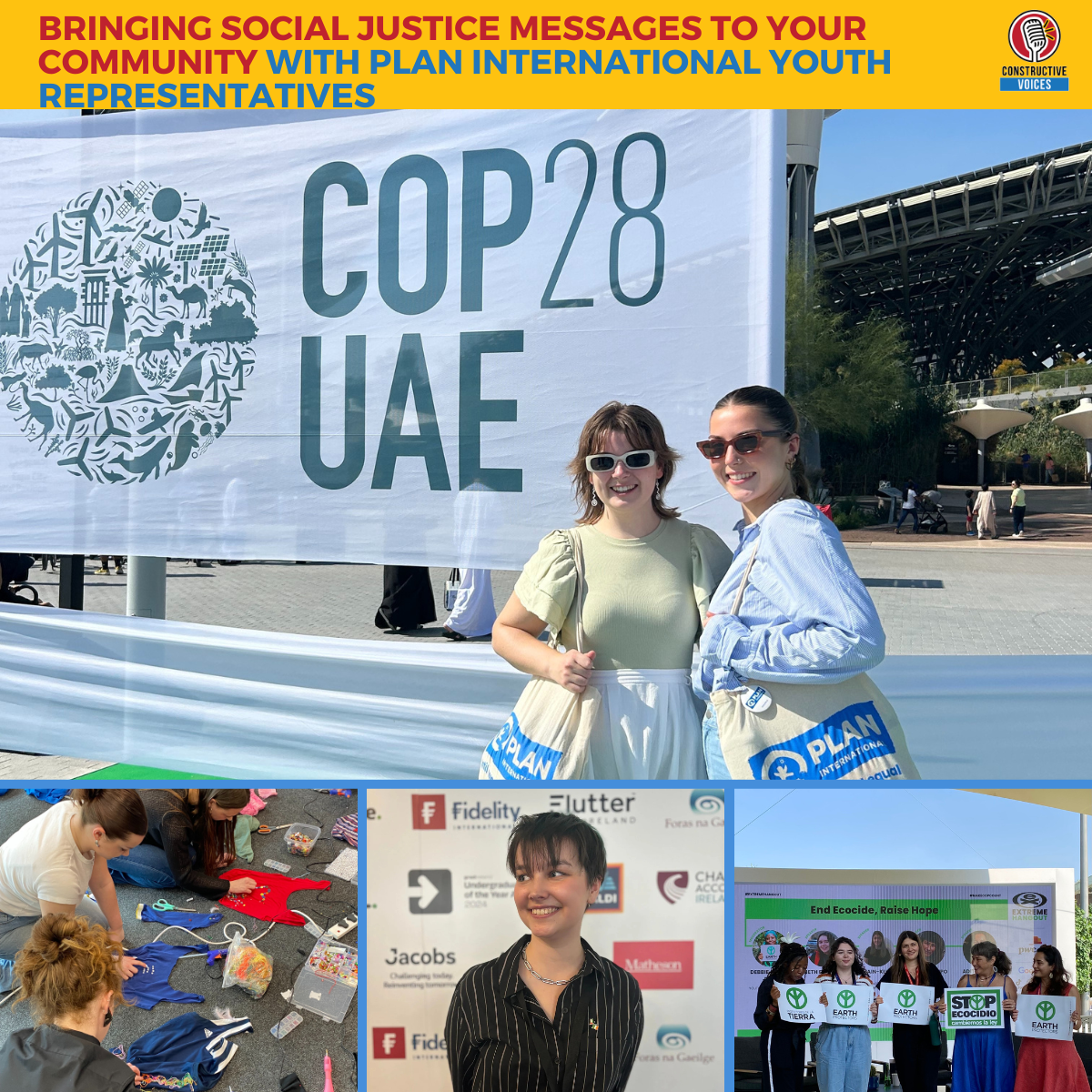
[00:00:55] Speaker D: So my name is Jessica. I'm from West Cork in Ireland, but currently based in in Jamaica where I'm working on women's rights and gender equality issues. I'm a former member of the Plan International Youth Advisory Panel. I joined the panel in 2020 and was really actively involved with the panel during those years. So as a result of that, I was chosen as one of the representatives of the organization for COP28 alongside Een, who's also on the call. And we decided after our experience of COP28 to organize an event to share some of the learnings that we were so lucky to learn in the event. So we organized the event, Feminist Voices for Climate justice, which took place on Saturday 6th April 2024. And we organized the event to take place at the Carmelite Community Centre in Dublin. And the event essentially explored the climate crisis through a gendered lens. And we had panelists including Vanessa Conroy, the project officer for the Feminist Communities for Climate justice campaign at the National Women Council, Jennifer Salmon, Ireland's Climate Youth delegate for 2023, 2024 and Kira Carney, the the Book of Leaps podcast.
[00:02:02] Speaker C: Amazing. Thank you so much. And E, you give us a bit about yourself and I guess Jessica's already covered the event for us.
[00:02:09] Speaker B: Amazing. So my name is E. Nevin Guineady. I have an undergrad and academic background in politics and international relations and then I did my main experience in youth advocacy, social justice campaigns and within environmentalism as well.
I joined the Youth Advisory Panel with Plan international Ireland in February 2023 and had some amazing experience and opportunities with them.
And I later got the opportunity to work alongside the digital marketing and communications team within PLAN Ireland as well, mainly focusing on social media management.
As Jess already mentioned. We both co organised the youth event in April last year, which is an amazing turnout and yeah, learned a lot from it.
[00:02:58] Speaker C: Amazing. And even you might continue there with just why you chose to run this event.
[00:03:03] Speaker B: So, as Jess mentioned, Plan got the opportunity to send two youth delegates to COP28 in December of 2023.
So me and Jess were luckily chosen. So we got the opportunity to go to Dubai and as a result, we just kind of wanted to bring some of our learnings back and also get a bit more of an insight into the advocacy that was going on within the Irish scene and the work that was being done to tackle climate change, but also from a gendered aspect. And so we got a few panel members in to talk about their experience within that field.
[00:03:46] Speaker C: Amazing. Jessica, do you have anything to add there about why you chose to run the event?
[00:03:50] Speaker D: Yes, I think we really also wanted to share a practical element of climate advocacy and we wanted to be able to have an event where we could equip youth with some skills for climate advocacy. So that's why we chose to do an upcycling workshop during the event. And we also wanted to shape the questions so they would have a bit more of a practical element. So we asked the panelists what's the top skill they recommend that young people develop for engaging more effectively in climate activism. So I thought it was a good chance to strengthen young people's knowledge of climate justice, but also to ensure they can develop some more practical skills.
Yeah.
[00:04:23] Speaker C: Could you tell us a bit more about the workshop that was involved?
[00:04:26] Speaker B: Yeah, of course. So we decided that to give more of a practical and sustainable skill to people, we got actually donated from Change Clothes Crumlin, which is a great initiative that basically have sustainable clothing cycle. And so people will donate, they do swap shops and everything like that. So they actually donated loads of T shirts to us and. And we did an upcycling workshop to change them into tote bags, which was really fun. It was a nice little element and I think it brought the group together really nicely. And it was more of an interactive kind of aspect because obviously everyone learns a bit differently and like, some people don't learn from just like taking in information.
So I think it's great to also give that practical element as well.
[00:05:10] Speaker C: Yeah, definitely. I know I myself was engrossed in the panel discussion, but other people were dying for a good tote bag session. So it definitely did cater to a wider variety of young people.
[00:05:21] Speaker B: Absolutely, yeah.
[00:05:22] Speaker C: So maybe, Jessica, start with yourself. Could you tell me about, like, what you learned during this event, either in the planning logistics side or from the panelists.
[00:05:30] Speaker D: Yes, I think in terms of logistics and organization, I think we both learned a lot about how to organize event effectively through this process. And I think we saw how much goes into planning these sorts of events. And because the event was targeted at youth, we did some safeguarding risk assessments. That's something I had never really considered before. So we had to do quite an in depth assessment to highlight which challenges could come up during the event and how we would mitigate those from happening and what we would do in the likelihood of certain challenges rising. And I think that was something I really learned a lot from. I think also because we had engaged with the youth advisory panel in the organization of the event. We, during one of the YAP meetings, we discussed with young people what kind of event they were looking for and asked them for speakers they would like to hear from. I think that really showed me how important it is to consult with young people in the organization of an event targeted at youth to make sure that it really addresses their needs and their desires and really is an event designed by and for youth. I think that really has shaped how I've organized events since then. In terms of the content from the from the event, I think one thing that was really interesting was looking at how you can make climate justice and climate related topics more accessible to young people and to your friends and family when you're discussing climate and trying to get the broader population involved. I think one of the panelists was talking about how it's really effective to bring up the topic of climate related issues without specifically framing them as climate related or climate justice related. Because I think sometimes that could be a bit overwhelming for people or people feel kind of intimidated by talking about this big scary issue. So you can talk about things like pollution, like you can be on a walk with your family and talk about, oh, there's so much rubbish on the speech. It'd be great if people picked it up and frame it as more of a community based issue as opposed to the big scary climate change issue. And this could help you to engage in better discussions, better conversations. I think that point that came up during the panel discussion was really interesting.
[00:07:19] Speaker C: Yeah, I definitely agree with that. Eeveen, do you have anything that you learned during the event you'd like to share?
[00:07:23] Speaker B: Yeah, I think me and Jess can agree that we definitely had our fair share of like stresses throughout it, but we learned so much from it. And I'm actually working in event management in London now, so it Kind of gave me like great skills, even like dipped my toe into the event kind of side of things. But I think personally I found the coordinating of like the venue availability and then also trying to get a day that's suited youth advisory panel and also a wider public.
And just obviously you put so much work into an event like this that it's always great to get a nice turnout, which we absolutely did. So we were delighted with that. But yeah, I think maybe coordinating the availability was a bit stressful at times just because we wanted everyone to be as involved as possible, but also managed to get a good venue that was cheap and kind of fulfilled the needs that we needed.
[00:08:17] Speaker C: Yeah, no, I agree with that and I know I myself got some things from it. I remember learning about trip chaining, I can't remember which one of the panelists it was, but talking about women using public transport when they're trying to drop the kids off at school, then go and drop groceries into a parent, then go to work and all this and how public transport systems aren't set up for that. And I know that I've been thinking about that so since that very day. And I know Kira talked about her vegan journey and I've been following her since seeing her vegan cake every year. And I remember Jenny talking about youth consultation and you're definitely right there. Jessica with the consulting. Youth is so, so important. I love to hear that message. So yeah, I really do think that everyone got something out of the event, but it's great to see that you got something out of planning it as well, both in terms of personal and also professional. So it's really great to hear. So maybe then talk about your highlights and events.
[00:09:11] Speaker B: Yeah, I think as Jess said, one of my highlights was definitely getting the feedback from it because it was like really empowering. And I think sometimes when you're in this world of, you know, social justice and even like environmentalism, it can be quite like dreary and sometimes I think it can be quite disempowering to, you know, you can see all the work that's being done and it feels so far fetched still. But I think like hearing the feedback and hearing the enthusiasm from people that maybe didn't even have that much of an interest in the environment to begin with at the start of the workshop. I think that was really enlightening and yeah, definitely made me feel like there's still so much hope and like still so much enthusiasm to make big changes, which was really great.
[00:09:57] Speaker C: I love that. And Jessica, what about you do you have a highlight.
[00:10:00] Speaker D: One of my highlights from the event was the diversity in the panel. I think it was really effective having people from different backgrounds. So Vanessa focused more on the theoretical approach and she spoke about the connection between climate change, the importance of taking a feminist approach towards it. Whereas Jenny had attended COP 2018 Dubai as well. She spoke about her experience and then the role that she thought gender played in the negotiation. So I thought it was interesting to see a bit more of a practical insight from the negotiations and climate advocacy and practice. And then Kira spoke a bit more about art and her work as an author and having her own podcast and kind of connecting climate activism to the arts. And I thought that was really interesting to have different perspectives and really to show the different approaches and how you can work in climate from different. From different angles.
[00:10:45] Speaker C: Yeah. Amazing. So your highlight really is the fact that there were so many highlights.
That's a nice thing to think about. All right. And now that we've kind of covered the highlight end of it, I wonder what the most significant challenge that you faced in organizing a climate event, because I know there's loads of people who would really like to do it and are enthusiastic and have that passion, but they're nervous about people not turning up. They're nervous about organizing the finances, the safeguarding. What was your most significant challenge you faced and how did you overcome it?
[00:11:12] Speaker B: Yeah, no problem, I think. Yeah. As Jess kind of touched on, I think the safeguarding element was a bit new for us. Obviously, working in Clan International Ireland, we had so many people who could help us with it because they focus on children's rights, which was amazing. But I think, like, that was a whole new element of planning an event, which kind of made it a slightly more tricky because obviously it's a youth event, you want to cater to every age. But then, of course, everything that comes with that as well, with signing up, parental permission and et cetera, things like that. So I think, like, going forward, if we were to do it again, it would be great to be able to have more under 18 youths there as well, and just to kind of broaden the spectrum. I know a lot of young people are very passionate.
[00:12:01] Speaker C: Yeah, it makes sense. And then it's good to hear the kind of the message of, like, collaboration being the way to go and getting that support from an established organization. I don't know, it's reassuring. It's nice to see organisations platforming young people and letting them lead the way.
[00:12:16] Speaker D: I'm so happy. Yeah.
[00:12:19] Speaker C: Jessica, what's your most significant challenge from the event, do you think?
[00:12:22] Speaker D: I think a lot of what Aviana said, I definitely agree with one challenge that I think comes up in organizing this event. And also just youth activism in general is a lot of events are Dublin centric and it's quite hard to get people to participate from other counties and from more marginalized communities. I think you see the same 10, 15, 20 people who are really active in youth activism. And it's so great to see people who are so dedicated, but you also want to bring in some other voices and some other people who are maybe less engaged. So I think it's hard to advertise these events to other communities and to get other people who aren't as engaged to participate. And you also see this issue with the gender imbalance. I think a lot of times it's a lot of women coming to these gender related, climate related events. And it's nice to bring in some young men too. So we need to definitely find some more ways to reach a broader audience. And I guess something that came up in the conversation earlier, you know, with young people, you really want them to be actively engaged, but it's difficult when, you know, people attend these events in their free time. You want to avoid the busiest times of year for students with exams and everything. So I think it can be a bit difficult to organize an event at a time that suits everybody. And so that's always hard with youth. And I think, you know, one of the challenges that came up in organizing the event too, was that, you know, myself and Avian also had other commitments for students and we're working and, you know, you really have to be creative with how you organize an event and send some voice notes in your free time. You can't always have really structured long meetings in a sense, as you would when you're organizing an event as a professional. So, yeah, we definitely had to be more flexible about how we, how we organize things. And there's obviously just some things that are out of your control.
On the day there was a storm, so some people who were traveling from further couldn't make it.
And we had a speaker who had a family emergency so they couldn't participate in the end. But there's always ways you can mitigate some of these challenges. We just prepared some extra questions just in case someone couldn't make it on the day. So then we could fill out the panel discussion a bit more with that. So I think while there are challenges in organizing an event, none of them are so difficult that you should just quit While, you know, quit before you start doing it and think it's too hard. I think definitely, while there are challenges, everything that came up we were able to overcome. So I definitely would say don't be put off by any of these things.
[00:14:24] Speaker C: Yeah, amazing. And I didn't even know that a panelist cancelled last minute. You really cover that one up. Well, that's actually quite impressive finding out now.
So you've covered a little bit there, but is there anything else that you would do differently next time or advice you would give to someone planning an event like this in the future?
[00:14:40] Speaker B: I think just go into it optimistic and yeah, as Jess said, it's such a good point. Although we did have a couple of challenges, all of them were very easily fixable or, you know, we could work our way around it. It didn't like the whole day was cancelled or ruined by any means. And also just go for it. I mean, you can be worried that some people might not turn up, but then even if you do a panel discussion or like a workshop with five people, that's five more people that you could have empowered to make a change and kind of make more steps towards advocacy. So I think, yeah, as Jess said, like, don't even think about the challenges that could present themselves. Just kind of go in and headstrong. And also with a mission of like, I want to spread my own, like, passion and learnings, I think the biggest.
[00:15:31] Speaker D: Advice I could give would be just to ask people, like, ask other people, you know, who've organized events. You know, you can ask for advice. You can ask them how they did it, what kind of venues they looked at, look at past events and where they held those events in terms of getting ideas for, for what time of the day to organize the event at, for what venue, what kind of structure and of events, you can just really take inspiration from the people around you and you can, you can just ask for help. People are so kind. In the youth activist space, I think people are more than willing to help. And we were really lucky to have young people in the app who wanted to provide advice and volunteer at the event and really support us. So I think lean on the community that you have. Most of the time, people are more than happy to just to share their experience. So I think that's my best advice.
[00:16:11] Speaker B: If I could just add one thing as well.
Don't take on too much for yourself, because I think at one point me and Jess had like such a grand idea of what we wanted this event to be and then we did just have to sit down and be like, I think we might be a bit too ambitious about this and we might have to just, you know, cut it down to maybe like two aspects. And that way it would kind of be more digestible for people as well. Especially if you are reaching out to people who might not necessarily know that much within the sector, if that makes sense. You know, you're doing an environment event, but maybe not everyone knows that much about climate change.
It's definitely better to kind of make it as digestible and approachable as possible.
[00:16:54] Speaker C: Yeah, that kind of one step at a time thing is. Especially when you're doing so many other things.
[00:16:59] Speaker B: Yeah, exactly.
[00:16:59] Speaker D: For sure.
[00:17:00] Speaker C: So thank you guys for telling me about this event. It's great to see young people organizing climate and feminist events for other young people and sharing that passion and enthusiasm.
[00:17:10] Speaker B: Thank you so much for having us. It's been great to talk about it.
[00:17:13] Speaker D: Completely agree. I look forward to attending everyone's events. I hope people are inspired by this and do organize events and hopefully we'll be able to attend them and keep learning a lot more.
[00:17:21] Speaker B: And also just to say you can find me and Jess on LinkedIn if you do want to give us a message about the event or more in depth kind of answers and we'd be more than happy to help.
[00:17:32] Speaker C: That's brilliant. It's a really good offer. Thank you so much, guys.
[00:17:35] Speaker B: Thank you so much for having us.
[00:17:37] Speaker A: This is Constructive Voices.