Episode Transcript
[00:00:00] Speaker A: This is Constructive Voices.
[00:00:02] Speaker B: Constructive Voices, the podcast for the construction people with news, views and expert interviews.
[00:00:13] Speaker A: Today's episode is a good news story that has been inspired by one of the world's most tragic situations, the war in Ukraine. A consortium of individuals, universities and entities in Ukraine, the United Kingdom and the Netherlands have come together to create a solution that will not only help rebuild Ukraine, but could be used in other places that have been affected by wars or extreme weather events. In a layperson's terms, rubble from the war in Ukraine will go through processes so it can be used to rebuild Ukraine swiftly, safely and sustainably. Now, before we go into a deeper explanation and discussion about all of this, I wanted to ask Professor Theodore Hanen, who's the professor of construction materials science at the University of Leeds, what his vision is for this vision for S3.
[00:01:03] Speaker C: Is to build a system where we decentralize construction. We pilot a system where it is, we should prove that it can be mobile, we prove it can work. We show communities that concrete obviously is made up of concrete, you know, cement, sand, gravel and water and we can theoretically get them all back. So my vision is to develop a system, a process where.
Well, not only for Ukraine, for other parts of the world, post disaster, post conflict. And we pilot it and we prove and we show people, and we demonstrations and we show people that, you know, this is doable.
[00:02:01] Speaker A: What an answer. And now over to Roman Puchko, who is the co founder and CEO at Rethink the same question please. Roman.
[00:02:11] Speaker D: It's quite difficult to say something that was not communicated by Theo, because he had a wonderful statement just now. So obviously S3 is amazing technological pilot that enables whole range of discussions that were non existent in Ukrainian construction community before it started. So the highest possible priority for the debris in heads of Ukrainian municipalities or local construction companies was to certify crushed material for use in the road bedding. This is the, say, the wet dream.
[00:02:51] Speaker E: Of Ukrainian communities, of the communal enterprises.
[00:02:54] Speaker D: Is to just crush everything put into the road bedding.
[00:02:58] Speaker E: And then we come and say wait.
[00:03:01] Speaker D: You basically could separate aggregates from cementitious materials and try to reuse it in construction. So that's a whole new twist in the discussion. Our Ukrainian construction ecosystem, which is great and still there must be many, many.
[00:03:19] Speaker E: Follow ups and other pilots that up on this one.
[00:03:23] Speaker D: But we have also rightly it was.
[00:03:26] Speaker E: Noted that we have launched the, the.
[00:03:28] Speaker D: Whole new culture of the soft components in the project as well, taking into account the Jetzi part, interviewing all those.
[00:03:37] Speaker E: Women in construction that are shaping the.
[00:03:40] Speaker D: Scene of female involvement in such a stereotypically male industry.
[00:03:46] Speaker E: Yeah. Also address the issue of veterans.
[00:03:50] Speaker D: This is the new culture of conversation in construction. I think S3 has done a great job on this front as well, but I think it will leave after the project ends. It will leave a lot of food for thought, a lot of results that will have to be exploited and many, many potential ideas how we basically move on with this circular reconstruction of concrete, which is the biggest, by far the biggest and the biggest chunk of all the debris by weight.
Yeah.
[00:04:26] Speaker A: Thank you so much, Roman. The potential is really immense. The situation is moving and inspiring, but there's a bit more background to it that I'd like to give the microphone over to Professor Philip Purnell of University of Leeds. And thank you so much, Phil, for joining us today. Over to yourself.
[00:04:47] Speaker F: Hi, everyone. My name is Phil Purnell. I'm professor of Materials and Scott Structures in the School of Civil Engineering at Leeds University. And I've been working on circular economy research for well over a decade now. Without blowing our own trumpet, we've got one of the largest portfolios of circular economy research, certainly in the uk, probably across Europe and in the world. We were there at the beginning, we were there at some of the definitions of circular economy and some of the theoretical work that we've done underpins how people think about the circular economy today. But of course, it's nothing without a practical application. And our researchers right across the university, both in civil engineering, in our textiles department, in our Earth and Environment section, they're working on things as broad as wind turbines, looking at how we can make sure all the materials we put into wind turbines now we can get back out afterwards. We're looking at textiles. You know, textiles is one of the biggest, fastest growing industries in the world, and the sheer quantities of textiles we consume contributes greatly to global warming, to water pollution, to microplastics pollution. So understanding how we can use the circular economy to minimize that is extremely important. And I'm on the UK government's Circular Economy Task Force, largely wearing a textiles hat. And of course, where a lot of our circular economy research started was in construction materials, which links us through to this particular project. We use more construction materials than all the other materials we use as a species put together. So understanding how we can minimize the extraction of our construction materials, extract them as efficiently with as little energy and waste and pollution as possible, and make sure we can reuse those construction components and materials at their end of their life is incredibly important. So we've got A portfolio of research that covers many of the major things that we see every day in our lives, including our clothes, our buildings and the energy that we use.
[00:06:35] Speaker A: That's absolutely fascinating as well, Phil, and really, you know, explains the background of the University of Leeds leading up to this. And regarding the circular economy, one of the things that actually pops into my mind during our discussions is the whole circular journey. Imagine there's a stone that was part of the rubble from your neighbor's house and when you are lucky enough to have your own property rebuilt with all the memories of the war, the memories of your life before the war and now trying to grab on to your new future.
I mean, it's just the whole concept is, you know, fantastic. Not just the rebuilding, but all the energy behind it. And, you know, this wouldn't have been made possible. There's so many people and organizations involved in this and it wouldn't have been made possible without Innovate Ukraine. So I'd also like to hear from Andy. Thank you so much, Andy, for joining us.
[00:07:32] Speaker G: Hi, Jackie. Yes, great to be here with you. So my name is Andy Horsley and I'm the head of the Innovate Ukraine programme delivery.
[00:07:39] Speaker A: So Innovate Ukraine, Andy, what exactly is that?
[00:07:43] Speaker G: So Innovate Ukraine is a collaborative energy and clean tech R and D programme.
It's led and funded by the UK Foreign and Commonwealth Office and it's delivered through the British Embassy in Kyiv.
So our focus is on developing innovations which are can go on to support Ukraine's future recovery. So it's in areas like energy security, energy supply and energy access. But there are also benefits, of course, for UK businesses too. So the programme was launched in 2023 at the Ukraine Recovery Conference in London. And so far we've had two active rounds of the programme with a total of 34 million of investment from FCDO. And that's boosted by co investment for the companies who are involved in the programme.
So our first round of projects started last year and they're running until 2026. And we're about to announce our second round winners and they'll be announced just before Christmas. And those new projects that will start this year will run into 2028.
[00:08:40] Speaker A: Okay, so yes, what does make this program different?
[00:08:43] Speaker G: So there are three aspects really that characterise this program. The first of all, it's collaborative.
So that means that UK and Ukrainian organisations are working together. Some projects are led with UK technology, some are led with Ukrainian technology and others with international technology as well. So there's a real balance across the program and it's about creating this multi way relationship. And that mutual benefit aspect is really the key to the 100 year partnership the UK signed with Ukraine early this year.
So there are clearly benefits to Ukraine, but there are also benefits to the UK as well. So it gives UK business access to new markets and it also means we benefit from Ukraine's unique perspective on the energy challenges that face the UK as well. The second aspect is about kind of the focus and intensity of the work that we do. So rather than spreading our funding across hundreds of different organizations, we really focus on those projects that can deliver real impact. And we use a panel of Ukrainian and UK assessors to help us select those projects. So we really want to try and move the dial with some of these innovations that we're funding, not to spread our funding too thinly. And the final bit is all about demonstration.
So the key focus of our program is about demonstration and helping innovators to demonstrate their technology in the field for the first time and to do that in Ukraine, where obviously where we can. And most of our funder projects will demonstrate their technology in Ukraine. So those three things are really the key things that characterise the work that we do compared to other programs that you might come across.
[00:10:12] Speaker A: Okay, fantastic, Andy. So let's just hone in on S3, which I think is a wonderful example of what you've just spoken about.
[00:10:21] Speaker G: Absolutely. So S3 is one of our winners from our first round of the competition. It's one of the biggest projects we've got on our program in terms of the budget and the number of projects partners we funded. And the project includes organizations from the uk, from the Netherlands and from Ukraine. And it's also a bit different, some of our other projects as well. So we fund a lot of projects in the energy generation, energy storage, energy management, space.
But the energy and carbon savings that the S3 project is delivering are really all about embodied energy. And if we think about Ukraine's reconstruction, the amount of energy consumption and carbon emissions that will be created by the materials that go into Ukraine's reconstruction, that's going to be very significant indeed, particularly if we use only virgin materials.
So the S3 innovation really offers a way to upcycle debris that's been produced by the war and the impacts of the war, and to upcycle those to directly displace virgin materials to effectively to rebuild new structures directly from rubble of the wall. But this technology could have a really big impact on Ukraine and also elsewhere in the world.
[00:11:28] Speaker A: That's one of the things that certainly has come across in the conversations with the other experts. Andy, that's been an amazing background to the role of innov, Ukraine and yourselves are all involved and congratulations for the amazing work you're all doing.
[00:11:42] Speaker G: Thank you, Jackie.
[00:11:43] Speaker A: This is Constructive Voices. So now that we've set the stage for a far deeper discussion about S3, I would like to hand over the microphone to Rhiannon Mathias, who's going to be our key moderator on the main discussion here today. Thank you so much, Rhiannon.
[00:11:59] Speaker B: Hello everyone. My name is Rhiannon Mathias and I'm really pleased to be moderating today's conversation.
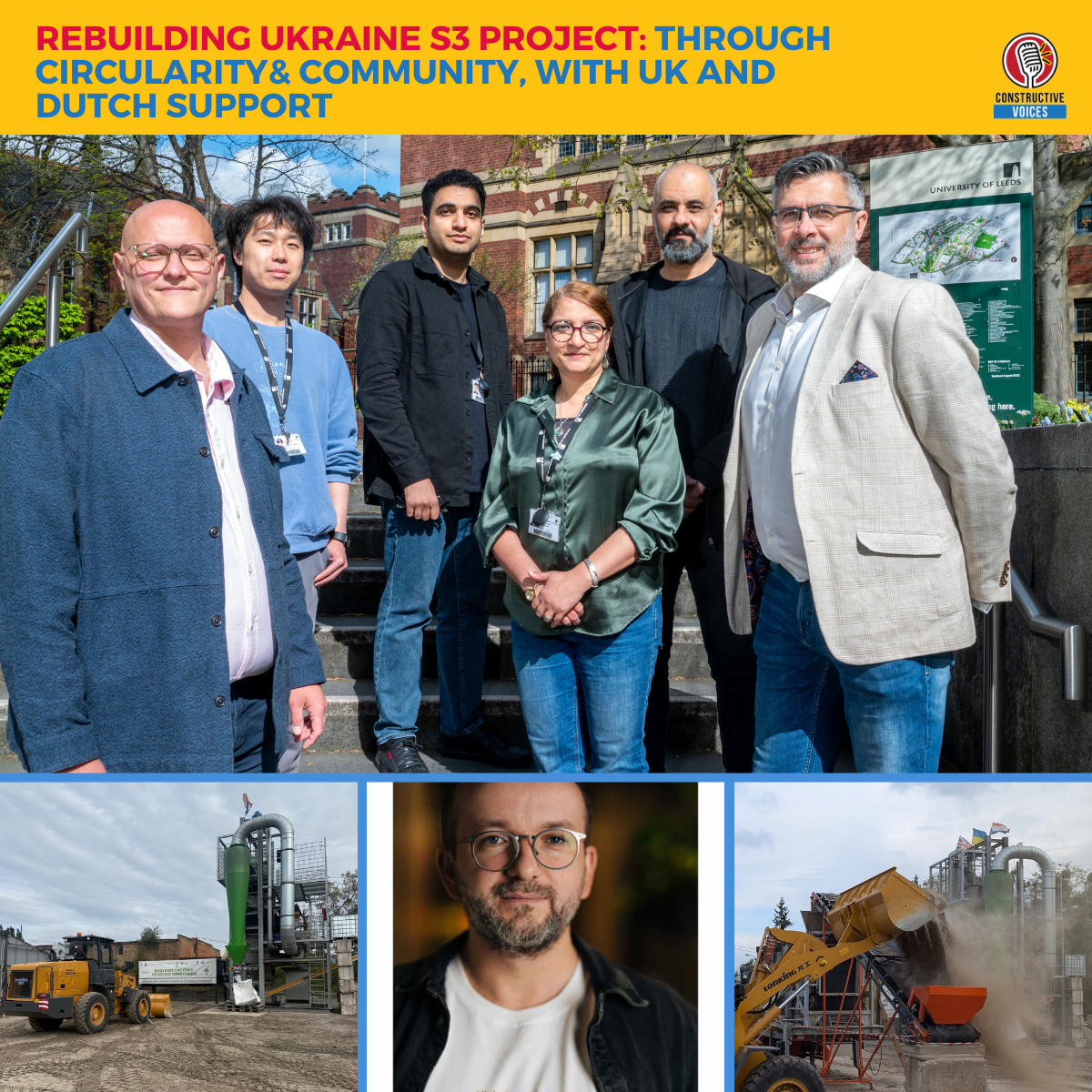
I am based at the University of Leeds at the Faculty of Civil Engineering where I work in research and development and have the immense privilege of supporting the Safe, Swift and Sustainable Reconstruction of Ukraine Project, or S3ROU.
This is a two year initiative funded through the Innovate Ukraine Program, which is run by the UK's Foreign Commonwealth and Development Office.
Our consortium brings together academic, industry and practitioner partners from across Ukraine, the uk, the Netherlands, to explore circularity within concrete, particularly how upcycling war debris into low energy, low carbon materials can support long term resilient reconstruction.
My own background is in frugal innovation, urban transition and international relations.
So these conversations resonate really strongly with me on many levels, particularly when we think about embodied memory, questions of inclusive practices and how communities imagine and build towards their futures.
We're joined today by two of my wonderful colleagues, Professor Theodore Hanane, who is the Chair of Construction Materials Science at the University of Leeds. He is a UKRI Future Leaders Fellow and the Vice Chair of the International Society for the Environmental and Technical Implications of Construction with Alternative Materials, or escoa for Less of a Mouthful. His work focuses on cement and construction materials and how rethinking them can support safer and more sustainable futures.
We're also joined by Roman Puchko. He is the CEO and co founder of Rethink Ukraine and a leading voice within circularity and sustainable urban development conversations, especially around creating greener, more livable cities in response to the impact of conflict.
Thank you both for joining me today.
And yeah, let's get stuck in this is Constructive Voices. So I'm lucky enough to work with both of our guests today on this project and I'd like for each of them to introduce themselves. So can we start with you?
[00:14:18] Speaker C: Professor Theo hi, I'm Professor Theodore Hanane. I'm Chair in Construction Materials Science at the University of Leeds, UKRI Future Leaders Fellow, as well as the technology lead of crou.
[00:14:30] Speaker B: Okay, thank you. And since you've started working on this project, can you just elaborate on how this collaboration began and what initial needs or questions have shaped the project's development?
[00:14:41] Speaker C: Initial needs that have shaped the project developments are basically the amount of rubble that is now available in Ukraine as well as in other parts of the world obviously is very high. And reconstruction of cities which are necessary and are going to happen will have a detrimental toll if we were not going to do it sustainably because cement and concrete and building materials in general, they occupy a huge AM of greenhouse gas emissions, CO2 emissions which not only affect Ukraine, but they basically affect the entire world.
[00:15:13] Speaker B: Okay, thank you. And now if we can move on. Roman, can you please introduce yourself?
[00:15:18] Speaker E: Absolutely. Hello, I'm Roman from Resync which is a Ukraine based circular economy NGO that I co founded in 2018 and now it's focused on green and circular reconstruction of Ukraine after the full scale war. Yes, and we are proud members of the S3 help locally and disseminate this fabulous pilot project practices to systemic Ukrainian reconstruction.
[00:15:44] Speaker B: Can you speak a little bit to how you and Theo connected?
[00:15:48] Speaker E: So there was also a quite high role of British Embassy in Kyiv. I remember we had a meeting with Evelyn and discussing stuff we are doing, discussing Innovate Ukraine program back then focusing mainly on energy but the issue of debris was really, really high on our agenda. And then she said, you know, have this great guy, Theo Hanay who worked in Syria and perhaps you could do something together. Let me connect you. So basically this connection with Theo and then building up a bigger consortium started from matchmaking done by British people here in Kyiv, which is amazing and I'm really grateful for their support on that early stage.
[00:16:34] Speaker C: So, no pun intended. But for me it is an opportunity to rethink the future and make cities that are countries if you would like and systems that are self sustainable circular. It's an opportunity to redesign. It's an opportunity to be able to make a self resilient society. For example 15 minute cities, sustainable cities. It's an opportunity to make areas less reliant on imports and more reliant on using what they have locally. I think there's a lot of opportunities and it's an opportunity to.
[00:17:13] Speaker C: Rebuild in a sustainable manner. Because most of the infrastructure in the western world, let's say was built after World War II. So a lot of buildings are going to have to go down anyways because they do have a lifetime. So most of the infrastructure is going to reach end of life soon. And finding These ways of having smaller circular approaches to reconstruction, mobile decentralization of reconstruction of construction in general, I think supports local people, supports local businesses.
[00:17:47] Speaker E: If I just may continue on that question. For us Ukrainians, reconstruction is a huge opportunity also unintendedly, but to rethink the living the way of life in our country, but also with taking into account the context of full scale war we are having. And as for instance, New European Bauhaus is promoting, we are trying to focus our reconstruction on several important principles and values, which are sustainability, of course, which is also inclusiveness and togetherness and which is aesthetics. Aesthetics, quality of experience. For Ukraine, it is enormous opportunity to leapfrog to a better architecture, better urban design, better feel of, of a citizen.
[00:18:38] Speaker D: In cities, in urban systems, and of.
[00:18:41] Speaker E: Course to have a better material circulation, better material flows. And I kind of notice how we in Ukraine are becoming a pilot site for diverse sustainable pilots, diverse experiments and innovations that are also pushing Ukrainian technical standards, are pushing Ukrainian regulations. So having this trauma, having this necessity to leapfrog, we have to build a society and buildings and processes that are inclusive, that are beautiful and that are sustainable. That's our kind of vision. Of course, there are many barriers on this journey, but projects like S3 are important to destroy these barriers. So I'm happy we are doing it.
[00:19:30] Speaker C: I'll also add that it also gives opportunity not only for rebuilding of post conflict areas, but as well as post disaster areas, you know, where you have earthquakes and other kinds of disasters, as well as the rebuilding of other cities or areas which would probably need rebuilding in the future, such as Gaza and obviously parts of northern Syria.
[00:19:52] Speaker B: Can you just speak a little bit more explicitly to how design identity, whether that's cultural, aesthetic and sustainability intersect within your vision and how those became the principles behind your vision?
[00:20:05] Speaker E: Yeah, yeah, it's quite deep, basically. So besides embodied carbon and other things, destroyed buildings and cities, they have embodied memory and we have certain heritage and certain cultural value also to work with. It is quite sensitive topic, to be honest. And we primarily are focusing on circularity. But then still, for instance, in one of our projects, we used AI to categorize materials on destroyed buildings in bucha back in 2023. And then this algorithm became a base for our Venice Biennale installation that, that is featured still in Venice this this year. It's called Circularity on the Edge, developed by my colleague Katerina Lopatuk, which features fragments of materials in a 3D space. And they are, they are having a kind of a light projection and they showcase a house in Hostomel nearby that has been destroyed and has to be rebuilt. And there is a family that used to own this house. And when you look at these materials and how AI is kind of playing with them, you see this extremely interesting blend of modern technology, disaster and sadness, but also this willingness to rebuild in a more innovative and circular way. Probably this is the only project we have on the verge of circularity and reconstruction and culture and embodied memory. But overall, I feel like our vision is to not only create physical objects, but to respect the context, respect the nature, respect the people who are still fighting for our freedom and independence and to make everything possible. That all of them are happy when they come back from the front line and that they feel like it was not waste of time. And we all feel like we have better country.
[00:22:07] Speaker B: That was so profound. I really like that you speak to this idea of embodied memory and heritage, because I do also think that there is this tendency to really essentialize sort of destroyed cities, destroyed landscapes, and reduce them to that or sometimes overly romanticize the past. So I really love that you speak about both embodied memory, but also building forward, building better, and also using building as a way to kind of pay, to kind of honor the people who are deeply affected by conflict on all levels. So yeah, that was such a beautiful statement. So, Theo, we're going to go back to you. So before talking a bit more about more technical or policy related shifts, would you be able to speak a bit to the more personal levels of resonance that you have with this project?
[00:22:49] Speaker C: From a personal perspective, which is probably nowhere close to what Roman has experienced. I was in Lebanon during the 2006 Israel Lebanon War. And seeing infrastructure destroyed and how it really affects everything, it affects availability of food, it affects, you know, availability of electricity, of availability of connection, traumatizes you to hear jets flying over you, you know, or rockets flying over you, you know, whether it's or night. But I think that was a short and nowhere close to probably what people are experiencing in Ukraine at the moment.
[00:23:23] Speaker E: Yeah. So personally we feel like there is significant gap in both technological landscape. So lack of pilots, lack of advanced practices on the ground. And we also feel there is considerable capacity gap in local municipalities, in ministries. What we are trying to do is to tackle both and S3 project is a very cool, technical, innovative project to drive innovation on the ground. It's an amazing pilot which is gaining a lot of attention over here from the side of the Ministry for Restoration.
Local municipalities, businesses, everybody is asking like, oh, how exactly you're doing it? La la la but then it has to be scaled and it has to have impact on local legislation, technical regulation, etc.
[00:24:14] Speaker D: Which.
[00:24:15] Speaker E: Yeah, which is why we also work with ministries, for instance, on the software component. We launched Green Reconstruction course this summer. It was also quite an interesting exercise. We had over 500 applications from architects, engineers and local communities and trained them over five modules. During three months of summer, about 100 people stayed till the very end and completed home tasks. So we are a bit proud that we try to contribute to local capacity building and education as well. There are other projects that are in the domain of reclaimed materials use or biogenic insulation, where we also promote the use of natural materials in construction. But I don't want to dive very deeply into those.
Just end by saying that this circular construction has to have systemic approach and we have to build up on projects that we are doing. For instance, S3 is an amazing project to give knowledge and also produce advanced material that could be used in reconstruction. Then we have to see how we use this material and go further into products, building materials, buildings and how we optimize value and how we optimize environmental footprint and how we optimize aesthetics in reconstruction.
[00:25:41] Speaker B: So far, what have your collaborations with civic networks, municipalities, design communities, policy circles like you mentioned, what have they revealed about what really enables circular reconstruction?
[00:25:55] Speaker E: So we try to build ecosystem around the topic of green and circular reconstruction, because obviously this is not top of mind in the heads of our government officials.
We honestly have many more urgent needs, more important needs, social needs that still.
[00:26:15] Speaker D: Have to be covered.
[00:26:16] Speaker E: So the topic of greener, more sustainable reconstruction is. Well, it has to be pushed a bit, in a way. So that's what we are trying to do and trying to build the ecosystem around. With some stakeholders, it's much easier to do than with others. For instance, architects and urbanists, they are very advanced people. We have amazing communities of architects and urbanists that have done amazing projects in Ukraine, but also abroad. They understand all these things and it's.
[00:26:51] Speaker D: Quite easy to speak to them.
[00:26:54] Speaker E: But sometimes those people who take decisions are other people. They are developers, they are local communities, there are people in ministries, etc. Etc. And there it's a bit more difficult because you have to speak in like, you have to use the language of life cycles. You have to explain the strategic value of things that you are proposing. If you look for instance, on the initial investment that is needed to build a concrete wall, then they will most likely tell you that it's cheaper to build it from virgin concrete than to use recycled components. This is not right in the strategic sense. So we try to break this paradigm of simplistic thinking and we try to shift this dialogue to a more Schlift life cycle based approach. And we often gather policy dialogues around tables or we organized a summit last year on green and circular construction, where we invite ministries, local communities, we invite architects and builders, everyone. The thing that this dialogue is launched already shows that we are kind of on the right path. And since the topic of green reconstruction is pushed by European Commission, is pushed by Ukraine's willingness to enter the European Union, we see that the government and local officials, they basically do not really have much choice but to do it anyway. It's just that they really require assistance from projects like S3, organizations like Rethink NGOs and are not on a civil service, but are quite good experts in it. So those enablers for green and circular reconstruction, they are sometimes in different spots in different places. But the key to success, I think, is the inclusive dialogue between diverse stakeholders, showing what's possible on the ground by piloting and then saying, okay, maybe you could put this into legislation.
[00:28:58] Speaker B: Well, thank you for mentioning the importance of dialogue. I'd like to just take that a step further, if we may. So, from your experience, what is it that makes this dialogue genuinely inclusive? So whose voices do you feel need to be heard in order for reconstruction to be reflective of people's needs on the ground?
[00:29:15] Speaker E: Okay, well, I would separate things into two here, because the needs of people on the ground sometimes do not reflect the needs of green and circle reconstruction. I have to be honest here because as I said, we have sometimes very basic priorities in reconstruction. So let's say people don't have heating, or people don't have electricity, or they need to insulate their house, but they do not care about materials that are being used just cheapest.
So it's quite hard to expect that the needs of people on the ground will reflect also the most advanced practices and the process to reconstruction. When it comes to circularity. We have one case which is illustrating this thing quite well, I think so within one of the projects, which is called Teplo, it's translated from Ukrainian as warmth.
We are together with some French and Estonian partners, we are trying to insulate and retrofit one of the Soviet residential buildings. It's from 1936, so really old. And in retrofitting we want to use natural materials, ecological materials, we want to do some urban design, we want to change the roof and reinforce the building because it's quite an emergency condition. And then when it comes to participation and speaking to inhabitants, and when it comes to choosing materials for facade, we have very interesting conversations. For instance, we promote the use of wood instead of cement based panels. And basically inhabitants say, yeah, yeah, it's a nice idea, it looks natural, it's beautiful. But then you kind of realize that you have to have maintenance in Wood in 10 years. You have to cover it with, with another layer of protective and it costs money. And if you calculate how much it will cost, including inflation, in 10 years, you realize it's about say 40, €40,000.
And then you communicate this to people like, okay, you're getting this project for free. We are doing all the works for free because it's funded by the European Commission.
But in 10 years you will have to do this maintenance.
And then they say, oh no, but it's too expensive, we are not ready.
[00:31:38] Speaker E: And then they say, yeah, we actually don't mind having cement based panels.
So it will, it will cover the same function. It will, it will do the job.
Then we don't care much.
So when it comes to needs of people on the ground, they are different.
You still have to work a lot with both awareness, but also capacity of people to mobilize some money and realize some value in this insulation and maybe start saving money right now to be able to do this maintenance in 10 years. So there could be different approaches, but it's not easy. So this is part on local needs. But then if we speak about the other aspect, which groups should be heard when we design a green and circular reconstruction, an inclusive one, then obviously the main clash happens between architects and construction companies.
So very often developers who are paying, they are neglecting certain environmental and aesthetic principles because they are thinking in square meters. Square meter is the main KPI for them. And if they can commercialize their square meters, yeah, then they're not really, really interested in many other things. And it's a huge cultural differences, for instance, between what is happening in Ukrainian construction and what is happening in, let's say, British construction or Western European construction. When you come to London and you see a wonderful building, or when you come to Rotterdam and you see a wonderful building, everybody is telling you the architect who built it, like, oh, this has been built by Norman Foster, or it has been built by Mfer de Wey or, yeah, the Koolhaas. So people are fascinated by the architect who built it. In Ukraine, you will almost never know the architect of the building because, oh, this was built by this construction company or that construction company. And the decisions in construction are taken very, very much by those developers and architects are always in a weaker position and have to compromise. As you can imagine, the same happens when some other people are coming like us or engineering consultants or other people and say, look, maybe we should use some bio based materials or maybe we should recycle debris, or maybe we should apply smart demolition to buildings that you already have on site and let's maximize value of these materials in your project.
You can imagine what is the typical answer of people who are focused on square meters. So that's why I underlined the importance of dialogue. And this dialogue has to be multi stakeholder dialogue because when it's one on one only construction company and only architect, then you know the winner and it's clear. But if it's roundtable, if you see policymakers involved, you see municipality involved, you explicitly present some nice things and you show the long term value of nature based solutions or circular solutions, then in the roundtable it's quite difficult to be, you know, nasty and very mercantile and speak only about, about square meters and profits.
So yeah, I think it's very important in our situation to have this multi stakeholder dialogue.
[00:35:30] Speaker B: I think this is a good opportunity to bring the conversation back to Theo, who can probably speak to something similar, but from a different perspective. So Theo, from your perspective, what kind of shifts in terms of. So if you're talking technical, industrial, you can even speak to kind of more paradigm or policy related shifts if you like. What kind of shifts? Shifts are necessary for lower carbon and circular innovations to become more mainstream.
[00:35:56] Speaker C: So I'll start with the first part. So people think, especially places like Ukraine, obviously in places like Holland, where one of our partners are based, people do recycle construction, demolition, waste. But there's a saying which Leon Black, my colleague who works in another project, told to me about, but it's actually a saying, I don't know who the actual author is. It says waste is a material without identity and we need to identify, give this material identity in order for the people to accept it. Because there is a mindset change that is needed and a perspective change that is needed. In certain places where, you know, especially when you, you know, like Roman mentioned earlier, it's cheaper to at the moment to build with virgin materials, right? But that's only because of the economies of scale issue and that, you know, this is still new technologies. So in terms of policies, what would be needed is basically subsidies would be needed in the first, I believe in the first instance to completely roll out the project. I mean, we'll talk about the technical parts in a bit, but we're talking about a mobile system that basically reuses every part of the concrete back into its original form.
On the industrial side of things, decentralization is needed. I mean, it's not, I mean, five companies probably own almost a little bit less than half of the world's cement production. Right.
Decentralization is, I think, necessary. Subsidies, not only from local governments but from around the world is necessary. Because if Ukraine, for example, or any place is rebuilding in a sustainable manner, then they are not only protecting the climate of that country or they are protecting the Earth. And the Earth is for everyone.
But we do have a study and we do have some work. In the long run, this is the best solution, is to stop excavating from our planet to preserve planetary health and we can reach a point.
We will reach a point. All countries will reach a point. Not yet in places like Africa, if you would like, in the global south, but in the global north in general, we're reaching a point where buildings going up or materials quantities going up and quantities coming down are matching.
We'll be there before, let's say, 2040, 2050.
So it is necessary to build this mindset of circularity and to show and prove that it's possible.
And the mobilization of the technology is also essential. And it's not only mobilizing, you know, a crusher or a separator, it's also mobilizing cement production unit and it's also mobilizing a quality control unit. So, you know, putting all of these on the back of lorries, moving from area to area. Yeah, so that is basically decentralization. Because when you talk about circularity, like you could draw a circle around the whole of the uk, but it doesn't. That's not what circularity has to be. You could have a hundred circles within, within the UK alone or within Ukraine. You know, it's about resilience and local sustainability.
[00:39:39] Speaker B: How does decentralizing production or material flows strengthen resilience? So you can speak to that technically or in terms of communities, supply chains and the different reconstruction contexts that you mentioned when you initially discussed this project.
[00:39:55] Speaker C: So when you decentralize, you create jobs locally, you make communities less reliant on other countries, if you would like, or importations, you make use of what you have locally in your area, whatever that material may be. When companies try to promote a certain type of. This is the only best solution.
I, I think that's neo colonization, to be honest, because I think, you know, people I've been working in construction materials for a while and everywhere can construction materials to build for themselves using their own locally available material.
And this is even past rubble. Obviously we're talking about rubble today. But it, it helps people be, or communities be more resilient, self sustainable, you know, and not if you would like have to rely or have to, you know, accept conditions that they, that they do not like. You know, it's really, I think remove some pressures off of communities. When you decentralize as well as create jobs locally and create skills and create a better environment and better if you would like learning and like things. Roman does very well with rethink, you know, with the NGO and things also that we do in S3, that in the headsee aspect, which is for gender equality, disability and social inclusion. So these will all be improved when you decentralize.
[00:41:40] Speaker B: Okay, thank you, that's very interesting. Building on what you mentioned about local jobs, what do you see as the bigger system level implications of circular cement when you talk about resilience? So of course you've discussed the economic side of things, but how does it shift the way that communities function during reconstruction processes?
[00:42:01] Speaker E: Okay, I could just tell my take in a few sentences on this one. And it's also related to circularity in general.
So basically nowadays with this conventional approach to construction, where we have a massive scale of extracting materials from the ground and.
[00:42:19] Speaker E: Processing them into construction materials, then constructing something, it actually involves relatively small amount of people, a relatively small amount of companies, most of which are transnationals, basically acquiring local companies and then optimizing their EBITDA and their profits locally because of natural resources and because of low cost of labor over here.
And when we speak about moving to a more circular model, especially now in the context of war, in the context of this massive scale of destruction, where we have tens or maybe even hundreds of million of tons of debris laying on the ground, and we have those veterans coming back from the front line, many people without decent jobs. Circularity brings more value in terms of jobs, in terms of larger number of involved parties being there in the process. Because you have to separate materials, you have to test materials, you have to crush materials, you have to do many things.
[00:43:30] Speaker C: Things.
[00:43:31] Speaker E: One of the systemic barriers to making this circular process profitable is basically the fiscal system, which is putting quite huge load on labor and putting very small load on natural resources. So it's very cheap to extract and it's very expensive to hire a person and pay a monthly salary. So if we shift that load a bit, if we shift the priorities in fiscal policy.
It will make this process profitable. It will engage many more people on the ground because you will have more. It's simply more work to build from debris than just to extract.
It's more of a local value creation. It's more about involving small and medium enterprises rather than huge corporations who have their grip on, on the natural resources and key processing businesses. So I think that is, that is how it looks like. But it's as Tio said previously, it's business and traditional industries are very, very powerful and very reluctant to change because they, they are big. And if you're big, you're not really flexible.
[00:44:50] Speaker C: I'll jump in and add to that. Another thing is when we, you know, we must also not forget transportation.
So moving things, because when things are centralized, you're moving them all around, you know, the world or like around the country or around wherever. And transport is a big part of CO2 emissions. And even if you electrify the transportation, you know, there is a lack of energy in the world and especially in parts like Ukraine, so that energy is better used somewhere else. So transporting for shorter distances is another very, very beneficial aspect to the decentralization of the reconstruction.
[00:45:34] Speaker B: Theo, I want you to also kind of outline LEED's role specifically in the project, obviously, but before that. So just to build on the previous answer where you talked about inclusion, can you talk about how this plays out on the technical side of things? So how does this actually influence the more kind of technical decisions, the innovations and the materials work that's happening in the project?
[00:45:54] Speaker C: So this obviously increases manpower in itself is probably an exclusive word, human power, let's say, and the amount of people that is needed because obviously this transition, you know, it's not just Leeds or Ukraine or Lviv or any particular one of the partners that's going to carry it all alone. It's. It's a mindset that has to go through communities and I think building the human power to be able to achieve this is quite important.
[00:46:24] Speaker A: Theo, based on Leeds University, who has a track record in circularity in general, would you like to highlight the various phases from a technical perspective that Leeds University has had up to now in Esse?
[00:46:37] Speaker C: Yes, certainly. First of all, just to start off with the Jedzi side of things, which is gender equality, disability and social inclusion, is that we do try to maintain a balance of gender equality in the team and even in the application that was already there and in terms of what the University of Leeds does in particular.
So my main part is remaking the former cement which people normally would.
So when you crush the concrete, obviously for a long time people have been getting back the gravel and sand or the aggregate if you would like. But the cement, which is the glue, which is the binder. So my main if you'd like the technologies that we're developing leads is remaking cement back into cement, so reclinkering and this includes using because so cement is normally made using fossil fuels and we're using microwave technology as well at the moment to turn recycled cement paste back into a cement basically to activate, to reactivate the paste. And that is mainly done by heating it back up, removing the water out of it and making it hydraulic again. My colleague Leon at Leeds also is working mainly on data mining, on value optimization and modeling. But although we have a partner, Everox, formerly known as C2CA who have very generously and kindly, you know, have their equipment running in their startup in Ukraine, we're also developing separation technologies that are optimized if you would like and giving that feedback into the project because one of the hardest parts of separating is separating the fine aggregate and the recycled cement paste. So just to summarize in terms of Leeds Leeds role is basically reclinkering, electrification of clinkering separation technology, concrete separation, you know, basically all separation technologies. You know, you never get 100%. I think currently people are reaching like 40% of not so 60%, 70% and we're trying to optimize that. And then as well as this value optimization through data mining in the literature and to see, you know, what is the best value for society through modeling of all the. This includes, you know, the effects of what is the difference between a virgin aggregate and a recycled aggregate and how do you improve a recycled aggregate to be able to be sold for the same price or to have the same value as a virgin aggregate. And those are the I would say contributions currently from the University of Leeds there is also contributions we're doing which are quite new and wouldn't say I won't go into the technicalities of it because it's something that's probably going to be patented but it's how do you pre process as well in order to make low energy because it's, it's cement production is normally a high energy industry if you would like. So we've found ways to reduce the amount of energy you need to reactivate the hardened cement or the cement paste, the hydrated cement, you know, when you mix it with water to be power glue and how to react activate that into a cement that can then Be hydraulic again and hydrated again and reused.
[00:50:05] Speaker B: Okay, thank you. So when you describe these different processes and technologies, without going into the kind of specificities or oversharing, can you describe what this means or how these steps kind of translate when you think about real construction settings and the potential for scaling up?
[00:50:22] Speaker C: So in reality, for some amount of time, for example in Ukraine, there is going to be a lack of energy. So reducing the energy needed to make the cement is quite crucial. And it's going to have a very big impact because as I said, there's a lot to rebuild. Our aim is to bring people back to their homes, rebuild their homes. And at the end of the day, not everything can be built of bricks and wood. And you know, you're going to need concrete in some places and infrastructure. And reducing the energy, especially in places that have lack of energy at the moment or will have a lack of energy for the next 10 years, is I think, quite important and necessary.
[00:51:01] Speaker B: Okay, thank you. And Roman, is there anything that you can add to that in terms of the potential or challenges that this project has revealed in terms of scaling up reclaimed material systems within a post crisis context?
[00:51:14] Speaker D: You know, it's quite difficult to judge at this point of time because it's not that we are having many more of similar projects and then this one has specifically revealed some challenges for scaling.
[00:51:26] Speaker E: Nobody tried doing this before.
[00:51:28] Speaker D: Obviously nobody tried to scale this kind of technology.
So we are playing the role of pioneers here as a consortium. So all the scaling barriers, all these obstacles, they sometimes are visible already, but sometimes I'm not. I would still wait early next year when the project is ending, before we judge confidently about the challenges for scaling.
[00:51:54] Speaker B: Okay, thank you. I think you've both painted quite a clear picture when it comes to kind of those realities and challenges. So just a final question for me, just to close us out, I just want to hear from both of you. What do you hope the legacy of the S3 project will be? So whether that's in terms of like technical innovations, whether that's in terms of approaches to international collaborations or just ideas that it set in motion. Can you both speak to that, please?
[00:52:21] Speaker D: So already at this point of time.
[00:52:23] Speaker E: I see a very important legacy of.
[00:52:26] Speaker D: This project being the game changer in circularity in reconstruction or construction domains, conversations. Because as I already said previously, nobody was really intending to extract maximum possible value of debris and try to promote circularity to such extent that you could actually use cementitious materials, cementitious paste in construction again. And this ambitious vision has placed S3 projects in a very unique position, at least in Ukraine, at least in this local landscape. And then when adding density components to.
[00:53:06] Speaker E: Our operations and our events and our.
[00:53:09] Speaker D: Discussions, we are quite outstanding in terms of advancing new culture in construction industry, focusing veterans and women, all the disadvantaged groups. So I hope that the legacy of this project will be that other stakeholders will learn from us, we will learn from our stuff that we have done.
[00:53:32] Speaker E: Maybe from our mistakes that we have.
[00:53:34] Speaker D: Done, from our interactions with the local communities and government and businesses. And we all will grow and we all will improve our understanding and our practices in reconstruction so that we can make a Ukrainian recovery more sustainable, more inclusive and more beautiful.
[00:53:53] Speaker E: And do it in participation with local communities, it in a wide dialogue with the central government, with local authorities.
[00:54:02] Speaker D: And I hope it will be economical, it will be environmentally friendly, and it will make us, as Ukrainians, some kind of front runners in circular construction. Because it is very sad that we have full scale war as a reason for innovation. I would prefer that we have other reasons for innovations, but in the local.
[00:54:24] Speaker E: Context, we are innovating in all sectors, starting from battlefield and defense, and then.
[00:54:30] Speaker D: Ending in sectors like circular reconstruction.
[00:54:33] Speaker E: And as Teo underlined before, these practices.
[00:54:38] Speaker D: Are not unique for Ukraine, they will be relevant in other parts of the world. And the consortium is leaving a great.
[00:54:45] Speaker E: Legacy that can be replicated, can be.
[00:54:49] Speaker D: Learned from, can be scaled to other places and countries. And I'm sure that the value of this project is still to be comprehended, that's maybe in the close future.
[00:55:01] Speaker C: So for me, I want the legacy to be a kickstart and proof community that decentralization is not only possible, but is the way forward and is the more sustainable way, because even though a building lasts for 50 years, or people aim for, you know, 20, 50 as climate goals, the truth is we do not want to cause problems for future generations. And, and we must think about, you know, at some point we cannot extract forever, otherwise we will dig ourselves to hell. But I want the legacy to be the proof and convincing the community that decentralization is possible, mobile, modular, electrified construction systems is possible, and also that everyone can get involved in the field of civil engineering. There is a role for everybody and be very much more inclusive and try to change the paradigm or the shift this thought of waste, as I said before, waste is a material without identity. And if we give identity to the materials, then we can shift that mindset. Especially in many places that, you know, have this mindset of, no, I don't want to use rubble to like rebuild my House, you know, so. So this is what I hoped the legacy of the S3 project would be. And to be honest, rethink and Roman and his team have been fantastic in doing a lot of the part of. Well, obviously not the technological innovation. They have been guiding the project very well disseminating and doing all the inclusions part on Ukraine because obviously we're in the UK and there are other, all the other partners as well who you mentioned earlier the episode, who evolved on their part. So yeah, that's what I hope the legacy would be.
[00:56:53] Speaker A: You mentioned earlier, Theo, in the conversation with Rhiannon and with roman, the future 15 minute cities. And obviously these are places that like most people who are paying attention to the signs, you know, they will have been affected by climate change. So we're looking, as you've just mentioned, you know, it's not just conflicts such as Ukraine and Palestine, it will be disasters as well. What is your vision for the future and how will S3 fit into that?
[00:57:22] Speaker C: Obviously we'll have to be selective.
[00:57:26] Speaker C: In what we crush and separate and break down. Because for example, buildings that are like half destroyed, you can recover concrete beams as they are and reuse them. You know, you don't necessarily need to crush everything and then remake it. But the problems with this come, comes with how do you go in there safely? So the vision is you're going to need also robotics, robot crawlers as well as drones, probably geospatial field like intelligence and information. But you also need crawlers to go into buildings where, you know, you put cameras, hyperspectral cameras or other types of imaging things that, you know, can first take a first assessment of this. But obviously that's not part of this project. But that is what we see as the next phase is that.
[00:58:26] Speaker C: You know, how do we.
[00:58:30] Speaker C: To optimize value more for more value optimization is, you know, what can we recover first and reuse as is for example, some concrete beams that might still be completely fine and you just reuse them as they are and there's no need to question and remake them.
And apart from that, there is, there is also the vision of. So currently, as you know, it's mostly men who are in the front line and. And one of the visions of the project is also to bring in, into construction because the civil engineering field has always been dominated by, if you would like, males.
And the vision is to bring also women into construction, you know, people with disabilities, veterans as well.
[00:59:22] Speaker C: And Roman has done a great job already, you know, promoting this in Ukraine.
And the vision would be to promote that worldwide as well.
[00:59:33] Speaker A: Okay, that's absolutely wonderful to hear about. And you know, I know some of what you've talked about isn't part of the pilot project right now, but of course with the huge potential it has to be used around the world, it's so important to have those visions and ideas in place.
[00:59:50] Speaker C: Theo, thank you.
[00:59:54] Speaker A: Thank you Roman for that. And one small little add on question for you because I picked up on something that you said that Rhiannon also picked up on very, very well. Earlier on you mentioned the showcase of the house using AI and spoke about fragments of material and I wonder when you've just spoken there about the involvement of women obviously and also veterans and just more inclusiveness as to how the reconstruction will happen, that there's sort of a feeling of perhaps on a psychological level that the environment will be reconstructed, will be perhaps a reflection of people's own lives. What do you think?
[01:00:34] Speaker E: Yeah, it was said in quite a.
[01:00:37] Speaker D: Wide sense because.
[01:00:40] Speaker D: The environment people live in, the context.
[01:00:46] Speaker D: Their local.
[01:00:50] Speaker D: Neighborhood. They're.
[01:00:53] Speaker D: Basically the aesthetics of the buildings from 60s or 70s. These are all private houses and all.
[01:01:03] Speaker E: The embodied memory that was there.
[01:01:05] Speaker D: It's quite strong psychological and mental aspect which is sometimes neglected when.
[01:01:13] Speaker D: Yeah, let's say people are provided with the temporary housing, which is often just containers you put people in to provide them shelter. Reconstruction.
[01:01:25] Speaker D: Has to take, I mean those people who design reconstruction have to take all these things into account because local materials, reclaimed materials up cycling the materials which are there should be done with the respect to the local context, the local design schemes and those feelings of people who lost their houses. That was probably my statement. We have quite interesting initiative by the way, by one of the most prominent Ukrainian architects, Slava Baalbek. They have an NGO as well. And they have done quite a social project where they kind of recreated these styles of houses that were typical for some region in Ukraine. So for instance, Kyiv region had a very typical architectural style back in 19th.
[01:02:18] Speaker E: Century and beginning of 20th century.
[01:02:20] Speaker D: And they have made a digital tool.
[01:02:23] Speaker E: Where you can enter and you can basically design your own house according to.
[01:02:29] Speaker D: The principles of that architecture of those times.
It's quite fascinating. So then they, then they went to Chernihiv region and all these regions they have different culture, different architectural approaches to housing. So it's quite interesting how architects are also researching this environmental but also mental attachments of people to the environment they are, they're living in and obviously take this into account when designing reconstruction.
[01:03:03] Speaker A: That's amazing. And it reflects something that we're working on Roman here with a chap who is in Cambridge at the moment and his theory is about neurosustainability, which links very well into what you've talked about. It's just a huge topic. I think that's, you know, coming more to the fore now for, for these type of reasons, I think.
[01:03:24] Speaker E: Yeah, absolutely agree, absolutely.
[01:03:26] Speaker D: Because it's such a cross sectoral.
[01:03:31] Speaker D: Conversation.
[01:03:32] Speaker E: That we are having.
[01:03:32] Speaker D: It's just impossible to grasp everything.
[01:03:36] Speaker A: That's why we're working with this guy, Muhammad Hashem Khalil, because very much the same thing in mind. At a time where the world is so desperately trying to become sustainable, or at least some parts of the world, why not, you know, go for everything at the same time, meaning how it affects our mind and our health and so on. So look, it's a huge topic. We're going to be running a couple of episodes in January on that. So I would like to say thank you so, so much to all of you, but also to remind you all about the background of the project itself and then also over to Rhiannon to speak about the conference of 2026. This is constructive Voices. This fascinating project is developing an innovative, impactful solution to the combined challenges of energy efficiency and reconstruction in Ukraine. Funded through the UK flagship Innovate Ukraine and Initiative, a foreign Commonwealth and Development Office 340 million clean energy competition, it fosters the deployment of innovative technologies in Ukraine, strengthening energy resilience and early recovery. Following the strategic 100 year UK Ukraine partnership announced by Prime Minister Keir Starmer early in 2025, Innovate Ukraine is a key part of building long term relationship relationships. The energy solution in this project and over 20 other innovative projects under Innovate Ukraine address immediate needs whilst also laying the groundwork into the future, supporting a sustainable approach for a more decarbonized, decentralized energy sector in Ukraine. As Innovate Ukraine enables Ukraine partnerships on clean energy. This is a joint venture bringing British solutions to Ukraine whilst also bringing Ukraine Ukrainian solutions to the uk, generating growth and jobs in line with the UK government's plan for change.
[01:05:28] Speaker B: For anyone who wants to keep up with the broader work of the project, the safe, sustainable and swift Reconstruction of Ukraine Conference will be happening on the 19th and 20th of March 2026. Registration is still open and you can find the link in the episode description. If you'd like to join or simply follow along with the discussions, this is Constructive Voices.