Episode Transcript
[00:00:00] Speaker A: This is Constructive Voices. Constructive Voices, the podcast for the construction people with news, views and expert interviews.
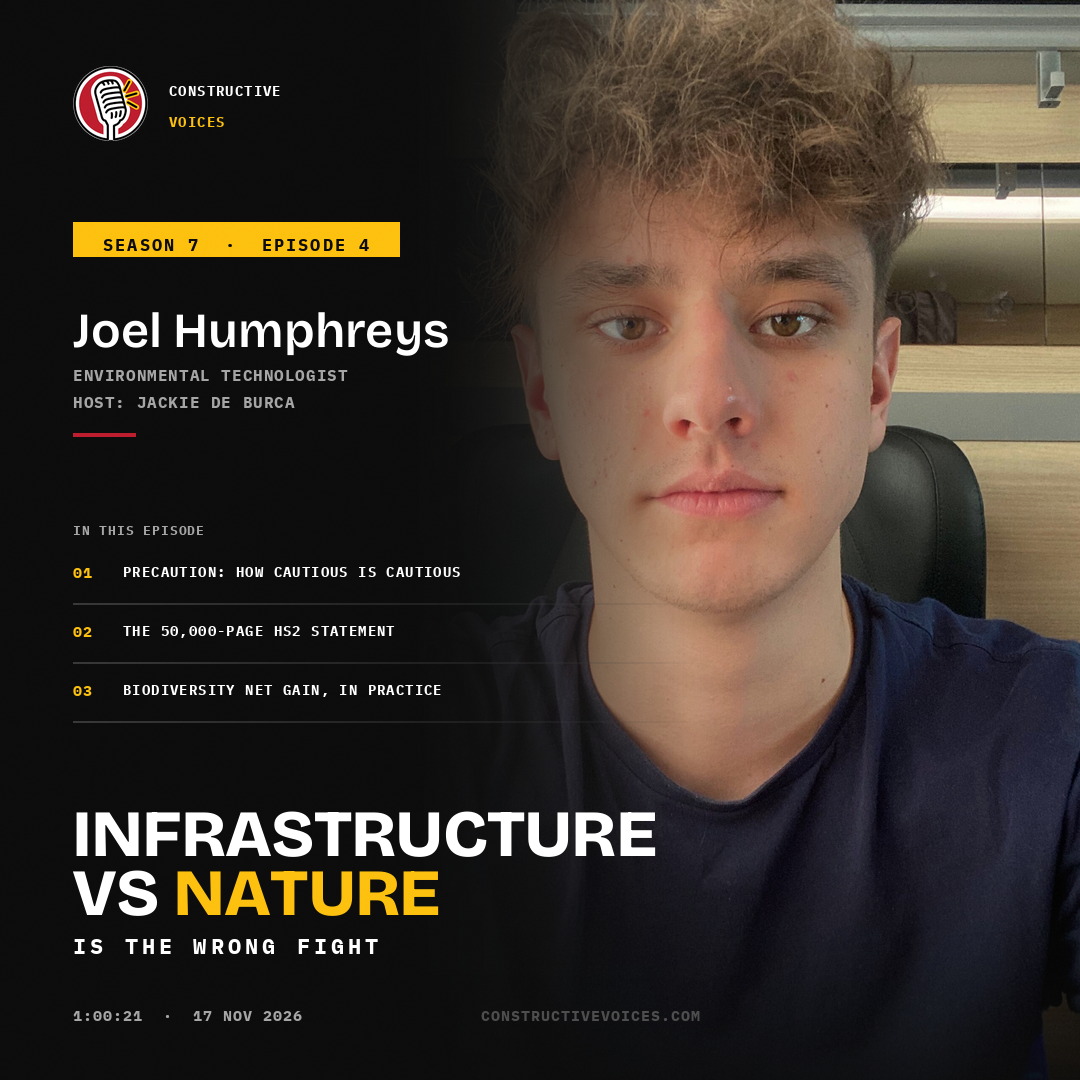
[00:00:09] Speaker B: Hi, I'm Jackie Deberka for Constructive Voices. And today I have a younger guest with me, a chap called Joelle Humphries that I discovered on LinkedIn a few weeks ago, and I was quite fascinated by what he's doing. Joelle, you're really welcome. Thank you so much for coming today.
[00:00:25] Speaker C: Thank you, Jackie, for having me. Great to be here.
[00:00:27] Speaker B: A quick note before we begin. Joelle has worked closely with Natural England, doing independent MSc research that was conducted in collaboration with Natural England.
Today, however, he's joining us in a personal capacity, and the views that Joel shares today are his own, not Natural England's.
[00:00:50] Speaker A: This is Constructive Voices.
[00:00:52] Speaker B: Fantastic. Joelle, a quick introduction. Who are you, what are you doing? And why would people, you know, want to listen on?
[00:01:00] Speaker C: Yeah, of course. So I'm a recent graduate from Imperial College London, and I've been working quite closely with Natural England in the planning, environment, space.
[00:01:09] Speaker B: So whatever you're doing with Natural England for the moment, we're not going to reveal, but we'll probably do that in a future episode at a time where, you know, it's ready to be revealed. However, I guess I'm very curious, Joelle, about your own past, even though you're. You're what age currently? At the time of recording,
[00:01:27] Speaker C: I'm 23.
[00:01:28] Speaker B: 23. Okay.
So it won't be too hard for you to remember.
Is there some moments or inspirations from your childhood that has kind of led you on the path that you're on currently?
[00:01:40] Speaker C: Yes, it would definitely. It may sound a bit corny, but
[00:01:45] Speaker B: go on.
[00:01:45] Speaker C: I loved volcanoes and earthquakes and all those natural disasters as a kid, and it really captured me.
It really drove me down, this sort of understanding of the environment and the beauty of it.
So I'd probably highlight that as a main starting point.
[00:02:00] Speaker B: That's amazing. What are your youngest memories of feeling like that?
[00:02:04] Speaker C: I can definitely remember being walked around Richmond Park. It's a local park to me in London, and it's grand. There's loads of deer. And I can remember just the idea of how this may have been a volcano once in the past or may have been experiencing different storms and earthquakes really resonated with me as a kid.
[00:02:23] Speaker B: And that came to you just because of the influence of the environment or you have an older person who influences you in that way as well?
[00:02:31] Speaker C: I would definitely say my dad was quite actually environmentally orientated. He grew up in a rural area in parts of near Wales. So it was definitely for him easy to be involved environmentally.
[00:02:45] Speaker B: Okay. I mean, that's often the case. So listen, fascination to hear all that. But let's just jump in. You're working at the intersection, Joelle, of infrastructure and environmental protection at the age of 23, you said, wasn't it?
[00:02:58] Speaker C: Yes,
[00:02:59] Speaker B: yes.
So how do you describe that tension, obviously, in the days that we're all living in, do you find it to be irreconcilable or do you find that there's some genuine common ground?
[00:03:11] Speaker C: I think it's definitely portrayed as irreconcilable at times, mainly in the media and in different political streams. It can feel like there's a battle going on between development and nature, almost as if one side really has to win and the other has to lose. Of course there are going to be genuine disagreements and we have limited land, particularly in England, different priorities and different decisions about what we should do with it. So conflict is unavoidable. But I do think it is. I think that it should be framed a bit more positive than people suggest. And what the media portrays, there is a lot of common ground. Most people involve one infrastructure that works, but they also want to avoid unnecessary environmental harm.
So I don't think it has to be this developer versus regulator or infrastructure versus nature. Hopefully today we can explore some of that common ground and some of the ways that we bring those different perspectives closer together.
[00:04:04] Speaker B: Okay. I mean, yes, a lot of us have that same hope, Joelle. Society obviously needs new energy, transport and water infrastructure.
That's not, you know, it's not something that we need to debate. But every major infrastructure project does have environmental impact.
So the question it isn't should we build, but how can we build responsibly?
Is that a fair way to frame it, do you think?
[00:04:27] Speaker C: The buzzword that is thrown around quite often is the sustainable development.
That's the idea that we're building for the long term and caring about all different aspects of nature. It is important to remember that infrastructure is vital for an economy, though. In the UK we've struggled to deliver major infrastructure quickly and consistently, especially in recent years. And I'm sure some economists will link this to why we are suffering with wider, slower productivity and growth problems.
But at the same time, we're starting from a difficult environmental position.
Infrastructure matters, but the UK is already one of the most nature depleted countries in the world due to the centuries of change to our land and industrialization and recent rapid development.
So it does matter. But it is also important to be responsible
[00:05:14] Speaker B: Absolutely. Okay, so now when we talk about environmental impacts, Joelle, what does that actually mean in a major infrastructure approval?
You know, what gets measured and what doesn't.
[00:05:25] Speaker C: It's a great question because environmental impact can mean almost anything, depending on the project, really. So at the big end, you might be talking about an offshore wind farm affecting seabirds, a railway cutting through an ancient woodlands, or the local impacts like a nuclear power station living next door to one. At a smaller end, it can be something very subtle, something, you know, you get these stories about protected species of newts and, you know, projects stalled by just, you know, tiny sets of animals. But those impacts are rarely under, usually understood through the different environmental assessments, models and field surveys. But every site is different. So an offshore wind farm on the east coast might affect seabirds differently, different fish habitats or the migration routes that these fish and birds take. The seabed conditions will be different, the species will be different, the nearby communities to different projects will react differently.
So it's important to understand that when we're talking about environmental impacts, it is very, very context dependent. And that makes it difficult to predict impacts before a project can be built.
So you can use models and surveys to define what an environmental impact might be, but there will always be some uncertainty. And context matters enormously.
[00:06:37] Speaker B: Absolutely, absolutely. And the precautionary principle, I suppose, is meant to help when scientific certainty like that lacking and also, you know, the specific site that you're dealing with. But what does that actually say and how does it work in practice in the NSIP approval process?
[00:06:54] Speaker C: Yeah, the precautionary principle is basically what you do when the science cannot give you the correct answer or give you an answer, a certain answer. Should I say if there is a credible risk of something serious or irreversible environmentally happening, you shouldn't ignore that risk. You just can't. It's written into law practically that the evidence, if the evidence is incomplete, you must err on the side of caution to understand this better. If you take offshore wind and you're trying to figure out the impacts of a turbine spinning on seabirds, a collision model might give you a fairly wide range for how many seabirds could be affected. The most likely outcome might be relatively limited, but there may also be a credible higher impact scenario.
Precaution means you have to take that uncertainty seriously and go with the assumed worst outcome. Now, that can create tension in infrastructure planning, as I'm sure you may gather, because developers naturally want decisions based on the most realistic outcomes with regulators have to by law think about what Happens at the worst case when estimates are wrong.
And in reality that mainly translates into costs. It means more surveys, it means changes to projects, delays while they try to reduce that uncertainty and control the risk.
So the real question becomes, in my opinion is, you know, the age old question is how cautious is cautious enough?
[00:08:15] Speaker B: Yeah, I would absolutely agree with that. And I guess, you know, here's the tension I see. Joelle, Environmental science is always incomplete. You know, you'll never have all the evidence. So you know, how much is enough? It's a judgment call, not a technical question.
How do you make that judgment?
[00:08:32] Speaker C: Well, there always has to be enough evidence to understand the likely effect. But how much evidence you should need needs to be proportionate to the scale and the seriousness of the effect. So if you likely to have a really devastating impact, you need to have a lot of evidence to simulate why it won't happen. This is really where regulators come in. If the potential impact is small, you would not really expect much evidence to be gathered. But on the other hand, developers do need to produce a lot of evidence because there are so many protected species in the UK and so many protected wildlife. I'll go back to the offshore wind as a good example and to back to birds really, because for developers it may, collecting data may take two years, you know, because you need to get two different sets of. You need to get. If birds are only coming once a year, you at least want two sets of data before you figure out a pattern. But two years, when you think about it, is a long time when you're funding surveys, waiting for construction to start.
But scientifically it can still. It only needs two cycles. You really do need that two cycles. So guidance itself recognizes that longer monitoring may sometimes be needed because, you know, the burn numbers may vary significantly from year to year. And the tension is that the scientists, regulators might have to make a judgment immediately, say, do we understand the rest well enough, the risk well enough to make a decision right now? So there's a massive timescale issue.
[00:09:49] Speaker B: Yeah, definitely. And I think that, you know, it's hard to avoid the amount of times in the media that we've all seen that the scientists are themselves shocked at how fast climate change is actually occurring.
[00:10:03] Speaker C: Definitely.
[00:10:04] Speaker B: Yeah. So that of course is, you know, it's a huge factor. Joelle, if a developer proposes a major offshore wind farm and the environmental assessment says, well, yeah, there could be impacts on migratory bird populations, but we're not certain of the magnitude. Well, what happens? Do you approve it?
You know, is there a need for More evidence or do you reject it?
[00:10:25] Speaker C: Yeah, typically the first response would. The first response would be to ask for more evidence, especially if the possible impact is significant.
But it is important to remember that regulators are not the final decision makers on whether a major project goes ahead.
Their role, especially like Natural England, their role is to assess the risk and give advice, statutory advice.
So for a major infrastructure project, the final decision ultimately sits within government and the planning spectra and whoever the head, the Secretary of State is, that will be their decision to make.
So what really matters here is the government policy. If a particular type of infrastructure is seen as strategically important, governments will be more willing to accept some residual environmental risk and uncertainty provided there is mitigation in place.
So it is really, it is rarely as simple as approve, reject or you know, we need more evidence. It ends up becoming a balancing game between evidence, risk, environmental protection and the wider public need for whatever that project is supplying.
[00:11:29] Speaker B: Yeah, and also of course, you know, given that two year time period that you've mentioned shortly ago, of course, that the people making the decisions could have changed during that period as well. Meaning, you know, the government, which. Yeah, it's another, you know, things that thing that can complicate everything, isn't it?
[00:11:47] Speaker C: Yeah, definitely. I mean we recently had quite a pro offshore wind Secretary of State in Miliband. And you know, moving forward, that risk appetite for stuff like environmental degradation or seabird impacts as we were talking about earlier, may alter and that just makes everything slightly more confusing.
[00:12:05] Speaker B: But
[00:12:05] Speaker C: the government specifically in energy have been quite clear on the path to net zero and the value of that.
[00:12:12] Speaker B: Yeah, absolutely. So I imagine the cost of being wrong is different for different people. Like say for example for the developer, delay costs a huge amount of money potentially for a regulator approving a project that causes serious environmental harm is going to be politically risky and for the community it's kind of a quality of life trade off.
How do you weigh those different risks?
[00:12:35] Speaker C: Yeah, it's a really difficult judgment because so many different people are exposed to so many different risks. I mean government policy and the wider societal value of a major project, as I just said, matters quite a lot and will be the sort of defining tool of how much risk we are willing to take.
But major infrastructure decisions also give different stakeholders a formal chance to contribute. So resident statutory bodies, different regulators, like Natural England I worked with and other interested parties do raise their concerns and submit evidence and challenge parts of the proposal through the planning process.
And that can really do. That does change projects, designs do get altered. Mitigation Gets added routes, move, site selection changes. I mean, so public and stakeholder input does matter. I think a nice example is the Heathrow Runway expansion.
In the news. A bit more recently, the current expansion framework is being tested against, you know, do we need more airports? What are the impacts on the economic growth, you know, what will it contribute to climate change and you know, what are the air and noise quality impacts of it to the local communities and they are being consulted. And, you know, this is probably explaining why this third Runway of taking there's been delayed for so long. So the question is not really whose risk matters most. A lot of time it is, you know, how do you weigh those risks? Fairly and against the public interest.
[00:14:04] Speaker B: Definitely. And here in Spain, as you'll have seen on the media also, of course, you know, tourism is huge and of course there's been lots of kickback in the last couple of years to that. So I guess, you know, looking, I know Heathrow is London for those people listening who don't know where Heathrow is. You know, I know it's a less condensed type of tourism as it might be in some of the Spanish resorts, but it still will, further down the line have all those kind of effects, the direct airport effects that you've just spoken about yourself, but then also the knock on effects to people feeling that they've kind of lost their place to the tourists, you know,
[00:14:41] Speaker C: definitely.
And I mean, the Heathrow example is quite a good one and I imagine it will resonate with people across the world because there will be displacements if this project goes ahead.
So it's.
[00:14:52] Speaker B: Yeah,
[00:14:53] Speaker C: and it's good to see that in, you know, different planning instruments, these people's opinions are put to the test, really. And paired against the wider public interest.
[00:15:02] Speaker B: Yeah, absolutely. So, yeah, it's a huge. It is a great example. And you're right to say that as well, Joelle, that, you know, people across the world will be interested, you know, and resonate. So moving on to the next question, the precautionary principle that we touched on earlier, that suggests, Joelle, that we should be cautious, you know, when harm could be serious or irreversible, possible. But almost everything has some risk of harm. How do you know when to invoke precaution versus, you know, when to say that risk is actually acceptable.
[00:15:32] Speaker C: Well, the truth is there really isn't a precise point where you can say this is where precautions should start and this is where the risk becomes acceptable.
This is why decisions are so difficult. I mean, almost every project carries some environmental risks. So the question becomes whether that risk is serious enough, likely, or, you know, and it just ends up going back to the idea of proportionality. You look at the scale of the possible harm and how uncertain everything is, and, you know, then you judge how important the project is.
But there is always going to be judgment involved and it's a human side of things that, you know, is quite complicated. You can never really remove uncertainty completely, especially when you're planning infrastructure. So at some point, somebody, that is the government most of the time, and different planning bodies have to decide whether the evidence is good enough and the risk remaining is acceptable.
[00:16:28] Speaker B: Absolutely. Now, you mentioned that one positive is the environmental research generated alongside major infrastructure. The Offshore Wind Evidence and Change Program as an example. Like, in a sense, infrastructure becomes also a platform for learning. But doesn't that flip the burden? Shouldn't we know the impacts before we build, like, not afterwards?
[00:16:47] Speaker C: I would say, yes, ideally, yes, you do understand as much as possible before you build. That is the goal. Developers spend, I mean, huge amounts of money trying to model that reality into existence.
But some effects only become clear once infrastructure actually interacts with the environment over time. That's why learning from previous developments is so important.
I think it's something we need to do more of as a sector. The more evidence we build across projects, the better our future assessments and decisions can become.
[00:17:15] Speaker B: Yeah, absolutely. And I guess although we'll say England and obviously Scotland and Wales and Northern Ireland, you know, they'll all have different terrains, depending, of course, within each country, like anywhere else, you know, even within the country there's different terrains.
So, A, you've got the fact that, yes, it'd be better to learn from a previous project, but B, it's probably quite challenging to find something that's almost like a photocopy of what you're about to do.
[00:17:41] Speaker C: And there's no two sites are ever going to be the same. And. Yeah, so it's important to factor that in before you make presumptions about what a community or a different species may interact with.
[00:17:54] Speaker B: Yeah, there's an awful lot of challenges now. Some impacts are considered to be reversible. Bird mortality can be mitigated with design changes. I mean, I'm asking you this question, but even reading it out to me, I'm like thinking, you know, it's reversible, but those birds have died, you know, obviously they're not going to come back to life. Some are not, you know, like habitat loss and species extinction. Does that distinction matter in the approval framework?
[00:18:20] Speaker C: It really does matter. Some environmental impacts are much harder to accept because they may be irreversible. England and any of your listeners in Europe will be happy to know that we have very strong legal frameworks around protected sites and species. If a project could adversely affect the integrity of any of these sites, the bar for developing that infrastructure gets much, much higher. The developer then has to show that they have considered all possible alternatives, that the project is genuinely, absolutely necessary for public interest, and then what ends up happening is this compensation secured. So a lot of that framework originally actually comes from European nature law, particularly the habitats and birds. I think it's directives, but that sort of stuff. And you know, even in the uk, much of it remains after Brexit through the habitat regulations. So in practice, developers and planners usually work very hard to avoid getting to that point in the first place. They try to look at as many different routes, designs and mitigation options. Because once you are talking about irreversible damage to a protected site or species, the legal and evidential hurdle becomes much more difficult to clear.
[00:19:29] Speaker B: Yeah, obviously. And I remember a few years ago at the time that biodiversity and that gain was coming into law and so on the course that we prepared with Claire Wansbury, who and various other people, one of the modules of that is the mitigation hierarchy, which of course is just, it's, you know, that term. And that process is such a big part of what we're talking about today, Joelle, isn't it?
[00:19:51] Speaker C: Yeah, definitely.
[00:19:52] Speaker B: So going back to climate change, you know, massive environmental harm is probably like. Yeah, it's not an understatement. But anyways, it's probably the biggest massive environmental harm that we're dealing with right now. Does that change the calculus for approving infrastructure, like we'll say the likes of renewable energy, even if there are local ecological costs?
[00:20:16] Speaker C: Yes and no.
Climate change is a huge driver of infrastructure policy. You can see that very clearly with the push for offshore winds and solar and recently the push to upgrade the grid. But it is not the only thing that the government is trying to achieve.
As you can imagine, obviously, economic growth, having houses are all major priorities. More recently, data centers are a very interesting new development getting pushed very, very fast through the planning space.
And that is because, and they are, they, you know, the amount of energy they are using means that goes against our climate to climate agreements. Data centers are going to be using a huge amount of electricity and it will also mean we need to upgrade the grids more. And you know, so climate change definitely matters. But it does not automatically come first. Governments are constantly balancing it against other economic and strategic priorities.
[00:21:12] Speaker B: Sure, absolutely. You know, you've pointed to something earlier on that I think is very important, which is, you know, moving away from the developer versus the regulator, so toward, like, a shared understanding.
But is that actually possible?
Don't they have fundamentally, like, different incentives?
[00:21:29] Speaker C: Yeah, they definitely have completely different jobs. But I believe that, you know, trying to get everyone to understand each other is the key to making this whole scheme and system work.
For me, having shared understanding isn't just about having the same information. It's about working with the same guidance, you know, using the same rule book, looking at the same evidence. And understanding where a constraint might be for one party can give leeway and where the project may not have to go ahead in some aspects, it's about knowing where the tensions lie. And, you know, that might mean understanding some very difficult, legally challenging pieces of evidence, but I think if we go towards that as a country and, you know, as a sector, I think if everyone is on the same page and as you say, singing from the same hymn sheet, the process can become much smoother. The problem, obviously, is, you know, shared understanding is not always there.
[00:22:31] Speaker B: Sure, yeah. And I mean, the planning inspectorate guidance emphasizes correctly so, early and meaningful engagement between applicants and public bodies.
I mean, what, in your view, with your involvement with Natural England and your experience to date, what does meaningful actually mean?
[00:22:48] Speaker C: The idea is really to get as much advice into the project as possible while it is still young and flexible. You know, not before it can really, you know, while it can still be altered. It means identifying the big environmental issues early on, before, you know, the designs are fixed and before the. Before changing a project becomes much harder or much more expensive for developers is also about showing their cards a little earlier and building relationships with regulators sooner and creating trust between different stakeholders. You know, it's a very important thing and it has to happen early. So meaningful engagement is not just basic consultation and rounds of meetings. It is about tackling the major problems early enough that you can avoid them in the design process.
[00:23:32] Speaker B: Right? I think that certainly, and I wouldn't like to put a number on it, but in whatever amount of the last few years, this is a huge cultural change, isn't it, between developers and, you know, other interested stakeholders, if you like. And I imagine a developer normally comes to the table with a project that they've already decided to build, and communities, they come with concerns they've already formed. So how do you create a genuine dialogue in that context?
[00:23:58] Speaker C: Well, you need to be upfront with the communities involved and you need to have really strong, open conversations with them. A lot of projects will hedge on whether communities can get behind it.
I can think of some pretty important ones happening right now where you've got fishing communities in Scotland and you've got visual and you've got fishing communities around the Isle of Man in the. In the Irish Sea.
And, you know, it makes it very challenging not to. To build a project if they're not involved. So it is regular, early and both informal and formal conversation.
A lot of developers nowadays will sort of take the approach of embedding themselves within a community and maybe offering college courses or in engineering for whatever infrastructure they're doing or promising to hire from local communities and trying to benefit.
Hosting park runs is another one I've seen.
So it is about embedding yourself in the community as early as possible and building that trust?
[00:24:57] Speaker B: Yeah, I mean, I think that's. Obviously, it's an intelligent strategy, at least, you know, they're attempting to give something back. But let's say that early engagement surfaces a real conflict. A community is like really deeply opposed to a project and, you know, it's not just about the process and the communication, they just don't want it.
So can engagement and those kind of tactics resolve under those circumstances?
[00:25:21] Speaker C: Sometimes engagement can help solve a conflict, but sometimes disagreement is fundamental and it simply cannot.
HS2 is a good example of this, actually, for your listeners who are not aware, it is a train line cutting through England that has had massive pushback and is taking a while to develop.
Some communities faced relocation noise and years of disruption. In cases like that, the engagement is not going to make people suddenly support the project, but it can still make a huge difference to how people experience it. There have been cases where HS2 was criticised for poor communication with families whose homes have been acquired. And that damaged trust, you know, the damaged trust really made a stressful situation even worse.
So engagement does not always solve the disagreement. Sometimes its value is in making sure people feel heard, understand what's happening and have a genuine chance to influence what can still be changed. If a project reaches a point where people feel decisions are fixed and communication is broken down, that can really pile another problem on top of a really difficult project.
[00:26:25] Speaker B: Yeah, and I think HS to, you know, for our listeners who aren't UK or close enough to the UK to know what it is, it's a great one for people to Google and, or Bing or, you know, any of the search engines have a look, because It's a great example that you've just given scientists and developers, regulators and the communities that we've obviously touched on. They all have different, you know, responsibilities and roles to play, different expertise. What would it take for each of them to actually understand the other's perspective, do you think?
[00:26:55] Speaker C: Put simply, the planning system expects developers to engage with regulators and communities, and it's put onto them.
How well that happens does vary quite a lot. I mean, some developers are really good at it, others have much more money, expertise and resources, obviously, than the community they are dealing with or the small stakeholders they are dealing with, which can create a massive power imbalance. You know, who really understands what's being built and who doesn't, who can influence things legally and who can't.
That is less common nowadays. But developers in development, that does happen where communities can get bullied and outpriced. That is why early engagement can become so important.
You really want people's positions and concerns to be understood before designs and solutions become fixed, so that these sorts of imbalances don't have to persist. There also needs to be support for communities and regulators to participate properly.
So whether that is through these liaison roles and independent chairs or regular meeting, a lot of the idea I want to talk, I talk about with shared understanding comes from simply giving people enough time and access and support to actually talk to each other.
[00:28:03] Speaker B: Yeah, of course, that's so important. And, you know, there's been some very good results. I'm not going to start delving in with loads and loads of conversations and questions to go through still, but there have been some very good examples of when the community has been properly engaged. So, you know, it's really vital these days, of course, environmental groups, rightly so, they talk about greenwashing developers claiming environmental benefits that they actually can't deliver.
From a regulator's perspective, how do you and people that you work with distinguish genuine environmental commitment from marketing?
[00:28:38] Speaker C: Yeah, uk. I can't speak too strongly on Europe here, but I know UK environmental regulation is quite strict and in my experience, most developers are genuinely trying to deliver environmental outcomes.
It is also worth remembering that many of the people working on these projects are environmental professionals themselves.
So a lot of planners, you know, will have an environmental background and a lot of them will have worked for regulators before. So it is not always the simple idea of, you know, a developer on one side and environmentalists on the other. The legal framework makes it, as I mentioned, very. Is very strict. It simply makes it difficult if commitments are written into the decision and the consent is given. Developers may have to provide evidence after approval to show that what they are doing and the environmental requirements they did are actually being delivered.
[00:29:28] Speaker B: Absolutely. Communities understandably distrust both developers and regulators. Now I say understandably, more so on the developer side. There they worry obviously about the regulators, you know, they're captured by industry, or you know, that approval processes potentially could be rigged. Do you think that distrust is justified?
And if it is, how would you rebuild that trust?
[00:29:50] Speaker C: Distrust is really sensitive issue for both developers and regulators.
If a community does not trust the people behind a project, it just makes everything so much harder. Scotland is actually a really useful example in this. In areas with strong links to oil and gas, the transition to offshore wind can feel very uncertain.
People, especially around jobs and local economic benefit, you know, people aren't sure. And Scottish government research has shown us that people working oil and gas are particularly concerned about what the net zero transition can mean for their jobs. And, you know, it makes sense. While communities also want to see, you know, they want to see more local employment and tangible benefits from these renewable developments. So trust is something that really has to be built over time.
Engagement helps and early engagement helps. But also does seeing, you know, real jobs in your community having investment and benefits that can actually effect on a local level, not just the wider public interest?
[00:30:46] Speaker B: Absolutely. Now, going back to biodiversity net gain that we touched on very briefly earlier, that's kind of interesting, Joelle, because it flips the question from like, minimize harm to leaving things better. And as of November 2026, major infrastructure in England needs 10% net gain. How does that change the conversation?
[00:31:07] Speaker C: Well, I think this is thankfully where the conversation can become a bit more positive because infrastructure could actually leave nature better off. Now, biodiversity net gain is one of the most exciting ideas currently going through the environmental planning space. The basic principle is quite simple.
If you are going to build something and affect nature, you should leave biodiversity in a better place than before. What I like about this is it turns environmental improvement into something you can actually plan for, measure and fund.
That will mean more money going into habitat creation and restoration.
And going back to that local idea I just mentioned, you know, more visible benefits for communities. I also think it moves the conversation just, you know, away from how much damage can we avoid, towards a positive framing of what can this project actually give back to communities.
[00:31:54] Speaker B: A clarification.
Mandatory biodiversity net gain for major infrastructure in England applies to applications made from 2 November 2026.
Offshore projects beyond the intertidal zone are excluded.
So for now, it doesn't cover the offshore wind farms we've been talking about.
[00:32:17] Speaker A: This is constructive voices.
[00:32:20] Speaker B: Of course, I remember back then you would have been in university at that stage, going back to a few years ago when we were creating the course and, you know, it hadn't even come into effect and then the date for coming into effect, you know, was pushed out. So it was something that at that stage wasn't even tangible. And I think that, you know, there still are, I suppose, active questions like, for example, how do you actually measure a 10% biodiversity improvement? Is it like through the acres of habitat that have been restored, species recovered, something else, or like a mixture of everything?
[00:32:52] Speaker C: It's measured using a metric which looks at things like size, type and condition of habitats. So acres is perfectly reasonable, you know, measurement for it. You know, those factors, the size, type and condition are converted into a unit, biodiversity unit, I think they call it, and it essentially gives giving aspects of nature a score. You know, I think it's 1 to 10 from memory, maybe 1 to 5. So you can compare what was there before with what the project will leave behind. The aim is for the value after development to be, you know, at least 10% higher in terms of these biodiversity units from where it started.
[00:33:30] Speaker B: Yeah. And what about Joelle? If a developer has to, like, achieve that 10% net gain, won't they be perhaps kind of tempted just to offset that damage somewhere else, restore habitat miles away instead of mitigating, you know, the local impacts?
[00:33:44] Speaker C: Yeah, this can definitely be one of the main criticisms of biodiversity net gain. In theory, you could damage nature in one place and create a habitat completely elsewhere, but the system is meant to avoid that becoming a default. The law sort of points developers that they're expected to avoid and reduce damage first and then move and improve, sorry, improve biodiversity on sites where possible, and then offset gains can come from after that. And government biodiversity credits are meant to be the final result.
So there is a hierarchy preventing this. But, you know.
[00:34:16] Speaker B: Yeah, I
[00:34:16] Speaker C: know. I think the principle is sound.
[00:34:18] Speaker B: I know, I know. But look, it's like, I suppose, you know, any country, anything so new and so different to what was, you know, in place before. It's not going to be from, you know, the law going into force and being tried out in a few, few different places. It doesn't go from one day to the next into something that's in a state of perfection. You know, that takes time and examples, as you talked about earlier on as well, isn't it?
[00:34:43] Speaker C: Yeah, definitely.
[00:34:44] Speaker B: For a developer, having to achieve net gain changes their economics which is of course one of their main driving forces. Do you think sometimes that will just make a project infeasible after all?
[00:34:57] Speaker C: There is definitely a debate around that and I think different developers will give you different answers.
But from my experience, some developers are already, well, most developers are already choosing to deliver biodiversity net gain before it has been legally required. And I've spoken to some developers who believe 10% isn't high enough.
And I can give you an example of a nuclear power plant. Well, you know, they, you know, like I said, I've spoken to developers who believe that they really want to push for more and that 10% isn't enough. So I would say, you know, biodiversity net gain automatically doesn't automatically make a project unviable. Yes, it does add cost. It's meant to. But many developers already see the value in going further and you know, they can see the value of it to their reputation and to their. Also the long term, just value of having nature.
[00:35:47] Speaker B: Yeah, absolutely, absolutely. So you mentioned the new nuclear power plant. Is that sort of the best example that you can think of of, you know, an infrastructure project that has left nature better off or that hasn't actually happened as yet. That's, you know, in the making.
[00:36:03] Speaker C: No, this is a really good example is size. Well sea. And
[00:36:06] Speaker B: okay,
[00:36:09] Speaker C: so alongside the nuclear project, around 250 hectares of land are being used for new habitats and nature reserves, including wetlands, grasslands, woodlands and from memory, I mean, I think the project is targeting around 19% biodiversity net gain, which is well above the 10% minimum.
[00:36:29] Speaker B: A note on Sizewell SEA, that 19% is the developer's own projection calculated with an earlier version of the biodiversity metric.
During the planning examination, Suffolk Coastal Friends of the Earth argued the claim was misleading. A submission from the local parish council and Stop Sizewell Sea put the real gain closer to 15% and as low as 4% over the plant's working life.
Sizewell C also predates mandatory net gain for major infrastructure, so its target is voluntary. We've linked the examination documents on the episode page.
[00:37:11] Speaker A: This is constructive voices.
[00:37:14] Speaker B: So a question that might seem a bit unfair if there's a major energy infrastructure project that genuinely helps climate change but at the same time causes local environmental harm that can't be fully offset. Do you feel that that should go ahead or not?
[00:37:30] Speaker C: Wow, that is definitely. It's a strong matter of opinion and you could have a great debate on this podcast between a biologist, an ecologist and a climate scientist one day. I mean, personally I would come down on the side that the wider climate and energy security and the economic benefits of energy infrastructure do outweigh the localized environmental harm.
That does not mean the local damage does not matter. Obviously it doesn't. And I think everyone would agree that and would love to see it avoided as much as possible. But you know, if we are serious about decarbonizing and building a more secure energy system, there will be trade offs.
[00:38:07] Speaker B: Yeah, absolutely. Great answer. That was a horrible question.
[00:38:11] Speaker C: It's okay,
[00:38:11] Speaker B: talk me through. Like an actual major infrastructure approval, you know, the developer proposes something, what happens next? How long does it take?
I know it's not as long as a piece of string scenario, but what are like the decision points?
[00:38:25] Speaker C: It takes years and years. I mean, you start with the early scoping, you try and figure out, you keep the design as flexible and as broad as possible and then the developer will start consulting with regulators, authorities and gradually trimming down what can and can't be in the project and what can and can't work as different regulators and communities, you know, have their say. From major projects to you. You are aiming to get something called, in the UK is a company called a DCO Development Consent Order. It's a really powerful piece of legal permission that can give you. Sorry, gives you permission to build a nationally significant infrastructure project. Once granted, it can give a developer powers to acquire land. You know, essentially a landowner cannot say no.
It can.
You can demolish buildings, divert roads, stop utilities reaching houses and carry out major works. So getting a DCO is a huge milestone and that is not just a permission to build. It can give the project the legal powers needed to actually make everything happen.
So once the DCO application is submitted, the planning inspectorate will check it and then there is a formal examination where evidence is tested and hearings take place between different stakeholders. This can take probably about six months they aim for, but longer. And after that the planning inspector makes a recommendation to the relevant Secretary of State and he will come up with a final decision. I'll go back to the size, we'll see. Because just to show you how long of a process this can sometimes take.
[00:40:04] Speaker B: Okay.
[00:40:05] Speaker C: The first formal consultation started in 2012.
[00:40:07] Speaker B: Wow.
[00:40:08] Speaker C: And the DCO application wasn't submitted in 2020.
[00:40:12] Speaker B: Yeah.
[00:40:12] Speaker C: So that's eight years,
[00:40:13] Speaker B: obviously. Okay. Yeah.
[00:40:15] Speaker C: And then for it to get granted took another two years.
So, you know, we're talking about a good decade between the first major consultation and consent. And that's before you haven't even put anything in the ground yet.
[00:40:26] Speaker B: Yeah.
[00:40:27] Speaker C: So it's a lot of money, a lot of surveys, a lot of engineers and you know, that you need to pay for years before construction can begin.
[00:40:35] Speaker B: Hmm. Okay. And what about, you know, when a decision maker actually changes their mind based on some new environmental evidence, which is quite possible, you know, considering the timeframes that are involved?
[00:40:49] Speaker C: Well, ideally, most of the big environmental questions get asked at the start and they're dealt with before formal application is even submitted. The whole idea is that it's front loaded, work out problems early, do the surveys speak to people and try to agree solutions.
You don't really want to be going into the later stages with fundamental issues lingering, although that does tend to happen. But just to give you an idea again of how large these documents are that we're dealing with here and the amount of evidence that can get submitted. For the environmental aspects of a dco, you're looking at everything from obvious things like loss of biodiversity, but you're also looking at the risk it can have on flooding impacts to, you know, views of the sea, archaeology, contaminated land.
You know, you have to look for unexploded bombs. And these are all chapters in a massive book or some of these. You know, the HS2 environmental statement was around 50,000 pages and when I googled just before this, Harry potter was around 4,000 pages, the whole entire series. So you're reading Harry potter, you know, 13 times before you even cover phase one.
[00:41:56] Speaker B: That's a brilliant comparison. I love that. That's fantastic.
It's, it's, it's amazing to hear you as particularly because, you know, you're just obviously coming out of university and so you're very fresh coming into this world and even somebody like yourself being so blown away by 50,000 pages versus Harry Potter. It's amazing, isn't it?
[00:42:18] Speaker C: Yeah, it's incredible. I mean, I don't have any facts for you on how, you know, high up a 50,000 stack of sheet paper would be, but you know, you're talking several meters here, so.
[00:42:27] Speaker B: Yeah, of course, of course, yeah.
[00:42:29] Speaker C: So bringing all this evidence together, understanding it, you know, and then challenging it for a regulator is a, it's a massive task. It's a behemoth.
[00:42:37] Speaker B: It is, it is. And sometimes as well, you know, smart, kind of well intentioned people can disagree, you know, profusely and profoundly about whether a project should even go ahead. So the environmental scientist is saying one thing, conservative conservation group are saying another thing. Developer has a different reading of the data.
How do you guys and girls resolve that?
[00:43:00] Speaker C: I think it comes back to, you know, from my experience working Making sure everyone is on the same page and, you know, having that shared understanding. I've heard, you know, stories of two regulators going into the same meeting with a developer
[00:43:12] Speaker B: and
[00:43:12] Speaker C: then when the evidence gets brought up, the regulators start arguing with each other instead of with the developer. So it shows you, you know, disagreements can happen all over the board. The important thing, that uncertainty, you know, you just can't pretend that it's not there and you know, you have to accept it.
So it's about being honest about what you do know and what you don't know and managing that proportionately.
If everyone understands the evidence, the risks and each other's positions, you have a much better chance of finding a resolution.
[00:43:42] Speaker B: Indeed. With so many people involved, so many, you know, stakeholders involved, do you feel that like there's a role for sort of a public preference or democratic voice in these decisions?
[00:43:54] Speaker C: There has actually been discussion quite recently about this, about giving communities independent liaison chairs, essentially someone who can help them navigate the process and make sure they have a meaningful voice. I think it's a shame that this already doesn't exist, but is definitely an interesting idea and should be explored more.
[00:44:11] Speaker B: Sure, I think it makes a lot of sense also. Now, obviously we're approving a lot of infrastructure at the moment. The likes of electric grid upgrades, renewable energy, heat networks, new transport. Are we systemically systematic learning from each project about what works environmentally and what doesn't?
[00:44:28] Speaker C: We are trying to, but it is difficult. I mean, better data storage and sharing, you know, recording how not just environmental outcomes, but also where projects went wrong, recording how disagreements were resolved, recording what actually worked and what didn't. When, you know, debates were happening between developers, developers and regulators and communities, you know, that is often get quite close knit and never leaves the meeting room. But there are key lessons in there that can be explored.
And I think I just want to also point out that when you're learning between projects, ecosystems can also have tipping points.
You know, things might look stable for years while pressure slowly builds up. So think of it like filling up a glass of water. You can keep adding little bits of water and suddenly, you know, one more drop and suddenly it overflows.
So that happens with. It tends to happen with ecosystems. At first everything looks normal, but if one species suddenly drops below a certain point, the entire ecosystem can collapse.
That is why regulators have to be very precautious and very cautious when they're learning from previous cases. Because nature is never predictable.
[00:45:38] Speaker B: No. And I guess in all of these cases there's a team of ecologists hopefully, some of whom know that area very, you know, very well because they've been working in that area for a period of time as well.
[00:45:50] Speaker C: Yeah, definitely. There is loads of professional, great professionals out there.
[00:45:54] Speaker B: Absolutely. So the NSIP process is designed for major infrastructure, but most environmental damage in Britain probably comes from smaller development, housing, commercial road upgrades, all that type of stuff. How does the system handle those?
[00:46:10] Speaker C: Similarly, they still go through environmental scrutiny.
Most people will have to conduct flood risk assessments, make sure they're not keeping within noise and air quality limits and that they're not encroaching on the protected species or whatnot. But obviously the difference is scale. Housing development or a local road screen might have a few specialists involved compared to, I can't even imagine how many specialists there might be on something like what we've been talking about as a nuclear power plant or HS2.
But the cumulative effect does matter. A lot of small developments can add up to a much bigger environmental impact.
That's why enforcing biodiversity net gain is going to be really important.
[00:46:54] Speaker B: Yeah. Much like a guest we had on earlier this year who was speaking about the amount of grass lawns in the United States and what they added up to in terms of like that part of what could be just like nature let go within itself. You know, it's all these small little places that add up to a lot, isn't it?
[00:47:14] Speaker C: Yeah.
[00:47:15] Speaker B: So going back to climate change, Joelle, you know, it means we're obviously in a genuine hurry to decarbonize. Does that change the precautionary principle? Should we be like less cautious about some of the trade offs in pursuit of climate solutions?
[00:47:30] Speaker C: Another great debate and interesting question.
I would recommend your listeners to read, especially the ones from the UK to read our government's recent national Security assessment on the biodiversity loss and ecosystem collapse.
[00:47:45] Speaker B: Okay, bit
[00:47:46] Speaker C: of a mouthful, but maybe I could say it again later. But what makes it especially interesting is. So this is a report done by a national intelligence service, nothing to do with any environmentalists, none of that involved.
And it was eventually published recently after pressure from Disclosure for disclosure. And the conclusions are pretty alarming. It warns that ecosystem collapse could mean that major crop failures, fisheries collapsing, severe water shortages and food insecurity.
From there, the effects spread into higher food prices, political instability and even conflicts between countries for food and water. So this is a government security agency who have now for the first time publicly stated that climate change and biodiversity loss are going to be the biggest threat to national security. That is the underlying assessment and they've come to the Conclusion that we are on the pathway towards this collapse with a realistic possibility starting from 2030.
So I think when we're talking about being less cautious about environmental damage or should we tackle climate change, I think eventually you're picking a poison really.
So I probably am more biased towards having decarbonizing and building energy infrastructure for long term climate resilience. I was biased earlier and I probably still would be now because I like infrastructure. But the wider point is that protecting nature and tackling climate change are not going to be separate in the long term.
[00:49:22] Speaker B: No, no, no. I mean I saw about that report already myself.
Guess you know, hearing what you're saying, I can't help but think about all of this is very powerful and incredibly worrying obviously. But unfortunately, let's say the average Joe or Jane is normally in the position that they're going back and forth from work costs have been come, you know, we've got obviously a cost crisis going on as well and they don't really have the time to maybe act as much as they might like to or take on this information that I think is another, it's another thing that makes it more complicated, isn't it?
[00:49:58] Speaker C: Yeah, you can't really see parts per billion of carbon, can we? So it's very hard to act on that, you know, especially as a individual.
[00:50:08] Speaker B: Yeah, I mean it's just again going back to a theme that's been recurring during our conversation today. You know, it is the people who are in the place, they're absolutely vital to the decisions, the right kind of decisions being made moving forward, aren't they?
[00:50:24] Speaker C: Yeah, totally. And it's going to be the people who live in these communities around the infrastructure that are going to have the greatest consequences.
So it's important to really consider the local communities involved.
[00:50:37] Speaker B: It is, it is. Now I don't like the word because we're all. I laugh sort of. Not because it's entertaining or funny, but we're all so aware of this word.
You know, I hear a lot of doom about the environmental destruction, infrastructure. People are doom scrolling. You know, that's how we're far too familiar with this word these days. But you yourself, with your knowledge and with whatever it is that we'll reveal later in the future that you're working on with Natural England, you're coming from a different premise and you feel the infrastructure can be built responsibly it seems and that engagement in frameworks like the likes of BNG can be, you know, actually move us forward towards that. What gives you this confidence
[00:51:19] Speaker C: thank you. I do try not to be glum. I mean, it can be. Infrastructure in the UK can be quite a frustrating topic. But I generally think environmental protection is not the main thing holding infrastructure back. As a country, we are starting to recognize, you know, that biodiversity and the environment have real economic and social value.
You know, this summer has probably made that more obvious to, you know, us as well. We have seen droughts and water restrictions, you know, fish deaths. I mean, it's been pretty brutal with so the environmental problems becoming much harder to ignore. At the same time, there is a, there's political focus on getting infrastructure built.
You'll be happy to know that there's been recently released a 700 billion pound investment, public investment fund spanning over 10 years.
So I think you can see the, you know, the environmental debate itself is moving quickly, but the, the need for infrastructure is also moving quickly.
There's also a new nature rights bill that's being part, that's getting debated right now in Parliament, which is quite unique. It, you know, it goes much further than traditional environmental regulation. The idea is that, you know, nature itself is going to have legal rights rather than something being something that we protect. Yeah,
[00:52:29] Speaker B: because we got into that in Ireland first. I had to show
[00:52:31] Speaker C: that. No, definitely, yeah. Ahead of the game.
[00:52:35] Speaker B: Yeah.
[00:52:35] Speaker C: So there is a lot of debate, you know, in the space, which I think is a great thing.
I think people having conversations much more about, wow, the infrastructure that we need, we need to start seeing things built. The projects that are delayed, we need to start seeing them. But we're also seeing people care about the environment and see the effects of worsening climate change and biodiversity loss. So we're at an interesting point now. We need to protect nature, but we also need infrastructure. So I'm quite positive that the key priorities are there.
[00:53:06] Speaker B: Yeah, I recommend to you. Sometimes I give a shameless plug to another guest, but I do recommend you, if you haven't read it already, Generation Restoration by a man called Tim Christofferson. I'll probably introduce the two of you on LinkedIn at some stage. But going back to the actual, the conversation we're having, what would need to change, Joelle, in regulation, in how developers approach projects and how the communities engage and what the scientists provide to genuinely move that needle on infrastructure and environmental protection?
[00:53:39] Speaker C: Yeah, well, you know, that's a million pound question, isn't it? Million dollar question. Even one idea I think is really interesting that's getting debated right now is the idea of a lead environmental regulator model.
So you have one regulator that coordinates the others, rather than developers receiving separate or even conflicting advice from different regulators. I mean, I've heard examples where Natural England and the Environment Agency, which is meant to be very similar, were giving conflicting advice on a project.
So having one lead role would be I think, great for getting the environmental aspects taken care of quicker. I think also making the DCO process a bit simpler to navigate.
There tends to be a lot of duplication in major infrastructure planning. You know, similar evidence gets shared repeatedly, you know, to, you know, different people at different stages.
So maybe having better coordination along that.
Personally, something I'm quite passionate about because I've seen the incredible work that naturally then do. But I think funding regulators can make a huge difference or funding them better.
More money does not.
[00:54:48] Speaker B: Yeah,
[00:54:48] Speaker C: you know, more money. You know, people have this idea that more money going into regulation will mean more regulation.
No, it should really equate to it being more faster decisions, more specialists and fewer bottlenecks.
[00:55:02] Speaker B: Yeah, it should flow better, shouldn't it?
[00:55:04] Speaker C: Exactly.
And some of the things I've talked about today in my own perspectives, the idea of improving shared understanding, reprioritizing, having earlier conversations and building trust between communities and developers and regulators even, and making sure that the communities and regulators have enough resources.
[00:55:23] Speaker B: Yeah, I know, I know.
It's been a really, really interesting conversation.
One or two sort of slightly tough questions now before, you know, before we come to the end of it. If you could redesign the NSIP approval process, knowing what you know now, what would you do differently?
[00:55:43] Speaker C: Oh, difficult. I mean, redesigning the process.
I think the system works quite well. So any adjustments really would be improvements.
If I change anything, it'd be to make sure that precaution is applied a bit more clearly, you know, and so everyone's on the same page about, you know, understanding, giving regulators clearer guidance on, you know, how much evidence is enough. That would be a great start, I think. But I'd also look at countries like in Nordic countries, mainly Finland, I mean, and recently I read that they are moving towards a one stop shop model for environmental permitting. You know, so instead of going to loads of different developers having to deal with separate authorities and you know, you have one national authority that can coordinate everything and you know, deliver environmental permits together.
And I think this is interesting because it is not really about weakening environmental protection. It's about making the same protections easier to navigate and a bit more predictable probably.
So I wouldn't definitely not, you know, reduce the amount from my own safeguards, but make the process more coordinated and clearer.
I think you would Want, you know, you would want to be at a point where investors feel confident in investing in the uk.
[00:56:56] Speaker B: Yeah, I think that's a great answer. I think what Finland, Finland doing is, you know, also a great example to lots of other countries.
Where do you think Britain will be in 10 years time on infrastructure and environmental protection and what role do you hope to be playing in there?
[00:57:13] Speaker C: Oh, well, I mean, in 10 years time going back to that investment point, I think it'd be really good to see confidence back in the UK economy for investment into major infrastructure and, you know, so developers and investors can see that, you know, things will get finished.
At the same time, I'm really happy with the position that environmental protection is heading in.
We're beginning now to start learning from projects. We are building this evidence base and becoming much more confident about how things actually work and what works and what doesn't work really.
So ideally, personally I'm a massive supporter for renewables, so greater development there and hopefully we can see that feed through into stronger bills and alongside that maybe biodiversity net gain itself can, can be a model that should be imported globally, exported globally, you know, from the uk. I mean, we've done so well here that I want to see biodiversity net gain really physically in communities, you know, that would be a great position to be in.
Yeah, I
[00:58:14] Speaker B: agree with
[00:58:14] Speaker C: you. This is all quite ambitious.
[00:58:16] Speaker B: No, but I agree with you. I remember, you know, X amount of years ago when Clare Wansbury first told me about it and I was understanding it, I felt the exact same. I thought this is something I think they have.
There was somebody I spoke to in Australia who they had something not that far removed, but it wasn't the exact same. But yes, I felt the same, Joelle. I just felt it should be exported, you know, with maybe a higher percentages like we spoke about earlier on.
[00:58:42] Speaker C: Yeah, definitely. I mean, this is just something about, you know, you know, with Britain's struggling to lead on things at the moment, you know, globally, I think this is something that we're getting quite good at, you know, environmental planning, building sustainably in introducing biodiversity and is something we could lead as we go further into the future as a country globally.
Personally, I've only just graduated, so I'm looking to get back into the major infrastructure space. I really enjoy challenges, really challenging projects. The more difficult, the more interesting I personally find it.
And maybe one day I'd love to be in the policy side of things, but I haven't explored those.
[00:59:24] Speaker B: Yeah, I think you do well there as well. I think you do well there as well. So before we say goodbye to each other, I just like to let listeners know that your LinkedIn URL will be on the episode page for those who are interested to get to know you. You know better. The report you mentioned earlier on, you said you might like to mention it at the end again because it is a bit of a mouthful but it would be of interest to many people I believe.
[00:59:48] Speaker C: Yes. So it's the National Security Assessment on biodiversity loss and ecosystem collapse.
[00:59:56] Speaker B: Yeah. That is amazing.
[00:59:57] Speaker C: I really recommend. Yeah, you can tell they don't want people to read it.
[01:00:02] Speaker B: Yeah, you definitely can listen, it's been amazing. I hope that we'll be able to talk again in the future when you have more information to share regarding the Natural England work. But I hope you enjoyed yourself and thank you so much.
[01:00:17] Speaker C: I really appreciate it. Thank you for having me on.
[01:00:19] Speaker A: This is Constructive voices.