Episode Transcript
[00:00:00] Speaker A: This is Constructive Voices. Constructive Voices, the podcast for the construction people with news, views and expert interviews.
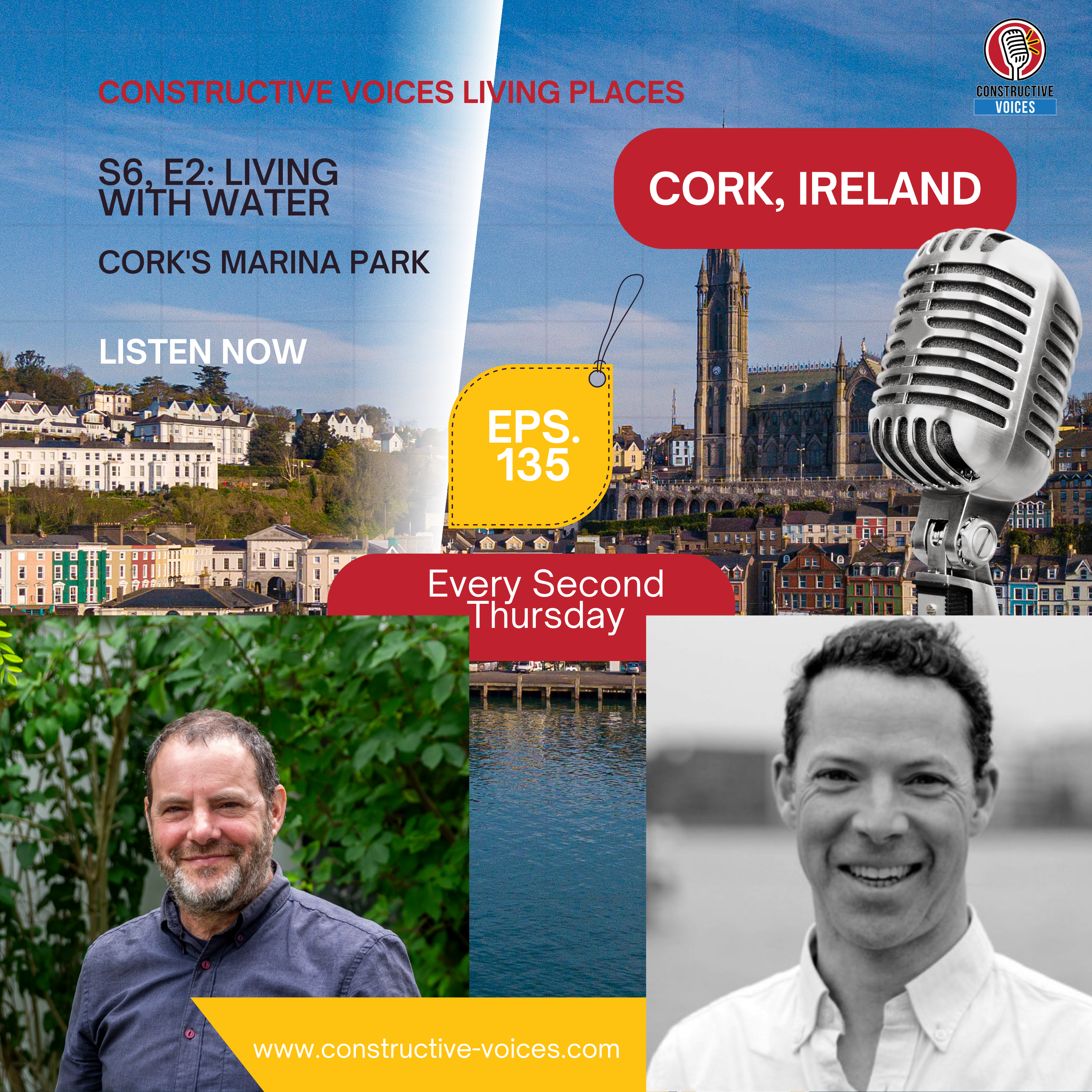
For most of the last century, Irish cities have treated water as a hazard. Walls have gone up around rivers, smaller streams have been piped over, built across or quietly forgotten. Marina park in Cork is one attempt to remember another way. Hello and you're very welcome back to Constructive Voices. I'm Jacket Burka and this is the second episode of our three part about Cork's Marina Park. In episode one, if you haven't heard it, I would highly recommend you listen to it first. We walked through the vision behind the project, its 15 year making and the heritage its designers pulled out of the undergrowth. Today's episode goes underneath all of that, into the philosophy that shapes the whole thing. Both of the designers behind Marina Parr, Patrick McCabe of Redscape and Rani Ishar of Okra Landscape architects in Utrecht, use similar language for it. Patrick calls it living with water. Ronnie has it at the top of a short list of Opera's guiding themes. For both of them, it starts with the same instinct, one Patrick first developed in his years training and working in the Netherlands. This is episode two, Living with Water.
[00:01:19] Speaker B: I mean, I think it's obviously because of my background of design in the Netherlands. You know, it's something which is never taken for granted here, but it's something obviously living in the Netherlands. Water is a key theme, so you're constantly designing water, you're compensating water. Water is a quality. People want to be near the water. And I think it's about taking a lot of that knowledge and transferring it back to the context, to the Irish context. And in fact, the Irish context is very, very different. So we have dynamic river systems in Ireland. So we carried out, for example, an international study between the Netherlands and Ireland Rivers 2040, where we began to kind of showcase how rivers could be designed to become much more central to urban regeneration and greening and so forth. And so many rivers in Ireland, particularly small ones in cities, they tend to form the back, the city isn't orientated towards them. Whereas in the Netherlands, these rivers are actually the front, front side of areas. And of course, most of our towns and villages in Ireland nearly always have some river that runs through them, whether you're in the small villages of Limerick, right up to the almost thin structure of rivers running through Dublin, the well known rivers like the Dodder. But then you have the Santry.
We're working on a lovely project there at the river restoration, but much smaller rivers as well, and they form Key drainage structures within the city. And they're perfectly suited to creating, if you like, a regional green structure, not for just biodiversity, but for amenity and recreation as well. So we can really create these lovely green structures through our city. We create a healthier city and a better way to navigate through the city as well in terms of cycling and walking and so on. So that's living with water, therefore is really one of the basic starting points in landscape. So the water and the existing water and what that does with the soils and the kind of vegetation that that can develop is very, very specific in each part of the country as well, based on the soil types. So it's already sort of a basis for identity and the basis for regeneration. So, yeah, living water for me is something just very, very basic.
[00:03:22] Speaker A: Water as a starting point, not a problem to compensate for rivers as the front of a city rather than the back. That instinct, the one Patrick brings to Redscape, isn't just his. It's shared by his Dutch collaborators and also a whole design practice is now organized around these three themes. Rani Isar of Okra will take us through those.
[00:03:43] Speaker C: Yeah, I think in Okra, quite a bit of we have been the last year we've been redefining how we kind of approach or our strategic approach to project. And definitely we have a couple of themes that came out of it and one of them is living with water relates to climate adaptation, resiliency. We do quite a bit of coastal protection outside of the urban environment, but in urban environment adapt to climate change and resiliency mostly related to water. Kind of other theme is the kind of healthy urban living and well being relates to introducing nature in the public realm, in the cities and, and how it influences daily and quality of life. You know, we're thinking about mitigating urban heat but also contributing by greening to well being. The third one is what we call the rediscovering landscapes. And that's quite a theme that comes from the last years of landscape leading urban development, how kind of landscape thinking guides kind of development of master planning, development of planning in the city. So that sits a bit in the background of this statement.
[00:05:00] Speaker A: Living with water, healthy urban living, rediscovering landscapes.
Those are the three themes at Okra and at Marina park specifically. The first of them takes a very physical form, a hidden valve buried inside the park that decides whether storm water goes back to the river or has to be held for hours until the tide finally drops.
[00:05:24] Speaker C: The river is always a quality kind of the quality of life, the quality of walking along the water. It also brings a lot of risk these days, you know, with climate change, higher levels of water. So quite a bit of the Marina park is based on how to kind of resolve these issues, how to kind of store water. The Marina park is built kind of as taking quite a bit of the stormwater of the Docklands development.
And in times of high kind of storm or high tide, the water has to discharge back into the river lee. But in times of storms, of high tide, this can't happen because there's a valve that sits further in the park and it's kind of locked when the water is too high. So the park actually acts as a sponge. So quite a bit of the water that comes from the Docklands has to be accommodated in the park then. So it's what we call the sponge. And a lot of the park is designed to accommodate for this water. And where the storm is relaxing, the water can be discharged back into the river. So actually what we took this theme and we integrated it in part of the park design, part of how people experience the park. The river becomes part of the park and the water in general becomes part of a strong identity of the park.
[00:07:01] Speaker A: A sponge park. Six air storage windows, water pulled back into the design as identity, not walled out as a threat.
This is what living with water looks like when it's actually built, but it's not a set of techniques. Patrick could just lift from the Netherlands and drop into Ireland. What travels on his experience and what now shapes how he works at Redscape is more like a habit of mind formed early in his Dutch design training.
[00:07:28] Speaker B: Yeah, I think, well, I went to UCD and I was educated there, but as a designer, I was probably more educated in the Netherlands because I also did a design master's there and my practical experience very often is there. I think the beauty of design of the Netherlands is interesting because the first thing you do when you step into a project is you open up with your client, typically, and you say, well, what amazing thing can we be done here? That's the question, how can we make this better? And what are all your ambitions? And let's just put them all together. And it's a very inviting kind of culture, if you like, of design and armament is it can be different now, it's changing very quickly, but it can be quite defensive sometimes. Now it can be very legal very quickly. It can be very kind of precise and detailed. And that is changing, I think, a lot at the moment. So I think. I think my influence is about creating this Open this openness to design and this sort of almost this we can do kind of attitude and opening up those discussions. So I think that's the big influence from the Netherlands, I would suggest. And in terms of climate change, it has to be a lot to do with the role of water and the importance of that and just being aware of all the little parts of designs that can contribute to that at a very small level. So whether it's cleaning water in systems or whether it's, you know, even removing heat stress, which probably sounds a little bit strange in Ireland at this stage, but it's important that you can begin to design all those aspects as well into your, into your projects.
[00:08:47] Speaker A: That opening question, what amazing thing can we do here is not historically how water related projects in Ireland have begun. There's a story about how Irish cities got to where they are, and it's one that Patrick has been thinking about for a long time.
[00:09:01] Speaker B: Here he is a lot of the problems already partially upstream, downstream and through the whole network of the river. So water then can become much more your friend. Even though it can be very, very difficult to control and sometimes impossible to control, you can still counteract that by designing around that and giving it space in some cases, in other cases, defending.
That's very critical for creating a new, maybe a new relationship with water. Because a lot of the relationship that Ireland has had with water has been one very positive in the past. That's how we've developed trade, how towns have become well connected and so forth, trade in particular. But in more recent times, water has not been seen as a friend in Ireland. It's been seen more as an inconvenience and concrete walls have gone up around it and we prefer to maybe just forget about it. And sometimes we're even afraid of it, particularly if the rivers are a bit smaller and they're easier to keep out
[00:09:52] Speaker A: of mind, front or back, positive or defensive, friend or nuisance. The gap between how Ireland and the Netherlands have related to their water is closing. But the traffic doesn't only go one way.
Rani's next example is one of the sharpest illustrations of the philosophy in built form. It's a coastal town in the Netherlands that faced almost exactly the choice Cork is facing along the Lea.
[00:10:20] Speaker C: I think when we look at climate adaptation from a landscape perspective, we look of course quite a bit in, you know, kind of definitely modern society, traffic became a dominant part of the cities and we look of how to rebalance the traffic. And in the case of the marina park is definitely kind of pedestrianized. Several kind of traffic arteries, create the public realm, you know, but create space for green. So and then we look of how to kind of integrate the climate adaptivity in the green and the blue networks. So the space is quite limited in the city. So we kind of look at it, we call it the integral approach. How to integrate different systems of green network of traffic, mobility, movement, a blue network and overlay them. So they kind of also work with vibrancy in the city.
This, the green spaces, the blue spaces, they have to work very hard to provide for different requirements in the city. And so we look, I would call it the integrated approach or holistic approach. And as landscape designers, we kind of. We always are used to work in the public room considering a lot of different perspectives, different systems that have to be accommodated in the public realm. I can give an example from a project that we're doing in the. We have done several years ago in the Netherlands. It's a coastal protection project in Katwaig, it's a town adjacent to the coast, you know, in the Netherlands, in order to redevelop these towns and you have to reinforce the coastal protection. So the engineering solution would be to raise the protection. And of course from urban planning, from a landscape perspective, this creates a disconnection from the town to the coast, which is part of the capital asset. So we worked close with the public and with the city then to kind of create a soft approach or integrated approach. Integrated the engineering solution with a landscape solution. Actually we created a larger mass, so we increased the scale of the dunes, but we created a wider area instead of a higher kind of area. We still kind of integrated engineering and landscape approach and then enhanced the connection of the town into the water. And creating a park instead of a dike is a dividing element. We created the park that is now kind of visited from all around the world. People come to see it as a integrated approach to climate adaptation, but also planning urban.
[00:13:25] Speaker A: Yeah, we did speak in the last year or so to Rutger de Graf, who's one of the Dutch people. I don't know if you know the name. He's Floating Residence. This is his big speciality. Lovely, lovely man. Very fascinating man. Do you see that as something Floating residences? Is that something that we see in our future in Ireland, do you think?
[00:13:44] Speaker B: It's quite possible. It's quite possible. Floating residents, very often they have. They're slightly more static systems. They have a highly managed water system within the Netherlands, whereas Ireland has highly dynamic systems with rivers that come up and down very quickly. Several meters. So it can be a little bit more difficult. But within a lake setting it's easier if you like, it's a little bit easier to manage. So yeah, there is potential for it, but the scarcity of space is not necessarily the biggest issue in Ireland. I would suggest maybe there's going to be some. Absolutely. There's going to be some cases where it's very, very relevant and important. And that's something actually that we were even suggesting within the Cork Docklands at one stage was to bring much more kind of floating and more water back into the site and use that as a kind of equality. So I would like to see that happening certainly a bit more. Yeah, for sure. Floating houses could be very interesting in that regard.
[00:14:33] Speaker A: Seems like it's a great success story, Rani, so far, isn't it?
[00:14:37] Speaker C: I think, definitely. I think, you know, Okra is located in Utrecht, which is kind of quite similar to Cork in its size, that's where. So I think there are equivalents that we can take.
Of course, I think in Okra kind of we work quite a bit in the Netherlands, but we work abroad and we like to see that we bring kind of the ideas that we develop abroad quite a bit back to our practice practices in the Netherlands and Viversa. There are quite a bit of synergies that happen, but I think definitely this kind of the tidal kind of works of the rivers in Ireland are things that are kind of quite a bit conditions that we bring back to the Netherlands. You know, in the Netherlands the water is quite well managed.
[00:15:24] Speaker A: Wider dunes, not higher walls, a coastal defense you can walk through. Floating houses that might one day sit on the Cork Docklands and. And a two way traffic of ideas between one country where the water is precision mannered and controlled and another where the rivers rise and fall by several meters a day. That's living with water, not as a slogan, but as a discipline. And Cork's Marina park is now one of the clearest built examples of it anywhere in Ireland. In the third and final episode of this series, we ask what all of this has catalysed since Marina park opened. The families walking the marina, the otters in the drainage, the 10,000 people on the promenade at weekends. Rewilding biodiversity and the balance between nature and public space. And what's coming next for the docklands, for the North Banks and for the wider city that Marina park was always meant to reconnect. That's episode three. From Marina park to Cork's future, this has been constructive voices. Our thanks to both Patrick McCabe of Redscape and Rani Isar of Okra Landscape Architects. Thanks for listening. I'm Jackie De Burca and we hope that this miniseries has been thought provoking for you. So far. This is Constructive Voices.