Episode Transcript
[00:00:00] Speaker A: This is Constructive Voices.
[00:00:02] Speaker B: Constructive Voices, the podcast for the construction people with news, views and expert interviews.
[00:00:11] Speaker C: Funny story, it was actually a mistake because the project I was on, we were actually, you know, trying to heat it up at lower temperatures using certain alkali material. And I got to the lab and the furnace was broken.
So I said, you know what, I'm just going to mix it in a mixer without heating it up. And I did the characterization material after that. And yeah, we got very good results.
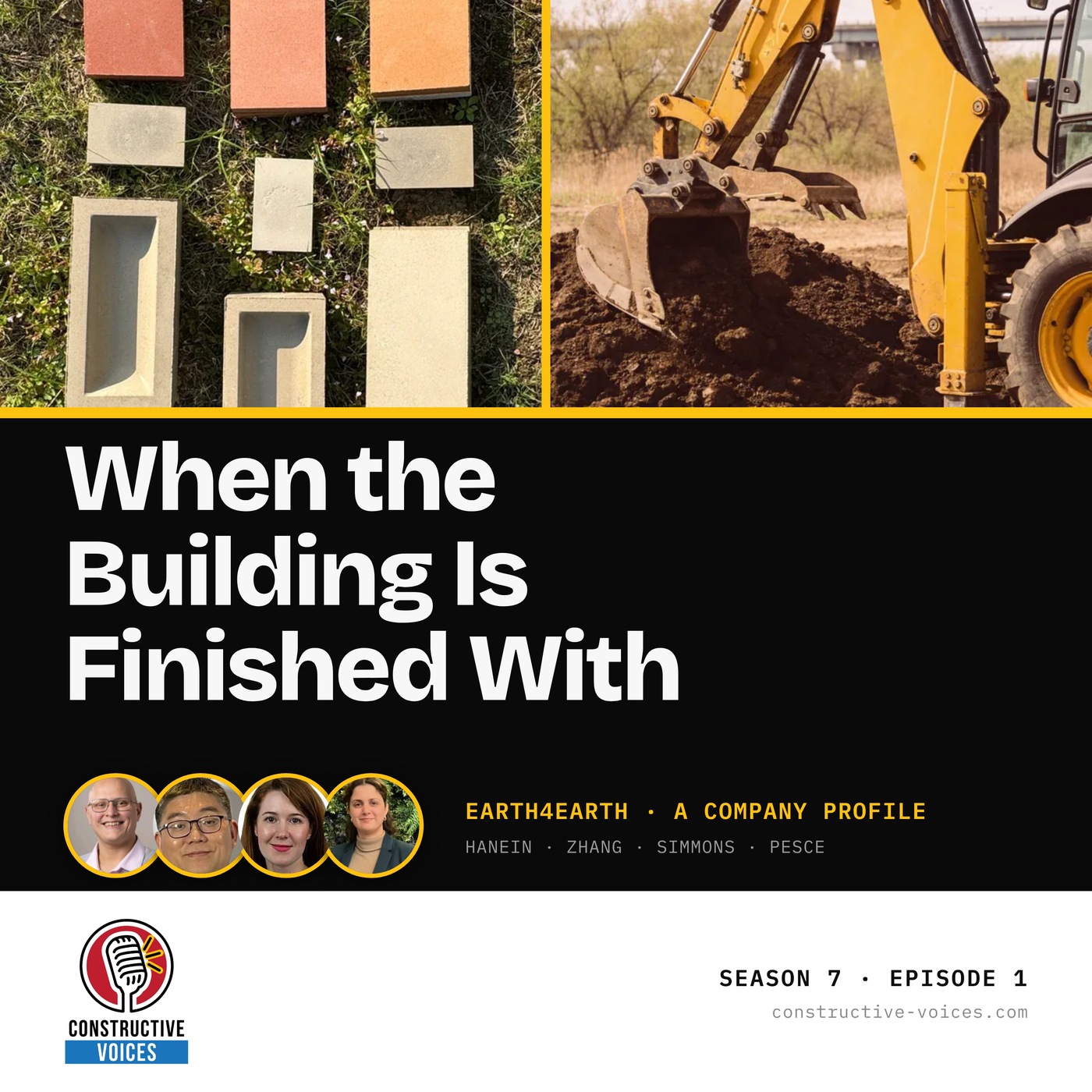
[00:00:43] Speaker D: And that was Professor Theo Henan, who is one of the co founders of Earth for Earth. This episode is a company profile about Earth for Earth.
As well as Professor Hanen, we speak to the other co founder, Li Zhang, Alice Simmons, who supports the development of sustainable and decarbonized building materials, and Cecilia Pesque, Earth for Earth's principal process engineer.
[00:01:09] Speaker E: And for those of you who don't
[00:01:11] Speaker D: know me, I'm Jackie Deberka.
[00:01:13] Speaker E: What exactly is Earth for Earth, Anna, and what is your personal vision for it?
[00:01:18] Speaker B: Yeah, so Earth4Earth is a sustainable materials developer. So we develop materials that are either low or negative carbon with technology that began as somebody's PhD project at the University of Sheffield. And we've developed that further in order to make our materials. So the first products that we've made are a range of Earth based bricks. So they're made from soil which has been excavated from construction projects and would otherwise go to landfill. And then that's combined with a unique binder that we've created. The binder is lime based. And whereas lime is traditionally produced at high temperatures, so 900 degrees C, we've developed a process that can be done at room temperature.
And also normally the breakdown of the raw materials releases carbon dioxide. And for us, the carbon is in a solid byproduct. So we decarbonized the production process of the bricks and then they also directly capture carbon dioxide from the air. So as a result we have made carbon negative bricks. And they're also fully recyclable. So at end of life they can be crushed and either made into new bricks or returned to the soil for crop growth.
[00:02:36] Speaker D: Thanks to Anna for that great explanation. Next we'll hear from Li Zhang, one of the Earthfirst's co founders on the net zero brief he couldn't fulfill. And the HS2 building that turned out to carry 400 plus tons of CO2.
[00:02:51] Speaker F: Yeah, actually just say this one's the really first idea. I have this one from 2020. 2020 actually on that times I. It's one that received a project called Net zero project is not making design is from beginning is I receive a design design finished and the client say Lei, could you please do a minor adjustment making this building net zero.
So that's the first time actually I think I'm very confident doing all design type. But when I really started to do a research to check how many ways I can make in the buildings Net zero found the carving technology is not providing anything is like really achieve that goal.
So in that time I'm thinking about one thing. Just say what we can do if I can get similar projects in the later stage or whatever in the future. So I get a little bit panic say if this one is in the future we'll get more similar project what should do.
So that's why I say I must develop some the new ways I can solve the solutions for them, you know. So of course partially this one's because my first time to understanding the net zero.
So I think at that time Net zero is not means making the all the carbon emission from the building come to zero. You know, it's just part of them.
But from that times I get a little bit pressure say in the future if my project I designed it get high carbon what I need to do. So. So that's generally like motivation I had for develop this new construction material. And from the 2022 I noticed in the UK building regulation have a new part called Part Z Part Z reg recommend for most buildings designer should providing carbon emissions for the whole buildings. And after that one, the first one to be serious actually I need to calculate the carbon emission for that project. That's UK we called High Speed 2. That's the one of the largest projects infrastructure in UK. I found actually my projects or single buildings produce more than 400 ton CO2 is massive. I did not recognize that's much. You know. So I get probably some pressure say if someone stand out, say okay, your project, your design is rejected. It's because carbon emission too much. So what I should do, you know. So that's why the immediately after that time I try to look at the solutions and try to combine what is latest technology research and what we can do together to really develop some new construction materials. I can really apply to the design help the designers to minimize the carbon emission.
[00:06:07] Speaker E: Fantastic. So I guess what springs to mind is, you know, it's a huge story that you have there and how you. You know, you're obviously very, very motivated. But how did you actually come to be inspired to form the actual material that you have as Earth for Earth As a company now there must be a story behind that also. Lei.
[00:06:32] Speaker F: Oh yes, actually just say as a structural engineer, my interest is particularly on all different type of construction material. The people always like new materials and from the glass to timber.
So from 2018 start research on historical rammed earth before probably 500 years ago, before the invention of the concrete and steel, people use timber, people use the brake made from the soil or clays.
And also sometimes they come compact soils to get the big buildings for that one. I noticed actually some building type historical rumors building last more than 500 years.
So in that case we think why we cannot using the recipe from old buildings for new buildings for that one. So under some search because when I really look at the what is the construction material with lowest carbon emission the ram come to the top one.
And at the same time and I notice one of my another co founder of the company is called Professor Fidel Hahnel.
[00:07:47] Speaker D: And we will hear from Professor Theo Hanin shortly. However, a very quick correction. Part Z is an industry proposed amendment to the building regulations of 2010. A proof of concept not enacted law. It was put forward by built environment professionals in July 2021 and is not backed by government. An amendment was tabled by Lord Ravensdale during the Levelling up bill committee stage in 2023 and did not pass. Embodied carbon remains unregulated.
[00:08:16] Speaker C: In the UK we are basically making earth based materials, Earth based construction materials. I mean and the technology, the major technology behind it being carbon negative and we have an EPD of it being carbon negative is something I invented in 2017. It's a way to produce the binder, the lime without high temperatures. And funny story, it was actually a mistake because the project I was on, we were actually, you know, trying to heat it up at lower temperatures using certain alkali material. And I got to the lab and, and, and the furnace was broken.
So I said, you know what? I'm just gonna mix it in a mixer without heating it up. And I did the characterization material after that. And yeah, we got very good results. And then we got two PhD students, Marco Simone and Chongnung Wu Bernard, who continued to work on this and was also under the supervision at the time of Professor Hajime Kinoshita, who I think is now at Kyushu University.
[00:09:30] Speaker E: Okay, that's very exciting. Now obviously Theo, there will be, you know, challenges in applying research in real world settings in construction. What, what have they these been so far and how have you overcome them?
[00:09:47] Speaker C: The challenges.
Anyone who has a startup would know how difficult it is taking something From, I mean making a few grams to making tons is a whole other story. There's different types of equipment you need to use and you have to find the right one. You need a lot of pilots and you need a lot of testing and, and you need a lot of human power and you need a lot of testing and resources and money to be able to get it there. And you know, some you have to try different options, which we did. Some were okay, some didn't work, and then we found the best option.
So yeah, I think, I think the, the, the main challenge is.
Well, especially from, for me coming from academia, it's a total different world.
You know, making things in the lab, in gram scale to moving to 10 scale, which is, yeah, I think that was the major challenge.
I know that at Sustainable Ventures in Manchester was our first pilot. They called it the Wonderwall, which is I think 4 by 4 meter pilot. And we have a lot of other projects coming through as well.
[00:11:05] Speaker D: A central person in the projects for Earth4Earth is the principal process engineer, Cecilia Pesky. Cecilia, tell us about your studies and background.
[00:11:16] Speaker A: I did study, it was chemical science applied to restoration and conservation of cultural heritage. But then after my studied I kind of specialized in architectural materials. So then I started, I did my PhD on lime based binders, so mineral binders and then a postdoc more on cementitious binders. So there is, that construction element is quite strong. So it all contributes to why I joined Earth4Earth and why I enjoy being part of this company. But definitely the connection between ancient buildings, ancient architecture and modern innovative architecture is very strong.
[00:12:04] Speaker E: Fantastic. And how does cultural heritage inform developments and innovation and sustainability in your opinion, Cecilia?
[00:12:13] Speaker A: So I think again the key is definitely sustainability. In the previous century in construction, the.
The prevalent material was definitely Portland cement.
And there's a reason for that. It was cheap, it was efficient, effective, widely available, could be produced virtually anywhere. In the previous century, the conditions were different. We didn't have that awareness that we have today. We didn't have that urgency that we have today to also protect the environment we're in.
[00:12:52] Speaker D: Absolutely. Cecilia, what is the innovation that the team is doing at Earth4Earth?
[00:12:58] Speaker A: So normally to produce lime, we need to take the raw material, which is limestone and calcine it at high temperatures. And the CO2 emissions related to this process are quite substantial because both the breakdown of the raw material itself and emits CO2 and also we need to burn some type of fuel.
In the antiquity was probably wood and then coal, but some type of fuel or fossil Fuel. And this also creates CO2 emissions. So this is a traditional material that has a significant carbon footprint.
And what I like, a really innovative part that I like at Earth4Earth is, is that we have completely changed this approach. We produce our own lime binder, which then we use to stabilize our bricks. And we have scaled up this process where we can produce the same material, the same mineral binder, but without having the same CO2 emissions. So we have completely avoided any CO2 emissions during the production. This process allows us to operate at room temperature.
[00:14:13] Speaker D: And where does the underlying inspiration for this come from? Cecilia?
[00:14:17] Speaker A: Yeah, so maybe my colleagues have already mentioned this, but our inspiration for our company is a group of buildings. They're found in China, in the Fujian province. They were built in 1500 and they are predominantly made of raw earth, specifically rammed earth. They are big circular buildings which host, for example, one building can host hundreds of families. So they're quite big buildings. And they are an outstanding example of the resilience of this material, of this construction technique because they can withstand, they have proved to be able to withstand earthquakes, extreme weather. These buildings are also socially and economically sustainable because they, they promote a sense of community.
So this is really an inspiration. But also I recently learned, and I like to mention this building, it's a modern building made entirely in rammed earth.
It's in Germany and it's a warehouse of a big cosmetics corporation. This is the. Is a clear example that building in raw earth is compatible with, not only with the arid or deserty climates, because we are in Germany. So it can withstand extreme temperatures, frost, but also summer is hot, a variety of temperatures and climates. This technique was specifically chosen because in the warehouse the products of this corporation are stored and these products are sensitive to temperature.
So to reduce the cost and energy to air condition the environment, they chose round earth because it's known to have good insulation properties. So this is a very nice choice and really an example of how traditional techniques can be innovative and modern and compatible with our times.
[00:16:27] Speaker D: Indeed. And as true as that is for your team and many others, for sure, interfacing with the traditional construction industry can be challenging.
[00:16:36] Speaker E: I guess the first question, Anna, is what response have you had to these new materials?
[00:16:42] Speaker B: So we've had a lot of excitement and definitely enthusiasm and interest. Certainly people are really interested to hear more and there is definitely a real passion and appetite for more sustainable materials and alternatives. But with that we've also had scepticism. I think people really want and understand, want to know the details about the products, but Sometimes maybe looking to find is there a catch?
Which, again, is kind of human nature. And if something, you know, sounds so good, you want to check that it actually is as good as it sounds. So people want to know, you know, the details of the sustainability, so more information about, you know, the materials that are used. If we have an environmental product declaration, which we do our N10 brick on, that is shown to be carbon negative, and then they do want to know, obviously, about the quality as well, will they perform in the same way as a traditional brick? And so, yeah, it's a real mix of excitement and enthusiasm, but then also at the same time, scepticism, which I do, like I say, think is understandable.
[00:18:03] Speaker E: It is understandable. And of course, a lot of the people you'd be approaching in the industry at the moment have plenty of struggles to be getting along with right now in such hugely changing times. And particularly, Anna, because the construction industry is well known for being kind of steeped in its own traditions and a bit slow to change.
How can this be overcome? Or do you believe it could even be overcome, Anna?
[00:18:25] Speaker B: Yeah, so I think it definitely can. I think, even though, like you say, there is a lot of tradition there and, you know, materials that have used go back hundreds of years, you know, centuries.
I think overcoming that is through having conversations and providing all the details. Details. And also by, you know, getting certification. So that proves what you're saying that's really important as well. I think sometimes people don't want to be the first to use something, and you can understand why. So I think another way of overcoming that is making sure that you have examples of where it's been used.
You know, places where people can actually go and see it in use. You know, touch the bricks, look how they're performing. We're even giving some of the bricks to colleges where they have, you know, brickwork courses for the students and staff to use. Because we want people to, yeah, have experience with them and see exactly what they're like so that they can see, you know, they are high quality, they can look at how they perform. And we've been doing that from the very beginning to get as much feedback as we can and also demonstrate how they can be used. So I think it can be overcome. But it's about taking various steps and doing it gradually and not kind of expecting things to change overnight, I suppose.
[00:19:47] Speaker E: Just finally, Anna, what are the most common objections you hear from construction professionals and how do you respond to those?
[00:19:54] Speaker B: So we do get asked about the range that we have available Because I think people and their clients do want choice. And initially we didn't have a wide range. We had a standard size brick in a colour that depended on the soil that was used.
But we now have also made a range of brick slips and they come in various different colours. And we've also made a frogged brick.
Again, they come in different colours on the soil, but we can also use pigment to make them a particular colour. Because as well, some of the other feedback we had was that the bricks were heavy. So we've made that frogged brick available as well, so it's not as heavy. And also there's that space for mortar, if that's desired. And then people obviously do ask about the price because obviously that is a factor in any project or any work that's being done. We have tried to make them as comparable as we can. There is such a wide range of bricks and prices available and ours are comparable to kind of commonly machine made bricks. But then in some cases, you know, people have said that would not be within our budget. But then others are pleasantly surprised and say, yeah, that, that sounds ideal.
So it's mainly been around the choice range. So just what's available in terms of appearance, price and type. And we have now massively expanded what we do through the brick slips and the frogged bricks. We also offer, we now offer five different types of brick, have L0, which has no binder in it, so it's just an earth based brick. We have L10 which is made with traditional lime. So it's still low carbon, still directly absorbs CO2 from the air. Still earth based, still 100, recyclable. But the binder is traditionally made, the lime in it is traditionally made.
And then we have N10 which has 10% of our unique binder. So the binder where the lime is produced at room temperature, 20, that has 20% of that binder and N30 that has 30% of the binder. The more binder that's in the brick, the more CO2 that they can absorb. And the price does vary along that range. So again, we've tried to make it so that there's more choice choice. There's more of a range available to suit different needs and budgets.
[00:22:30] Speaker E: And quick question for you, where can people see the bricks in use?
[00:22:36] Speaker B: Yeah, so we have in Manchester, at a place called Sustainable Ventures, at their office in Manchester, the bricks are being used in their office there, on one of their walls as cladding. I think they would be more than happy for people to get go in and have a look if they were interested. We also have samples at our office in Sheffield and we can send those out. And we are very soon going to have some projects at colleges in Sheffield and Leeds as well. But yeah, we, we do need to.
We are hoping to do further projects so that people can come and see them. But everyone is more than welcome to come to Sheffield and actually look at the bricks. And we have samples available as well.
[00:23:21] Speaker D: And now back to Professor Theo Hanen for some final words from him.
[00:23:26] Speaker C: Obviously, having earth based materials is one aspect of it, but the binder, not everything can be built with bricks. The binder itself can be used in other types of infrastructure or other types of, you know, even if even lime is used in many things. Lime is used in sugar production, lime is used in steel production, lime is used. And it's a very, very. I think it's one of the most used materials in the world. Inorganic bulk materials. Basically most of it is used in cement production and then the rest obviously is used in all those other industries. So if I had an endless R and D budget, I would focus on using the products, are optimizing the process further to make the product not only technologically viable, but market viable as well in order to basically reduce our emissions. And yeah, because for me, I don't believe in a silver bullet. There is not one solution to, you know, solving the crisis. We're going to need many different options and using the right material in the right place.
You know, there is no need for over design and it's definitely not good to under design. Yeah, there's still a lot of work to be done in our area, but that's if I had an endless R D budget, obviously.
[00:24:50] Speaker E: Well, hopefully, hopefully, you know, something like that will be happening in the not too distant future. Theo, anything else you'd like to cover?
[00:24:59] Speaker C: No, I just, I just want to really thank Marco Simoni, Professor Kinoshita, Cecilia Peche, Jax, who has done an amazing job in bringing the bricks to where they are.
Bernard, who is one of the hardest workers I've ever met and an amazing human being o' Day, who also. So these are all people who trusted me and followed me on this journey of making Earth for Earth because I had worked with them before and obviously Anna Simmons, who you've met, she's fantastic.
So yeah, the only thing I'd like to add is I just, I'm just very grateful for them to trust in me and bringing them into the company to make it reach where it is reached.
[00:25:55] Speaker E: Thank you so much.
[00:25:55] Speaker D: Everyone for your time today, let's leave this episode about Earth for Earth on a thought provoking note from Lee.
[00:26:03] Speaker F: Many things actually just say you try to design from beginning, but you try to set design life 120 years. But even don't need 120 years. Probably after 50 years people probably don't need this building. People want other things, you know. So I would like to think about things just say if we have some construction material, this one won't be very sustainable. Is very. If we need that one, it can be on for 500 years, 1,000 years. But if you want to change, we can put this material returnable to the ground.
I see so many pictures from the old, how to say history pictures as photos for the local. Since they have more trees, they have more gardens and now we have more infrastructure and more house.
But if thinking about after 50 years or 100 years, this building don't need anymore. So how we get rid of them? And so that's my thinking about just say we can we making some construction material when we don't need them. We can make this one go back to return to it was so we still have the garden come back. We have our plants, we have agriculture gardens come back.
It's not leaving a lot of concrete or steel very hard to treat in the future. Yeah, that's my current thought for the future materials.
[00:27:27] Speaker D: And that was a special episode about Earth for Earth. Thank you for listening and we'll see you next time. This is Jackie De Burcke for Constructive Voices.
[00:27:36] Speaker B: This is Constructive Voices.