Episode Transcript
[00:00:00] Speaker A: This is Constructive Voices. Constructive Voices, the podcast for the construction people with news, views and expert interviews.
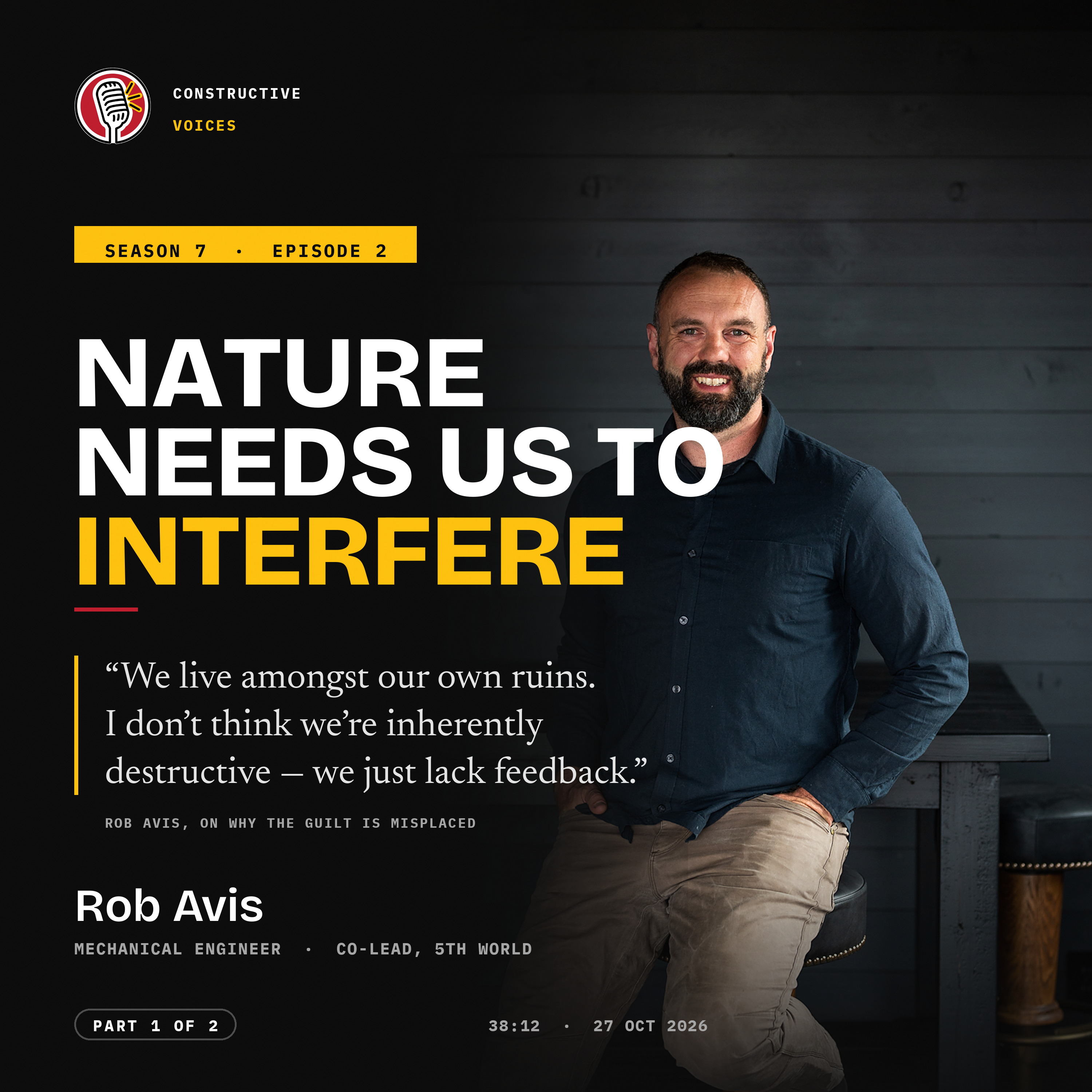
[00:00:10] Speaker B: So we live in an interesting time right now where we're surrounded by the fruits of our labor, although maybe fruits is not the right term, but we live amongst our own ruins. We're actually probably one of the first times in human history where we're living amongst our ruins. And so it's easy for us to believe that humans are inherently destructive. And I actually don't believe that to be true. I think that we just lack feedback. And when you think about the fact that we've only had satellites in space for 60 years, humans are just starting to wake up to the fact that we have created a lot of destruction, which is where the guilt comes from.
But the work that we do is very hopeful because that same mechanism that's allowing us to see the damage that we've done is also the very same technology that we're going to need in order to repair the damage that we've done on this planet. And so I believe that if the negative thing humans have done on the planet is build a nuclear bomb, what's the most positive? And I think that's what we have to focus on more than focusing on all the destruction.
[00:01:15] Speaker C: Well, hello there. I'm Jackie De Burka, your host for Constructive Voices. And that was our guest today, Rob Avis. Rob has an amazing background. He actually used to work in the oil industry, would you believe it? And why would we have him on Constructive Voices, you might ask? Well, because he made an absolutely massive change many years ago. And that's the story you're going to hear today. When I know and learn about Rob's situation and other guests that we've had on here, I think about the kind of places we could be living in quite soon where we could have sustainable homes, we could have passive homes where, you know, they keep the heat for us, they keep the sun out, they're energy efficient, they're really beautiful to live in. And in Rob's neck of the woods, and excuse the pun there, we could also be living in homes where, you know, we're kind of self sufficient and we are giving back to nature at the same time as nature providing for us. So I'm going to leave it over to Rob now just to introduce himself and then we'll start the conversation.
[00:02:15] Speaker B: Sure. My name is Rob Avis. I live in Alberta, Canada.
I'm a mechanical engineer. I actually grew up in the industrial food system.
So my dad had a 40,000 square foot cake facility. We'd make 100,000 cheesecakes a day.
I left the industrial food system to study mechanical engineering, thinking that I was going to build machines to build more industrial food. Ended up meeting my wife, Michelle, and following her to Calgary, where I joined the oil patch. And I worked there for many years while I got my professional designation. I was the guy that was tearing down massive tracts of forest in order to bring pipelines and gas facilities and oil facilities online. And, you know, I. I didn't. It created a lot of cognitive dissonance. I'll just say it that way.
I was really sad every time I had to engage a contractor to tear down forest. But at the same time, I was also consuming the very product that, you know, that I was bringing to market. And so how, as a consumer, could I criticize an industry that I was supporting with my life energy? My dollars and serendipity struck. I ended up with a video in my inbox. YouTube was still pretty new at that time, and it detailed out a gentleman named Jeff Lawton, who produced a video called Greening the Desert. And it was about how he took a meaningless dead piece of hypersaline soil in the Dead Sea Valley. Lowest place on Earth. Super arid, super hot. Originally, the cradle of civilization kind of started in this area, and now it couldn't grow anything. And he completely reversed the course of that piece of land using a system called permaculture. And I got completely enamored by this because I said, you know, as an engineer, I actually took my calculator out and I said, how many hours of life energy do I have left on this planet? First, I figured out what the average human actually lived. It was about 600,000 hours, and I'd burned through about one third of them at that point.
And I said, that's what I want to spend the next two thirds of my life doing. I want to be part of the change. I want to show a different path.
Um, and so I started talking about this with the folks in my office, and they all thought I was nuts. Like, we're going to burn fossil fuels for the rest of, you know, history.
Nobody was willing to have a conversation about peak oil with me because that was just, you know, heresy. And so I didn't get very far talking to my colleagues. And so I called my wife up not long after, you know, maybe a week or two after we both worked in the oil and gas industry. So I called her at work one day, and I said, you know, it's time for us to leave the oil industry and we quit our jobs. We moved to Denmark. We lived there for six months. We studied renewable energy at a place called the Folk center for Renewable Energy and proved to ourselves that the world didn't have to run on fossil fuels forever. This was back in 2008, when oil was hitting $157 a barrel. And then we came home, back to Alberta. We converted a 1983 Westphalia van to run on vegetable oil.
And then we drove on spring rolls and donuts, the oil from those things down to Mexico, across the United States, across Canada. And we started studying how to power the human metabolism on the agriculture side, because that seemed like a much tougher problem than the renewable energy piece, which is kind of solving itself now, or watching that in real time. And got back from all that traveling. And then I ended up living in Australia for a while under Jeff Lawton, the guy that, you know, encouraged me through that two minute video on YouTube. And I told my wife, I'm going to teach permaculture. And she said, you're nuts. You're a mechanical engineer. You're not a biologist, you're not an ecologist. Like, how are you going to do this?
And so Verge permaculture started shortly after. And just after Covid, we had taught our 10,000th student globally Permaculture design.
And while Covid was happening, I got approached by some folks in the crypto industry who ended up building a property for a regenerative property.
And I said to them, these crypto guys are really big into massive purpose.
I said, if we had the resources of the US military, we could regenerate Earth's ecosystems in less than 10 years. And they said, oh, my gosh, that's a cool mission. Let's do that. And I'm not even kidding. A few weeks later, a bunch of money ended up in my bank account and I was given the mandate to start Fifth World. And so Fifth World's mandate is to accelerate the adoption of renewable energy and regenerative design across Earth's ecosystems as rapidly as possible. And that's what we do today.
[00:06:54] Speaker A: That is, yes, super cool. Doesn't even go to describe it. An amazing story.
What about your wife? Because I know your wife, Michelle is obviously involved in the business with you.
[00:07:07] Speaker C: She left immediately with the same sort of.
[00:07:10] Speaker A: It's fascinating, you know, the story of the two of you.
[00:07:13] Speaker C: Did she have the same kind of
[00:07:15] Speaker A: faith in the huge leap that you both.
[00:07:17] Speaker B: I think eventually, yes. I remember learning about peak oil.
I ended up taking a university course in environmental design and learning about peak oil, actually. And I brought that home one day to her and I said, you know, one day we might be, we might be riding horses and buggies again. And she's like, you're crazy. There's no way we're going back to horses and buggies. That's just never going happen. And I think maybe, maybe her and I have had five arguments in our 25 years of marriage and that's probably one of them. But you know, overall, like, I could never have done this without her or without my mother in law actually. When we left our jobs, I mean, we left $300,000 a year as two petroleum engineers.
[00:07:57] Speaker A: The first expression that comes into my mind is like, yeah, either brave or crazy, isn't it?
[00:08:03] Speaker B: Well, both probably.
And maybe the braveness is what creates the craziness, I don't know. But I, I came back to Calgary, we had no income, we had savings and we moved into my mother in law's basement suite which is where we had our kids and we lived here for.
In fact, I'm, I'm in that house today. I don't live here anymore, but I sold it to one of my students. It has Calgary's oldest food forest. And it looks amazing. It's full of fruit right now. And the garden back in the backyard is just unbelievable.
[00:08:33] Speaker A: Oh, wow.
[00:08:34] Speaker B: And I threatened write a book because I just figured, you know, you don't make a lot of money teaching permaculture.
And so I thought I was going to be living in that basement suite for the rest of my life. And so I threatened my wife that I was going to write a book, how to Save the World. Living in your mother in law's basement suite.
But yeah, I mean, without my mother in law and without actually my parents and without Michelle, none of this would have happened. It's definitely taken a village to kind of support this vision.
Currently though, Michelle's not in the business. She's taking mat leave just about 15 years late.
[00:09:06] Speaker A: I mean that makes sen as well, obviously. So yeah, apologies. I didn't, I didn't see that. Going back to this huge leap that you made back in 2008. What about your engineering colleagues? Did they also think there was like a lot of crazy going on?
[00:09:18] Speaker B: Oh yeah, I think my dad even thought that too. They didn't really. And I mean, in fact, like, I think probably still a lot of people think I'm nuts. You know, you still, you go into a Costco or any kind of big box store today and it's easy to be kind of Cast as Chicken Little, you know, saying the sky's falling down when these big box stores are full of shiny.
They're not. It's not food, but it's marketed as food, you know, in freezers and shelves. And, you know, we definitely live in a time of abundance right now, but what I think most people don't realize is that that abundance hangs by a thread. You know, it's almost like we're Damocles and there's a sword hanging over top of our. Our head hanging on us.
[00:10:01] Speaker A: Right.
[00:10:01] Speaker B: Yeah, Horse thread.
[00:10:03] Speaker A: I. I heard in the interview that you did with the solar guy, which I very much enjoyed, that the. In a city that the food supply would be gone within three days.
[00:10:13] Speaker B: Yeah. So, I mean, we've. We've done. There's actually a really great podcast that just came out on the great simplification. Nate was interviewing a French researcher, actually, and he talked about the difference between efficiency and resilience. And we've put a lot of effort into our economy to create just in time, everything which is. Which you could say is efficient. But, you know, any number of things break in the system, and you end up in a system that's not functioning anymore. And we saw that in Covid. But people don't have very long memories.
[00:10:43] Speaker A: No, no. And we saw it more recently here in Spain, Rob, when we had the Valencia floods, so a little bit under two years ago now, and we're about an hour south of Valencia and going to the supermarket within a day or so of that, like, there was so many empty shelves.
So, yeah, we've experienced it more recently here. So listen, going back into permaculture, it has a reputation for, like, hand waving, if you like, where there should be sort of numbers there. As an engineer, where do you feel that field mostly might get maths wrong?
[00:11:17] Speaker B: So I actually don't think very many people understand what permaculture is. I think that's the first problem. And it's. Permaculture is more akin, like, if you go back to Bill's original ideas, Bill and David's original ideas. It's a design system. And so if it's not performing, it has nothing to do with the design system. It has everything to do with the person that's doing the work. Fundamentally, the design system is. And this is probably why I resonated with it so much and why probably a lot of people don't actually understand what it's saying at the root cause. But are you familiar with. With Howard Odom's work? So he he was an American ecologist. Actually, him and his brother kind of operated in the same field. Eugene was his brother, and they proposed the fourth law of thermal dynamics. And herein lies the problem with permaculture. And actually, I would say the predicament that humanity faces today and kind of ties back to the original teaser that I opened with. But first of all, you know, we have millions and millions of engineers across the planet.
Every, pretty much every engineering graduate has to take basic thermodynamics. And so they learn about the second law of thermodynamics, which is that entropy is always increasing. Entropy is the measure of disorder. And it's a very depressing lesson when you take that class, because the endpoint of the concept of entropy is essentially heat death. So eventually the sun will burn out, we'll run out of oil, we're going to run out of soil.
You know, eventually the universe will just burn out, it'll become cold. That's essentially what that law states. But the piece that really got me fired up about permaculture was that that law is true, unless you're drawing the boundaries around a system in a slightly different way.
So syntropy is the opposite of entropy. And you've probably heard of syntropic farming. That word syntropy, is essentially the description of the energy or energetic state of a system that is getting more complex with time. And so if we think about the Amazon rainforest, as long as it's not getting cut down, that system is actually complexifying. It's becoming more stable, it's becoming more diverse. It's able to capture more of the nutrient that's being mineralized. It's capturing more sun in every successive iteration of that forest, which is the opposite of what humans have done over the last 10,000 years. We've actually done a really good job of creating entropy. So if we think about the Fertile Crescent, that was the most fertile place on Earth, and it was the act of agriculture that actually desertified it. And as it desertified the Fertile Crescent, we just moved to other parts of the planet to basically replicate the exact same pattern over and over again. So this was the core insight of David and Bill, was that what would have to be true in the way that human civilization is designed, human coordination is created in order for that civilization to be syntropic versus entropic.
That's the core of what permaculture aims to be. And you're asking a lot of any civilization to move from a kind of bulk entropic order to a syntropic order when you have free, basically free energy. So if you think about a barrel of oil being 100 bucks, you know, there's 25,000 man hours of labor in that, in one barrel of oil. So we have equivalent of 400 billion energy slaves working on Earth that work for a fraction of a cent per hour.
You've got box stores that have got like bulk calories basically for free relative to what it would, you know, cost me to generate those calories on my own farm.
We're literally salmon swimming up the most strong river in, you know, in history, trying to go against the grain by getting people to do permaculture. So it's a big ask for people to kind of go in a different direction than the rest of civilization is currently going.
[00:15:32] Speaker A: It's amazing how you've described it, Rob, because I'm actually reading a book that we will feature the author on the podcast. And if you haven't already, this is a shameless plug for the book I'm reading. If you already haven't heard of it or read it, it's absolutely in tune with what you've just talked about. It's called Making a World that Works for All. And the author is Jeremy Lent.
[00:15:57] Speaker B: Yeah, he recently reached out on LinkedIn and I've seen some of his work.
Yeah, interesting. It's good that there's other voices in this space cause I think it's really important and I know I spoke pretty, in pretty esoteric way there, so let me bring it back into something that people can understand. So I have a. I have 160 acres, about 80 hectares on my farm and I have two creeks going through that farm.
And up until recently we had a lot of rain this year. And so we had about 10, 8 to 10 beaver families actively working that creek. When we bought the farm, the, the owner before us was killing them because he, he didn't want them flooding his land. We've since let them come back. The all the rains have washed them away, but they'll be back, I'm sure.
And so to the untrained eye, you walk through our property when those beavers are actively working those dams and people will say to the untrained ecologist or person like someone that doesn't understand what's going on, they'll say, wow, these beavers have made a total mess of this area. They've cut all these trees down, you know, they flooded all this land, this beautiful land that could be productive.
We there, there are, you know, they're native but they're we don't want them. And so when, when something is native and we don't want it, we call it a vermin. When something is non native and we don't want it, we call it invasive. And this is, that's a whole other conversation that we can have later. But what's actually happening here is that just like humans, the beavers are creating disturbance. They're cutting those trees down, they're blocking the water.
But what's really interesting about this disturbance is that the, the beaver is in fact increasing the background biodiversity of that micro region by 20 fold.
And so I walk these trails daily, I watch these beavers for hours and I, I quantum, I look at how they're manipulating, they're terraforming, how they're improving their ecosystems as a result of their disturbance. And I always ask myself, you know, how can humans, because we create disturbance. That's actually our role in, in this planet. Our role is to create entropy. Entropy is not actually the thing that's bad. It's the scale, time, placement and form of that entropy that dictates whether or not the system gets worse or if it gets better.
And so the timed, like when you think about the beaver, they are operating at the right scale, small decentralized ponds, they're operating the right time in the right place.
And as a result of it, the KPI, if we want to bring it down to kind of modern industrial business terms, is increased biodiversity, increased drought resilience, reduced flood incidents, reduced forest fire, like all these things that they create as a result of their disturbance. And so they're a really good story for people to understand because we can be just as positive as we are negative by just controlling or understanding the disturbance that we create and making sure that we're doing it at the right scale, time, placement and form.
[00:19:00] Speaker A: Okay, so one of the words that came into my mind even maybe 5 or 10 minutes ago as you were talking, what you later said was a bit esoteric, but I don't feel it was personally. But is the word collaboration. And I believe that nature collaborates, of course, as competition within nature as well. And I think human beings essentially would like to or have collaborated when they needed to, let's say before the Industrial revolution. And it's not that far removed from us, I believe. So I would have a certain amount of hope, Rob, because of that particular word.
[00:19:32] Speaker B: Yeah, absolutely. And I think when we think about regenerative design, and again, back to the insights of permaculture.
Bill tells the story of being in the Tasmanian outback And realizing that if he could figure out 28 or 30 or 60 different species that could co habitate a space that we could create engineered ecosystems that showed their own evolutions and we could direct them in a way that met human needs while also increasing the stability, the diversity and the life force of an ecosystem. So it's not, and this is the problem that I have with kind of conservationists is that when you look at like national parks and you look at preserves, those all operate under the premise that humans are inherently destructive, which by the way, there's a ton of evidence to support. I'm not saying that we haven't created destruction.
I think the radical idea that we need to play with on millions of acres is like what does it look like for humans to co create, to collaborate, to live in synergy, to design syntropically.
And, and I would say that the people that can think this way are actually the most self interested individuals on Earth. Like we talk about self interest as, as a characteristic of, you know, somebody reading Ayn Rand or kind of a capitalist kind of mentality. I would say ecologists are the most self interested humans on Earth because we recognize that our well being is intrinsically linked with the well being of the ecosystems around us.
So yeah, I think that collaboration is the word.
[00:21:25] Speaker A: Okay. And I'm absolutely delighted that you agree obviously with this is something that I have felt and of course the more fabulous guests that we've had on Constructive Voices, the more conversations I've had, it just seems to become deeper and deeper inside me. And I would also say, Rob, I'm sure you'll either disagree or agree one way or the other with this, but when we spend time in nature, as you say, co creating, collaborating with it, I think we feel, personally, my own experience would be we actually feel more vibrant and younger.
[00:22:01] Speaker B: So totally. Yeah, yeah, absolutely. And nature, I think the thing that people have to ask themselves is like number one, are we of this planet? I know that sounds like a crazy thing to ask, but and then like the next kind of logical question is like, okay, if we're of this planet, are we nature? And I believe that the answer to those questions is yes and yes.
And then if we are, then we have the right to manipulate our ecosystems. And in fact our ecosystems actually depend on us manipulating them. That's not the issue. Just like the beaver has the right to cut trees down and block up small creeks and rivers, we have the right to be, to play an integral role in those ecosystems. And there's actually anthropological evidence of what Happens when we, when we disengage from our ecosystems. And it comes out of Zimbabwe. Alan Savory, Alan Savory's story talks about how he, you know, had 45,000 element elephants put to death because they were destroying the, like the, the savanna. And he says it's the worst decision he ever made in his life because he realized afterwards that the elephants were destroying the savanna because humans had moved away from nature.
So they were once living amongst the creeks and the streams and the rivers, which is where the elephants, the elephant, the behavior of the elephant operated in a specific way because they were scared of humans. And the humans lived around these watering holes. When the humans left that ecosystem, their behavior changed and all of a sudden they didn't have a predator kind of managing their behavior or changing their behavior. And so they able to operate in different ways. And we saw the same thing happen in Yellowstone.
The farmers around Yellowstone national park killed all the wolves and all of a sudden the deer and the elk and the moose all started behaving differently because now they, they could go spend as much time around the creeks and rivers as they wanted. And so they created all this erosion and they literally changed the ecological outcomes of that park. And yet these are native species.
And so nature requires predators, it requires controlled disturbance. Entropy we call it, we use that word when entropy is misappropriated, misused.
It's not controlled, it's not done with a conscious intent. It creates destruction, which is why we have the deserts and where the Fertile Crescent used to be. When we can control that, and this was the insight of permaculture. Humans actually can observe the metrics in ecosystems with regards to whether their behavior is improving or removing from. Then we can be just as positive as we are negative. Just like the beaver.
[00:24:44] Speaker A: Hmm, okay. Yeah, it's really fascinating, isn't it? Permaculture, Rob, obviously designs for abundance. And you as an engineer with your, you know, your training and your background, you would have been trained to design for failure modes. How do you reconcile those two instincts on the real sites that you're involved in?
[00:25:03] Speaker B: So I look at failure modes through a very interesting set of lenses as it pertains to ecology and permaculture. And mostly I look at coming back to this three days of food at any given time on the grocery store.
When we look at all of the supply chains in, you know, modernity, essentially energy, food, water, even the way we build our, our shelter, these are all highly fragile systems that are hyper dependent upon multiple inputs, operating at almost a hundred percent for them to work. So, you know, our water systems require fossil fuel that there's like literally almost no surface water on earth that you can drink without filtration anymore. That's crazy. Like, to think that within two to 300 years we've polluted all of our surface water on Earth is just absolutely insane to me. And so in order to have water, we need to have energy. And in order to have energy, we need to have water. Because energy, like the way we make electricity, requires cooling. And then in order to grow our food. This is an interesting statistic.
In the 1940s, for every calorie of energy we invested into a western farm, we got 3 calories of food off of that farm.
Today, we need between 10 and 30 energy calories for every calorie of food that we produce. And so our food systems are heavily dependent upon diesel, electricity, gasoline, potentially coal, if that's how the power is generated. If we were all wolves running around hunting for our food and we had to consume 30 calories of energy for every calorie that we actually were able to hunt, we'd all starve to death. You can go through every single modern system and you can quickly identify. You don't really have to have a degree in energy or an engineering degree or any of these things.
Your house is another great example. And we're seeing this in Europe right now. Like, we've built buildings that are not able to withstand, you know, 40 degree heat.
[00:27:09] Speaker A: Couple of questions, Rob, that come into my mind. It's really fascinating what you're saying. So, like jumping on what you've just talked about when things are going in the right direction.
So the diagnosis has worked and all the practices that have come together for a particular parcel of land, everything is working out really well the way you've described it, Rob. It's almost like if you have somebody very close to you and they know that you're going for a job interview or you're going for a health check or something, you can literally feel them thinking about you. It seems very similar. It's like an energetic thing coming out from the land and the people that are working with that land.
[00:27:46] Speaker B: Absolutely. I mean, so I think this is what the environmental movement got wrong, is that. And I totally understand where it came from.
The world we're living in and heading towards is super scary. And it's easy to kind of, especially with social media.
And also I think there's a structural issue with our brains in that the amygdala is always looking out for.
For risk. Right.
And so a piece of negative news needs three to five pieces of positive news in order to overcome it. And I think the piece that attracted me to permaculture in the first place was Jeff Lawton's mojo, like his. His optimism and positivity. And even Mollison, like, he has a. One of the most important aphorisms in permaculture is the problem is the solution. And so.
And then Penny Livingston, another kind of thought leader in the space, she says these systems should taste better, they should be more fun, they should be more positive, they should be more optimistic, because bees are attracted to honey, not to vinegar. And so, like, if we. Another way to think about this, like, I'm an avid canoeer. When you're going down a river in a canoe, you have to be aware of the hazards. Like, you need to know where the rocks are, otherwise you're going to break your. You're going to sink. But most of your attention when you're in a canoe is on the path that you have to take, not on the hazard. You have to identify the hazard, and then you have to steer your canoe to the safe passages. These permaculture properties are those safe passages. They are places where people can celebrate, where they can enjoy good food and good company.
When I travel around the world and I find my tribe of other people, permes we call ourselves, I always have a bed to sleep in. I always have an amazing conversation to have. I can skip all of the small talk.
The sun never sets on the people that are actually doing it. And the permaculture revolution is a silent one. It happens in backyards in a decentralized way, and nobody's going around making piles and piles of noise about it because they're just off doing their thing. It is energetic.
And the closer you get to nature, the more that you realize that there is. There's an energetic force out there that is very difficult to describe. And you mostly realize it when you don't have it, when you're sitting in front of a computer all day.
[00:30:08] Speaker A: I think. I think the Oriental word is qi, for energy.
And I think in a way that they're like, their culture is maybe. I'm talking about maybe traditional, you know, Oriental medicine and sort of the premise there, you know, you're talking there. They recognize the elements as part of their medical kind of process. You know, sort of like some of the main core decisions are made based on the elements. And qi is the word for energy. So it's kind of integral. Whereas I guess in Western society, as you've correctly said, that there's. It does exist, but a lot of people maybe just are blind into. Blinded to it because they're living in a like what I would consider to be a false and a plastic world.
[00:30:49] Speaker B: Yeah, exactly. And actually the indigenous people are ones to pay attention to as well, because, you know, they. They used to, in a way, almost anthropomorphize the. The mountains and the air and the ocean. They had the. They basically thought of all of these elements which we think as inanimate as having chi or energy or spirit. And when you grow up as a child and everything around you is living and it has a spirit and it has a consciousness, and you interface with your ecosystem and the life within it and even the elements that Western culture would say inanimate differently. In the Western civilization or kind of ideology, we have no problem removing a mountain in order to get to coal and just unlike. Because it's just rock to us.
But to an indigenous person, that giant mountain had a spirit. And in the same way that, you know, decapitating a head off of a chicken means the end of that chicken's life, that that mountain and the forest that sat with on it and all the animals that lived amongst that forest and all the microbes that lived in the soil, that was one living organism. And it was, it was, it was. It's a much more kind of holistic view of life than just our Descartes reductionist approach to the way that we kind of view the world.
[00:32:16] Speaker A: Okay, so that brings me in my mind, Rob, to the people you've worked with. I mean, you've described really wonderfully the whole life that goes along with it. And when you travel, you've got a bed and fascinating conversations and, you know, not having go. Not having to go through how the weather is and all that stuff. The people have been attracted to come and use your services or come through your book or whatever way. You know, people have come to you as clients or collaborators.
Do you feel, from what you've just said there, do you feel that they're already at the stage where they realize those things or when is it a sort of like a variety of people who are at different stages and then through becoming a permie, they do start to realize a lot of what you've just spoken about, about the energy of everything and the spiritual.
[00:33:08] Speaker B: I think we all live on a spectrum and we all kind of enter into that spectrum in. At different places. A lot of people come to it from fear initially, just because they can't understand the world that they live in or the systems that they depend upon, which is a fine place to kind of find these things. I think it's just important that you don't remain in fear for too long because it has psychological effects on you. I think a lot of people are waking up now to how fragile the supply chains actually are. We saw a huge wave of that in Covid.
Some people are further along in their journey than others. For most of my career I've taught and so I used to call the permaculture Design course a 10 step process to dealing with eco depression or any number of other kind of ailments that you might have because it's a very empowering set of skills and knowledge that allows you to kind of operate and look at the world through a different set of lenses. Now we tend to work for individuals that want food security, energy security, ecological buildings and yeah, so it, it's really all walks of life and all of these problems that we talked about before getting onto this call, they're not technical issues. Like we've actually got all the technology, we've got all the knowledge, we've got the feedback loops, we've got the scientific method, we've got the holism kind of concepts from indigenous people. I'm not going to say we have everything that they had, but we have enough to figure this out.
The issues that we're dealing with are actually social issues. They're issues with regards to how we raise boys and how we raise girls and how we organize, you know, culture and civilization. It's our governance systems, it's the way that we organize money and these are the actual plights that we have to figure out how to deal with. And once we've evolved our coordination systems, because that's really all I've just described. These are all coordination problems. We can, like I said at the beginning, like if we had the resources of the US military and we had an evolved consciousness, we could turn this around in very little time. I mean you look at how China is regreening their deserts, there's parts of Africa that are getting rapidly regreened. There are other ways we can live on this planet in a different way than we currently do. But, but it's, it's, it's the climate between our ears more than it's the climate, you know, in our atmosphere.
[00:35:39] Speaker A: That's a great way of putting it. Yeah, it's very, very true. I mean I'm 100% in agreement with you and of course there's lots of other people around the world who, who feel the same. The problem is, are we the minority or the majority? What do you think?
[00:35:53] Speaker B: We're the minority.
But change has always come from the minority. It's never come from the majority. So it's, you know, Richard Dawkins talks about the concept of a meme which is an idea. That's whose time has come. And one of the biggest battles that we face as regenerative designers is surviving long enough so that we're no longer super early.
And nobody knows when we're not going to be early. We know that the biosphere needs us to be working on this now. But like I said, it's not a technology or biosphere issue.
It's a human coordination issue. So we need a Rosa Parks moment that energizes the masses towards a revolution that is fundamentally self interested because we all want the same thing. We want our kids to go to school, we want clean air, we want, want clean water, we want delicious food.
We want to laugh, we want to smile.
These are basic human desires. This is what everybody wants. And it's sitting there waiting for us to just grab. Grab it.
[00:37:01] Speaker A: Waiting for us to just grab it. Well, that's Rob Avis.
[00:37:04] Speaker C: And that's where I leave part one.
[00:37:06] Speaker A: If you've been listening closely, you'll have noticed what Rob has given us.
[00:37:10] Speaker C: Yet he's told us the damage is written. He has told us the thing standing in our way is not technology, it's us. And he's told us it's fixable.
What he hasn't told us is how.
That's part two. Next time Rob gets specific the five step process he uses to design a piece of land, what he tells people who are about to buy one and why he thinks the best person to design your property is you.
We visit a Calgary organized working with children who've had very hard starts where a market garden turned out to matter as much as anything happening indoors. And we get to the question I most wanted to ask him what any of this means. If you shape the built environment for a living as an architect, an engineer or a planner or anyone else involved.
[00:37:59] Speaker A: Well, Rob has an answer and some
[00:38:01] Speaker C: fairly bold numbers to go with it. I let you decide whether they hold. I'm Jackie De Burka. This has been Constructive Voices. Part two is waiting for you. Thank you so much for listening,
[00:38:28] Speaker B: Sam.