Episode Transcript
[00:00:00] Speaker A: This is Constructive Voices. Constructive Voices, the podcast for the construction people with news, views and expert interviews.
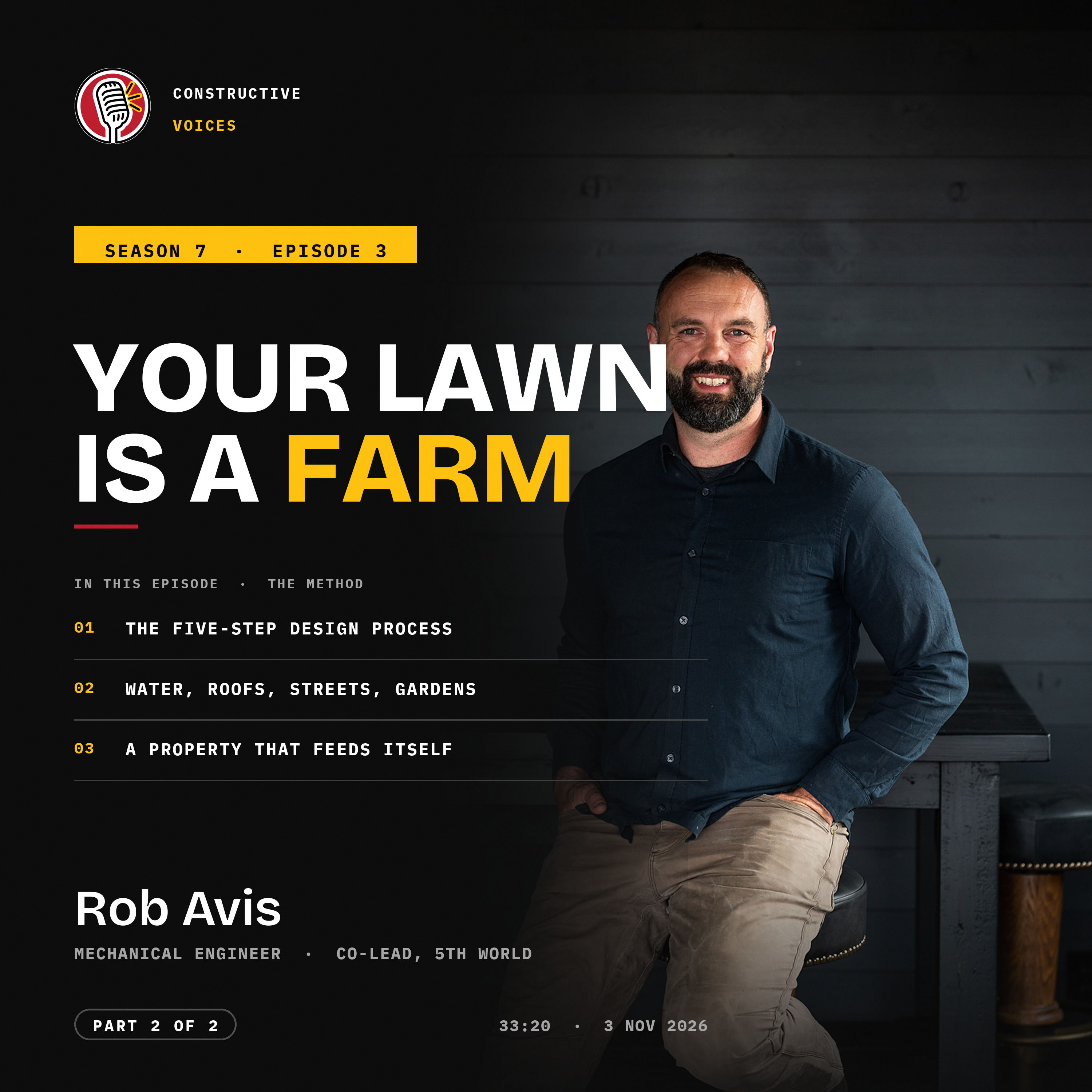
[00:00:10] Speaker B: Every year, America burns enough fuel mowing its lawns to drive a Hummer 21,000 times around the planet. That's my guest's figure, not mine, but by the end of this episode, he'll have told you what he thinks we should do with all that grass. This is part two of my conversation with Rob Avis. Rob is a mechanical engineer who walked away from the Alberta oil patch in 2008 to learn how land could be managed better. He Now Co leads 5th world, designing properties that produce their own food, water and energy, more than 100 of them across five continents. Part one was the worldview Beavers, entropy and why Rob thinks leaving nature alone is the wrong instinct. This is the practical half. How he actually designs a property, what he tells people who are about to buy land, and what any of it means if you shape the built environment for a living. Rob starts with your house. He isn't flattering about it.
[00:01:11] Speaker C: Most homes in Alberta have the same level of insulation as homes in California.
And so your home needs real time electricity, natural gas, pressurized water in order for it to be habitable. If we think about the modern house, the closer.
The closest kind of metaphor to the modern house, especially in North America, is a sick hospital patient. We have a bedpan to remove the waste, and we don't even deal with the waste very well. We have IV drips that bring in food and water and energy.
And if any one of those systems stops operating, that house is uninhabitable. And it doesn't have to be that way. We can, through design, and permaculture actually provides a lot of the insights. But because. So coming back to permaculture as a design system, one of Bill and Dave's big insights was that we can actually take inspiration in how we build our food systems, how we build our houses, how we harvest water, how we manage our waste. Like sewage is not a problem. It's an opportunity. Every. Every problem is just an opportunity. Like the world is literally gonna run out of phosphorus in about 25 years from now. This is not a contested fact anymore. And yet we put nitrogen, phosphorus and potassium in the form of manure packages into potable drinking water that we then flush away and deal in, deal with in an inferior way through antiquated sewage treatment systems that require huge amounts of energy to operate.
[00:02:45] Speaker B: Yeah, absolutely. It is. It's kind of crazy.
Let's Rob, because I know very well that yourself, myself could be talking for two to three hours here. And we haven't even referred to, you know, you're the author of. I think it's two books, isn't it? So far?
[00:03:05] Speaker C: Yeah, two books,
[00:03:06] Speaker B: yeah.
Let's talk about one of the aspects of your writing and your work, the five step process. Rob.
[00:03:15] Speaker C: Sure. So we wrote a book called Building youg Permaculture Property. And the idea there was to. To basically simplify down the design process so that other people could operate their own property using regenerative ideas. And well, I'll be the first to admit that once you become good at regenerative design, you don't need a five step process, you just do it automatically. But our current kind of pedagogical learning methodologies on planet Earth benefit when you can kind of disassemble a holistic process that really happens kind of at the same time into five kind of subsequent steps.
So the first thing that most people don't take enough time doing is understanding their values and vision. So why are they doing what they want to do? What are their goals essentially? What do they want to achieve? And these are really important because when we think about cooperation with a property, being regenerative on a piece of land is akin to building a Venn diagram.
So your land or wherever you happen to live on Earth has a tendency. It has something that it will do effortlessly, something that it tends towards. And when we think about kind of the Fertile Crescent as an example, you know, we developed agriculture somewhere in that region. And the reason that that region ended up desertified was because we basically followed a pattern that we're still following today, which is deforest plow and desertify.
And that has been the pattern of agriculture for the last 10,000 years. And we have to stop that because we're running out of planet to desertify. We can't. And I don't think moving from Earth to Mars is going to solve this problem.
Understanding what your goals are is step one. And I'll give you an example of this. If you are a vegetarian and you happen to live and like that's really important to you, like you have to live a vegetarian lifestyle and you choose to live in the Northwest Territories of Canada, you've made a fundamental mistake in your design because you cannot live a regenerative lifestyle in north, the north of Canada living a vegetarian lifestyle, unless you're going to require people to fly in avocados and carrots and all the other stuff that's grown in other parts of the world.
The ethical dietary choice. Living in The Northwest Territories is actually mostly carnivorous. That's what the land tends towards up there, because that's how nature organizes its energy.
If you insist on being vegetarian, then you need to move somewhere like the subtropics or the tropics, where that sort of lifestyle is possible. So every piece of land on Earth tends towards something. And so the first step is to figure out what you tend towards, what's important to you.
And then the second thing is to diagnose your property for strengths, weaknesses, opportunities and threats. And the goal of a regenerative designer is to figure out the intersection between what you want and what your land wants.
And when we can find that sliver between those two things. That's where regeneration exists. That's where collaboration exists. That's where a system can perpetually produce outputs for the humans living there without causing damage. And in fact, if we control our disturbance using permaculture concepts, we can actually increase the output of that property as the result of the human input into that property. So the humans can actually have a net positive impact, just like the beavers do with their dam.
So step one is your values and vision or your goals. Step two is diagnosing your property, so understanding it. And Gandhi said that 80% of any solution was actually in the diagnosis. And I think he's totally right on that.
[00:07:16] Speaker B: Sure. Does that make
[00:07:17] Speaker C: sense?
Yep. So step three is the design. And so this is where we kind of bring in a lot of the. We bring in engineering, we bring in architecture, we bring in.
I mean, permaculture is really a multi domain design system that brings in all of these facets of human science and engineering and ecology and biology.
And then once we've done the design, we implement the design. So we go move the atoms, we manipulate the land, just like the beaver builds the dam. And after it's built, then we monitor it to see and we set success metrics up to see if biodiversity is increasing, are the soils improving? You know, we had 500 millimeters of rain in one month here in Alberta. Usually we get 500 over the whole year. One thing that I monitor for in my garden is, is all of this rain causing pooling in my garden, or is my garden able to SAP up all that water? And it was, which is a metric of success. It tells me that I'm building organic matter. It tells me the carbon levels in my soil are going up. It tells me that I have more bugs living in my soil, making holes and pathways and tunnel that will allow that water to infiltrate. So we Monitor for success. And success in our system is more diversity, nutrient density going up, more abundance, food should taste better. You should have more community forming around you. You should have more people coming into your life.
You should be inspiring people, you should have more smiles, you should be hosting more dinners.
These are all kind of success metrics that tell you that you're moving in the right direction. And if you start noticing the opposite of any of those things, you create feedback loop. Any good system has a feedback mechanism and inevitably you're going to make mistakes. That's not the problem. The problem is when you don't acknowledge them and then course correct. And so we acknowledge our mistakes, go back to the design or the diagnosis, then redesign reimplement and monitor again.
[00:09:14] Speaker B: So then when you are starting to work with someone, let's just take myself as an example.
Imagine I'm going to buy some land here in Spain. Am I better off to get you over to Spain before I give a deposit for the land for you to see if there's like the, you know, the possibilities that are in tune with what my intentions are?
[00:09:38] Speaker C: Well, the first step that we would work on is your goals. So understanding who you are and what it is that you're trying to get to. Because once I understand those goals, you know, I can kind of bring that down to the lowest common denominator. Well, you need to grow a beer, Coke, pork, or we need to look for land that's, you know, suitable for olives or whatever it is that that expression is that you want. That's an agricultural version. But there may be architectural examples like you want to live in a house that consumes no fossil fuel, or possibly there's a water concern or desire, you want to drink rainwater instead of groundwater. These are kind of examples of like physical things that we would prescribe to the goals that you've created. Once we have those goals defined, then we have a lens with which to look at different properties and will help people to choose the property that is going to be able to collaborate most with the goal sets that they have. And it's at that phase where there can be a benefit to either having us or somebody with a similar set of skills in your region translate your goals into whether or not a piece of property is actually going to fulfill those needs.
Most people think that land is land and so they just buy whatever they can afford, wherever they can afford it. And sometimes that's all you have the ability to do. And that's actually an okay option as long as you're. If One of your goals is to live regeneratively and you just buy whatever piece of land you can buy.
Then you need to be flexible enough internally to change your goal set to work with that piece of land. If you want to do it in a regenerative way. If you've got specific regenerative outcomes, then you have to be a little bit more deliberate about the land that you purchase.
And then once you purchase that land, that's when we can get involved in the design process. We can, you know, create a 1, 2, 5, 10, 20, 30, 400 year plan for you and your future generations, depending upon how far out you want to look. With the caveat that there's feedback loops in there and we probably won't get it all right the first time. But the way that we ensure that we get it right is by identifying those feedback loops and giving resources to people so they know how to respond to them.
And then. Yeah, and then we can even go as far as implementation so we can actually organize the work, get things set up, and then coach you along the way.
[00:12:10] Speaker B: Okay, that sounds absolutely brilliant. And one of the things, you know, that's part of the premise that you work with is that, you know, you are the best person to design your own property, aren't you?
[00:12:21] Speaker C: Absolutely. And so, you know, if somebody has the ability to spend a year or two on their property and do nothing but just observe, you will learn more from your property, if your mind is open to it, than anyone can teach you.
Unfortunately, most people don't have that time or they don't make that time, and so we have to take some shortcuts. But I've been on my property for six years now, and every year I get at least one, if not a multitude of lessons from just observing and just being on my property. And so the reason that the best person to kind of design your land is you is because you're going to spend way more time on your property than I ever will.
[00:13:06] Speaker B: Just fascinating really, isn't it? What about you talked about some people, which will be probably a fair percentage of the people, you know, who. They've picked land because they've been attracted to the idea of having land and living maybe a different life or whatever, but of course they bought what they can afford. Is it the case from time to time that some people just don't adjust? Or maybe they've picked the wrong land? And if so, can you or design fix that?
[00:13:34] Speaker C: I mean, like I said, a piece of land tends towards something. And so if the intention is to collaborate with it, then you have to be humble enough to observe what that land tends towards. So there's not really a wrong piece of land in that sense. As long as you're malleable, if you absolutely have to grow olives, probably shouldn't live in Alberta. You probably should move to Spain or even the southern United States.
So, you know, people, people talk about being connected to land, you know, and connect, connected to place. I'm connected to Earth. And, you know, I think every, you know, square meter of Earth is special, whether it's on the ocean or whether it's terrestrial. And I just, I am a, a connoisseur, I guess, of life. Like, I love living systems. And there's like, you've probably heard of the concept of microbial infallibility. Life find, finds a way. And, you know, the fact that the Inuit lived in the conditions of the north and that, you know, humans have occupied all the way down to the tropics and even into Australia, which is another version of extreme. Life finds a way. And if you're, if you're humble enough, you'll find how life figures it out and then, and then from there you can start to understand where, where that Venn diagram, where that collaboration occurs.
[00:15:03] Speaker B: So tell me, Rob, about, like a case study or, you know, an example of what you've just spoken about, because people are very hooked on ownership, aren't they?
[00:15:12] Speaker C: Very. I mean, this is a, this is a problem of Western ideology.
I'm not saying we shouldn't have private property rights. I think that's, that's the foundational in, in how Western civilization works. But Vaden Sommers is a counselor slash teacher at Hull Services, and he'd be a great person to interview. Actually. He works at a school specifically for children that are coming out of really difficult situations. They're coming off of the streets, and I'll leave it at that because that whole comment is very colorful and it has a lot of connotations, but they come out of abusive families, like very, very hard situations. And he's built a permaculture system at his school which has garnered hundreds and hundreds, maybe even millions of dollars at this stage. I'm not sure the number, but lots of money from all sorts of different parts of the, the economy to create this market garden, passive silic, greenhouse, interpretive pond. And they're just, they're just getting started.
And he's fundamentally changing the course of lives of these children through the garden. All the world's problems can be solved through the garden.
[00:16:22] Speaker B: That's amazing.
[00:16:23] Speaker C: And so girls that are coming, girls that are coming off of the street are able to heal by nurturing a tomato. All of a sudden, they have something to take care of and that somehow heals something deep inside of themselves. And he's working with various researchers that help that, Who've. Who've studied how children regulate their nervous systems.
And so the work that he's doing is actually at the leading edge of neuroscience. And they're showing exactly how nature based play, nature based engagement, can act as an enormously regulating force in the nervous system so that people can kind of move on with their lives. And so he manages multiple acres of land. He's able to get all the benefits out of that ecosystem. And when he's done, what's even better about this is that it's going to continue. There's a legacy there. And not only that, but the research is picking up what he's doing so that others can actually benefit from it.
And because he's inspiring so many people, both on the research side, on the education side, the individuals, the patients that are actually engaging with this system, it's, you know, it multiplies, it grows on itself. It's not dependent upon his ability to finance or fund it.
So we have to get out of our heads and out of this idea that we have to own everything. Land access is very different. Land ownership,
[00:17:50] Speaker B: going back to, I suppose, your students, Rob, that's one of the things that, you know, that occurred to me before we spoke today.
You've taught thousands of students.
Have you got some amazing case studies of what they went on to do afterwards?
[00:18:08] Speaker C: Yeah, our students are all over the world.
We used to keep a much closer set of tabs on what they were up to, but a lot of them go off to start urban projects or rural projects of their own.
[00:18:20] Speaker A: Mm.
[00:18:22] Speaker C: And, you know, we have students in Chile and Spain and France, across Canada, United States, Mexico, and yeah, they're just all off doing their own thing. So I don't have a register of them anymore. Verge went to the moon during COVID and then people kind of lost interest in online education after Covid. So we, we slowed Verge down.
And I think in general, the way that information is moving in the world is in a rapid, transformational state right now. And the way that we learn and exchange information is going to be very different in just even a couple years from now. Again,
[00:19:03] Speaker B: how do you see that panning out?
[00:19:05] Speaker C: I don't know. I'm trying to figure that out for myself. But what I'll say is that permaculture doesn't scale with one central entity in the same way that nature doesn't scale that way, it scales in decentralized nodes.
And so, you know, a percentage of our students, when I have gone on to teach and do some of the things I just described, I think the vast majority of them are sleeper cells and they're just waiting for the right moment to activate their skills.
And you know, there's been millions and millions of people across the globe that have taken permaculture courses.
Some of them just go into it like gangbusters and others kind of wait for the right opportunity to engage their skills. And it just comes back to some, some of the coordination things that we've talked about.
So I suspect at some point in my career I'll go back to teaching small in person classes on my farm. Not because it's going to make piles of money, but because I think fundamentally I'm a teacher and I like helping people to kind of move forward with their projects. And I think it's going to be important. I think we are heading into an energetically consistent, constrained period of time. From a fossil fuel perspective, I think renewables are going to fill a lot of that void.
But I don't think people fully comprehend the volume of energy that we consume on a day to day basis. There's a scale mismatch there that people haven't quite wrapped their head around.
And so I think we're going to live more local, decentralized lives into the future.
And it's anybody's guess as to when that will all kind of pan out. But I think information is going to continue to be centralized kind of in these, these AI engines and at some point it's probably going to have to decentralize again is kind of my best guess. But I, I'm. Anytime I make a prediction, I always say that. I guarantee I'm wrong because it's
[00:21:04] Speaker B: okay.
I guess going back to the education side of things. Rob, you know what you said about, you know, Covid and obviously online training no longer being quite as attractive as it was before and you feeling that you'll get back into doing, you know, face to face teaching on your own land.
I feel from what you've talked about in the area there and so far in our conversation, that that is probably really, really important because people need to experience being with the teacher and being on the land.
[00:21:38] Speaker C: Yeah, I mean, I agree. It's as we become more digitally indoctrinated, the human experience I think will appreciate and value into the future. I'm certainly finding that the importance of literally unplugging and walking away from my devices is super important for my mental health.
I think that others are starting to have similar insights.
[00:22:05] Speaker B: Yeah, absolutely. If I don't get what I'll be doing when we finish speaking today is I will be spending at least an hour outside with our numerous dogs.
[00:22:15] Speaker C: Nice.
[00:22:16] Speaker B: Yeah. For the exact same reason, because I know I need it.
Okay. So everything that we've spoken about really, really resonates with me.
But. And the but is the audience that we have at Constructive Voices is quite a mixture of built environment professionals around the globe. So how would you package everything that you know and I know this is a huge ask. Very basically everything that you can teach and have experienced to somebody who is working in the built environment, perhaps a planner, what would you want them to sort of take on board in terms of new sort of places for people to be in the future?
[00:23:00] Speaker C: So built environment professionals, and I do quite a bit with the built environment myself, there's just systems thinkers, and we tend to get very siloed because that's again, like, I mean, Henry Ford started this with the production line. And it's kind of permeated through all facets of human civilization.
We have to expand out the boundary of the systems that we're thinking through.
And I'm not saying that this is true for every built environment professional, but we tend to get very obsessed with kind of the.
The air barrier or the siding on the outside of our house inward. And we don't spend a lot of time thinking about how our buildings interface with the environment around them.
And I think that's where the magic lives. If we look at every square meter of earth as a solar panel. And I think I. I started. I talked a little bit about Howard Odom, but I didn't finish the point there, actually. So Howard Odom proposed the fourth law of thermodynamics, which was. Which he coined the maximum power principle. And he said you could describe any ecosystem and its state based upon how much power it was managing or harvesting. And so if we think about a wheat field that's very, very low on the power scale because you have one layer of plants photosynthesizing, and it only photos. A wheat field actually only photosynthesizes for about three to four weeks, maybe, maybe six, but it's not. It's not a very long time. Whereas if you look at a perennial pasture, it can photosynthesize for six months. And then if we go up in scale to the Amazon rainforest. It's photosynthesizing at seven to eight layers in the forest for 12 months of the. And so it's harvesting like you can get to a point in some rainforests where there's almost no light at the, at the bottom of the canopy because every photon is being consumed. And, and so if we, if we think like a forest in terms of how we create the human built environment and we use Odum's maximum power principle, which is really just a way of describing what syntropic design actually means, syntropic meaning the opposite of entropy, then we should be thinking in terms of food, energy, water and shelter and how those systems reinforce each other. And so the, the wastewater that comes off the back end of a house is actually just nitrogen, phosphorus and potassium. And as I said, we're running out of phosphorus. We should really figure out how to cycle this stuff because phosphorus is atomic. There's no reason that it can't cycle within a system over and over and over again.
Our roofs shouldn't just be keeping water off our heads or holding solar panels.
The second book we've written is on rainwater harvesting. We can meet a very large percentage of our water needs just by harvesting rainwater. And in doing so we deal with the stormwater problems that we have in cities.
Every single road surface and sidewalk surface in cities is actually just a water harvesting opportunity that can feed rain gardens and reduce urban heat island effect inside of cities while the water is actually being processed. And there's some great case studies on this in the United States, in Tucson, Arizona where they, you know, they're regreening that city by harvesting urban drool off of roads into, into rain gardens. There's no reason that every house in the world is not self powered with solar, even if it's only on a small percentage. We don't have to provide 100% of the power with solar.
But when you, when you do bottom up engineering versus top down engineering, you get totally different outcomes. And the bottom up is far more optimistic than the top down, the food. You know, I did this. I had a master's student from Sweden call me one day and said, do you think we could feed ourselves out of, you know, out of cities? And I said, well, I don't know, what do you think? And he said, he was asking me for my opinion. I'd never done the calculation. And this guy was obviously quite, quite depressed about the state of the world. And he said, no, I don't think we can. Well, what assumptions are you making?
And he said, well, I don't know, what do you mean? I was like, well, are we going to keep our golf courses? Are we going to keep front lawns everywhere? Are we going to keep all of these spaces that we just spend huge amounts of fossil fuel on maintaining that do absolutely nothing for humanity? He's like, yeah, I think we're going to keep those.
I said, okay, well, let's assume that we don't. And so I actually wrote an article called the grass isn't Greener. And I, I did a thought experiment.
Turns out in the United States we grow just as much lawn as we grow wheat.
[00:27:50] Speaker B: Wow.
[00:27:51] Speaker C: And so we're actually, I'm not a u, I'm not a US citizen, but. And I couldn't find the stats for Canada. That's just why I'm picking on the U.S. but Canada's just as bad. And so we're all lawn farmers. We consume enough fossil fuel managing those lawns on an annual basis to drive a Hummer 21,000 times around the planet.
The amount of, you know, we, we get mad at farmers for using pesticides and herbicides and fertilizers, but the front lawn consumes vastly more of that than any farm ever will because farmers have to be efficient with their use of those chemicals, whereas the front lawn user can dump piles and piles of it on there.
And so I then kind of took that number and said, well, if we all changed our lawns to wheat fields, which we wouldn't do because we'd all become celiac, but just as a thought experiment, we could grow enough calories in the United States just on the front lawn to meet our caloric requirement off of one crop of wheat for two years without needing any of the farms. And you could do the same thing for eggs. So all of the crap that we send to landfill, which should not go into landfill, food scraps, should all be going into chickens. And then most we'd be egg self sufficient.
And another really interesting statistic is that if all of the corn, wheat and soy fields from North Dakota down to the Gulf of Mexico, east of the Mississippi was switched over to perennial grasses versus annual crops, the US would be carbon neutral overnight without changing any of its behaviors.
[00:29:21] Speaker B: Wow, that's incredible.
[00:29:22] Speaker C: So this is what I mean about hopefulness and coordination being the primary driver of these issues more than technical challenges. Like we can be a carbon neutral or carbon positive society, carbon negative, I guess we can grow as much nutrient dense food as we want and, and you can grow a ton of it. Just in on a small plot in your backyard. You just have to get going. It's just like we have to stop watching so much Netflix. We have to stop being victims.
And, and I think the reason that most people are victims to all of this stuff is that they, the media is not helping in this situation. Because every day you read about climate change, peak oil, you know, global conflict, like all of these things are like massively massive order problems that like some humans have put their hands up to deal with these things. And so they must have very stressful lives. But what we don't, nobody ever talks about. And again, this comes back to the brilliance of Bill Mollison and David Holmgren, is that it's the aggregate of our individual life decisions that actually lead us to where we're going. And when you actually do the bottom up math on what it means to have a small urban homestead that captures all of its own rainwater, that grows, call it 50% of its food, that processes all of its organic waste, that reduces the amount of crap going to the landfill. If you take a city like Calgary and you were to get 50% of the households doing those things, stormwater management problems would disappear, people's well being would increase, urban heat island effect would disappear.
Like it multiplies that 1 plus 1 equals 3. When we start doing these things, it's when we become victims and we demand that everybody else around us deal with our liabilities and how dare they damage the planet.
I'll finish with this.
The prime directive of permaculture is to take responsibility for ourselves and that of our children and to get our own homes and gardens in order so that they shelter and feed us. And until we do those things, we have no right to tell anybody else how they should or shouldn't live, because we are just as guilty as the next person. And so we have to take responsibility first for ourselves. And then when we do that, we still shouldn't be making other people feel guilty for what they do. We should be building cob ovens in our backyards and hosting pizza parties where people can go and pick the fruits and vegetables off of the garden that is right beside the pizza oven and give people visceral experiences on why living this way is actually better. It tastes better, it's more fun, it creates more smiles, reduces stress, and it fundamentally creates space for future generations to actually have a part of the planet to live on.
[00:32:11] Speaker B: Build a cob oven, throw a pizza party, let people pick the toppings off the garden beside it. That's Rob Avis and after two episodes of Beavers Thermodynamics and 40,000 acres, that's where he chooses to finish.
Not with an argument with dinner. If you come in at part two. Part one is where he makes the case that we're not inherently destructive, we simply lack feedback, and that nature may need more interference from us than we've been taught to think.
It's called nature needs us to interfere, and it's in the feed just before this one.
Rob's work is@fifth world.com his first book, Building your Permaculture Property, is where the five step process comes from. The second on, Rainwater Harvesting, is the one he mentions near the end.
Some of the numbers in this episode are very large.
Rob would be the first to tell you, go check them.
I'm Jackie De Burka. This has been Constructive Voices. Thank you so much for listening.
[00:33:18] Speaker A: This is Constructive Voices.